

Issues
A tourism-focused research institution sought consulting support to modernize its research capabilities and expand its influence in national tourism planning. The institution provided data, analytics, and policy insights but faced growing pressure to deliver more timely, comprehensive, and actionable intelligence aligned with the rapid evolution of Saudi Arabia’s tourism ecosystem. Leadership recognized the need to strengthen analytical rigor, modernize data collection methods, and enhance the institution’s integration into national tourism decision-making processes.
Solution
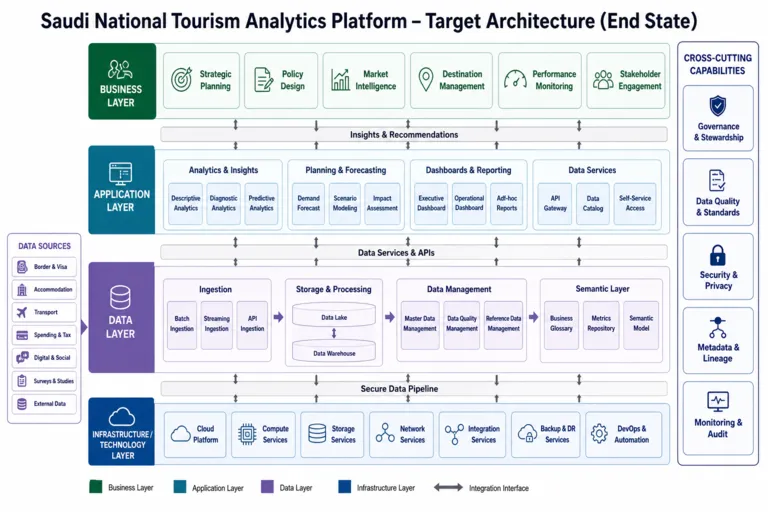
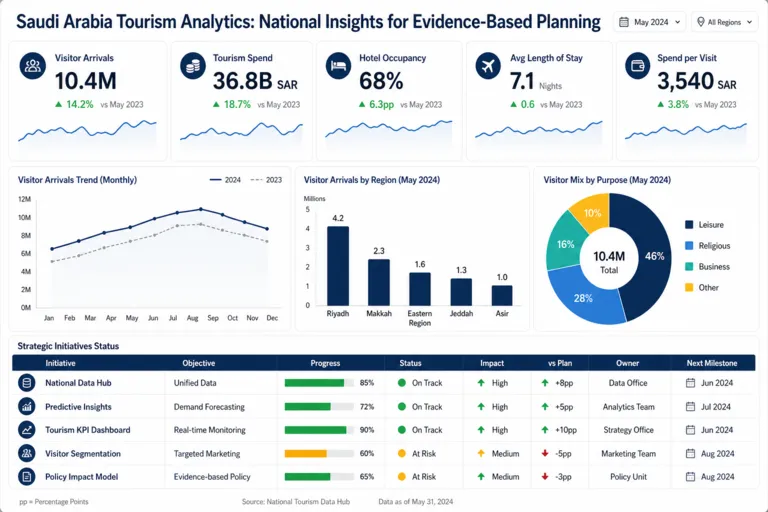
We developed a tourism insight enhancement program modernizing the institution’s research methodologies, data architecture, analytical tools, and stakeholder engagement frameworks. The program included the creation of a national tourism data hub integrating visitor flows, spending behavior, satisfaction metrics, and market trends. Predictive analytics and segmentation models were introduced to shift research outputs from descriptive to forward-looking insights. A structured research agenda aligned with national tourism priorities was established, covering topics such as product diversification, visitor experience, labor markets, and sustainability. Partnerships with universities, tourism boards, and private-sector organizations strengthened collaboration and enhanced the quality of data and analysis.
Approach
- Conducted a diagnostic of existing research tools, data sources, methodologies, and institutional capabilities.
- Designed a national research agenda aligned with policy priorities, investor needs, and sector development gaps.
- Built a tourism data hub consolidating datasets from public agencies, private operators, and international sources.
- Introduced advanced analytical tools including predictive modeling, segmentation frameworks, and sentiment analysis.
- Created partnership models linking the institution with universities, tourism boards, and private operators.
- Implemented capacity-building programs for researchers on data science, tourism economics, and qualitative methods.
Recommendations
- Position the research institution as a national reference point for tourism analytics and forecasting.
- Publish regular insight reports, dashboards, and thematic studies to support policymaking and investor decisions.
- Strengthen data-sharing agreements with airlines, hotels, attractions, and booking platforms to expand intelligence.
- Adopt standardized methodologies to ensure credibility and comparability of research outputs.
- Encourage collaborative research with universities to broaden perspectives and deepen analytical capability.
- Expand communication channels to disseminate insights more effectively to stakeholders and the public.
Engagement ROI
The modernization program significantly enhanced the institution’s influence, credibility, and analytical capability. The tourism data hub increased data availability by more than 45%, enabling deeper insight into visitor flows and behavior patterns. Predictive analytics improved forecasting accuracy, supporting more informed tourism planning at national and regional levels. Research output relevance and frequency increased, with stakeholder engagement rising by 30% due to stronger collaboration mechanisms. The institution’s insights supported policy adjustments that improved destination performance, sector investment, and visitor satisfaction. Overall, the engagement transformed the institution into a strategic knowledge engine for the tourism sector.
Talk to us for your needs in:
-
Tourism Infrastructure Planning and Optimization
-
Destination Marketing and Brand Strategy
-
Tourism Workforce Development and Training
-
Sustainable Tourism Solutions
-
Visitor Experience Enhancement and Engagement
-
Tourism Project Feasibility and Strategic Planning
-
Saudi Tourism Benchmarking