

Issues
A national tourism authority responsible for setting sector-wide targets, monitoring performance, and informing policy sought advisory support to establish a robust benchmarking framework for Saudi Arabia’s tourism sector. The authority aimed to better understand how the country’s tourism performance compared against regional and global peers across metrics such as arrivals, spend per visitor, length of stay, infrastructure readiness, and experience quality. The client needed an evidence-based diagnostic that could guide future policy interventions, investment priorities, and destination development focus areas.
Solution
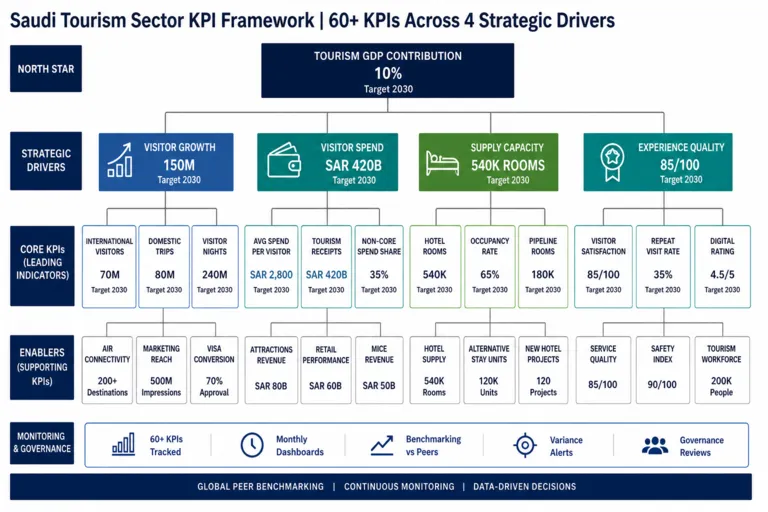
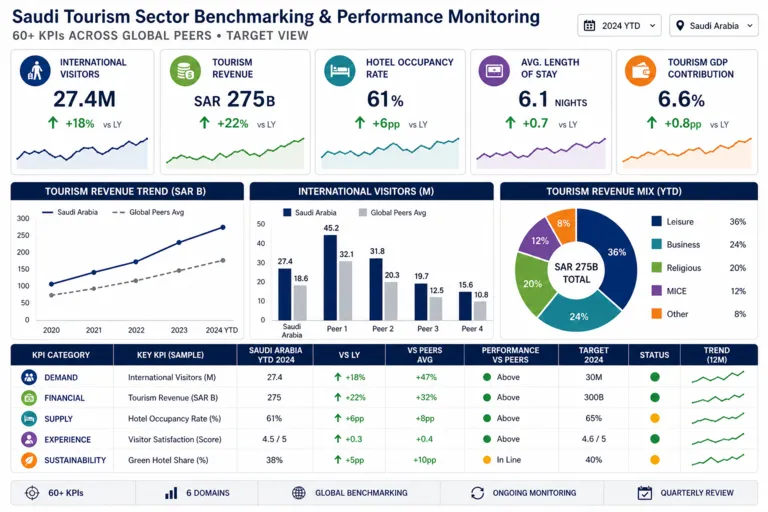
We designed and implemented a comprehensive Saudi tourism benchmarking framework covering demand, supply, competitiveness, and experience metrics. A structured KPI architecture was created, linking top-level goals (such as visitation, GDP contribution, and employment) to operational indicators (such as hotel performance, air connectivity, visitor satisfaction, and workforce capability). Data sources were harmonized, and a methodology for cross-country comparison was defined. A series of benchmark dashboards and analytical tools were developed to compare Saudi Arabia with selected peer and aspirational destinations. This enabled the authority to identify strengths, gaps, and priority improvement areas along the tourism value chain.
Approach
- Collected and harmonized data from national statistics, tourism entities, international organizations, and industry reports.
- Built a KPI hierarchy connecting strategic outcomes, sector performance, and operational metrics across tourism sub-sectors.
- Selected a set of regional and global benchmark destinations aligned with Saudi Arabia’s tourism ambitions.
- Conducted comparative analysis across key dimensions such as connectivity, offerings diversity, infrastructure, marketing, and regulation.
- Developed interactive dashboards and reporting tools for ongoing monitoring and decision support.
- Facilitated workshops with stakeholders to align on findings, interpret results, and identify priority actions.
Recommendations
- Institutionalize the benchmarking framework as a core tool for annual tourism strategy reviews and performance reporting.
- Focus priority interventions on areas where Saudi Arabia showed the largest performance gaps relative to aspirational benchmarks.
- Improve data collection processes across public and private entities to enhance reliability, granularity, and timeliness.
- Develop targeted policy initiatives to strengthen areas such as product diversification, workforce skills, and digital readiness.
- Use benchmarking insights to inform destination development, air connectivity, and marketing strategies.
- Build internal analytical capabilities within the authority to sustain and continuously evolve the benchmarking framework.
Engagement ROI
The benchmarking initiative significantly enhanced the authority’s ability to manage and steer the tourism sector. It provided clear visibility into how Saudi Arabia compared with peer destinations across more than 60 indicators, highlighting specific strengths and weaknesses. The framework supported the reprioritization of resources toward high-impact policy levers, improving alignment between initiatives and desired outcomes. Decision-making cycles became more evidence-based, reducing uncertainty and duplication of efforts. Over subsequent planning cycles, the authority used the insights to track improvements such as percentage growth in arrivals, increases in average length of stay, and improvements in satisfaction metrics, thereby improving overall sector governance and strategic clarity.
Talk to us for your needs in:
-
Tourism Infrastructure Planning and Optimization
-
Destination Marketing and Brand Strategy
-
Tourism Workforce Development and Training
-
Sustainable Tourism Solutions
-
Visitor Experience Enhancement and Engagement
-
Tourism Project Feasibility and Strategic Planning
-
Saudi Tourism Benchmarking