

Issues
A public–private tourism development entity responsible for conceiving and delivering new resorts, attractions, and mixed-use tourism zones in Saudi Arabia engaged our team to support feasibility assessment and strategic planning for a multi-component tourism project. The proposed project combined hospitality facilities, retail, cultural spaces, and outdoor leisure assets located in an emerging coastal destination. Stakeholders required robust analysis to determine demand potential, viability, and optimal phasing, ensuring that investments were aligned with national tourism targets and private-sector return expectations.
Solution
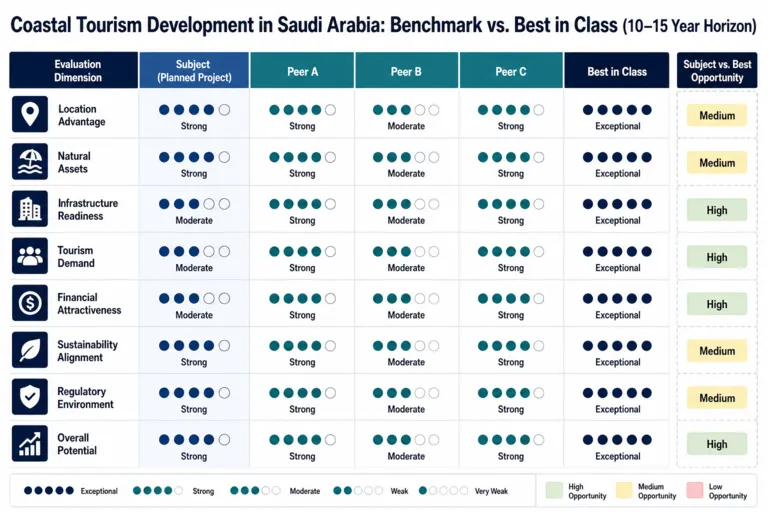
We developed a comprehensive feasibility and strategic planning framework covering market potential, financial viability, risk assessment, and strategic positioning. This included market demand forecasting across key segments such as families, regional weekend travelers, international leisure visitors, and event-related demand. Competitive analysis benchmarked existing and upcoming coastal projects across the region. Multiple development scenarios were modeled, incorporating different phasing, pricing, and asset-mix options. A strategic vision for the project was articulated, positioning it as a distinctive coastal hub combining leisure, culture, and lifestyle experiences. Financial models were built to estimate revenues, operating costs, and returns under conservative, base, and optimistic cases to support investor decision-making.
Approach
- Conducted detailed market research including tourism trends, income levels, trip motivations, and spending patterns for target segments.
- Benchmarked comparable coastal destinations and projects within the wider region to understand positioning and performance benchmarks.
- Built demand forecasts incorporating macroeconomic assumptions, tourism policy targets, and mobility improvements.
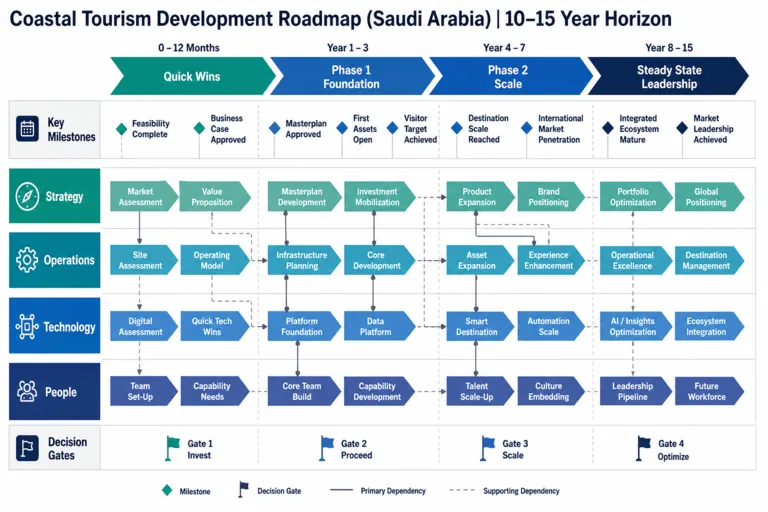
- Designed multiple development scenarios comparing asset configurations, scale, and phasing strategies over a 10–15 year horizon.
- Developed financial models estimating capital expenditure, operating costs, revenue potential, and investor returns.
- Prepared a strategic roadmap outlining priority phases, partnership opportunities, and risk mitigation measures.
Recommendations
- Adopt a phased development approach, prioritizing anchor assets such as a flagship resort and public waterfront promenade to catalyze demand.
- Focus initial positioning on regional and domestic family segments while gradually expanding appeal to international leisure travelers.
- Align project timelines with infrastructure upgrades, regulatory approvals, and broader destination promotion efforts.
- Secure strategic partnerships with experienced operators for hospitality, leisure, and retail components to reduce execution risk.
- Implement robust governance mechanisms for project oversight, stakeholder coordination, and performance tracking.
- Continue monitoring macro and sector indicators to refine assumptions and adjust phasing in response to market realities.
Engagement ROI
The feasibility and strategy engagement provided the clarity required to unlock investment and drive informed decision-making. Financial modeling demonstrated that, under the recommended phasing and asset mix, the project could achieve an internal rate of return in the mid-teens, with payback achievable within 9–11 years depending on scenario assumptions. Demand analysis validated sufficient market potential, enabling the client to secure interest from investors and operators. The structured roadmap reduced uncertainty, helping reallocate approximately 12–15% of planned capital expenditure into higher-impact assets. Overall, the engagement de-risked development, reinforced strategic alignment with national tourism goals, and positioned the project for successful execution.
Talk to us for your needs in:
-
Tourism Infrastructure Planning and Optimization
-
Destination Marketing and Brand Strategy
-
Tourism Workforce Development and Training
-
Sustainable Tourism Solutions
-
Visitor Experience Enhancement and Engagement
-
Tourism Project Feasibility and Strategic Planning
-
Saudi Tourism Benchmarking