

Issues
A national event and festival tourism authority responsible for designing and managing large-scale cultural festivals, entertainment seasons, and thematic events sought support to enhance operational capacity and visitor experience quality. With the rapid growth of Saudi Arabia’s events calendar, the authority faced increasing complexity in crowd management, logistics coordination, vendor integration, and safety oversight. They required a scalable model capable of supporting multi-city events, dynamic programming, and rising visitor expectations for world-class entertainment experiences.
Solution
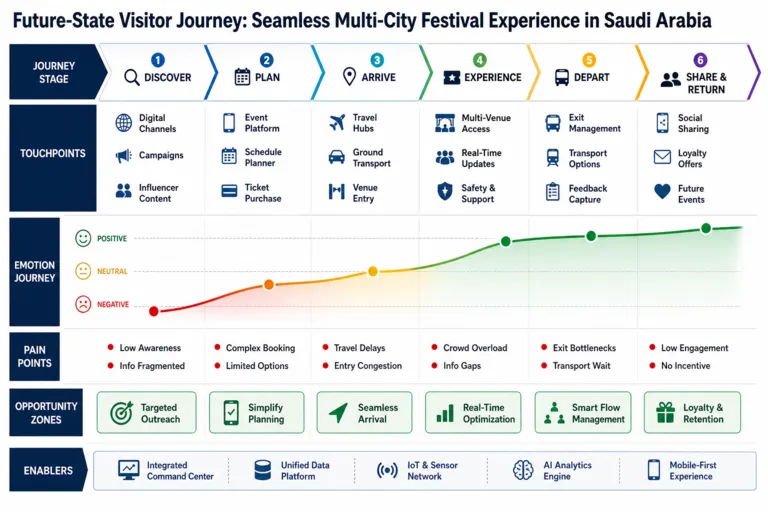
The consulting team delivered an event capacity enhancement framework integrating operational excellence, digital event management, and visitor journey redesign. Key elements included the development of a centralized event operating model, vendor governance frameworks, digital ticketing optimization, and real-time crowd monitoring systems. Experience redesign ensured that entry flows, venue layouts, content zones, and service touchpoints aligned with global best practices in festival management. Workforce capability programs were built to train event staff in safety, customer service, logistics, and emergency response.
Approach
- Conducted operational diagnostics across major events to identify bottlenecks in planning, ticketing, vendor management, and crowd logistics.
- Designed a centralized command-and-control structure for real-time event coordination and decision-making.
- Developed digital enhancements including smart ticketing, heat-map crowd analytics, and queue management tools.
- Optimized venue layouts to improve circulation, reduce congestion points, and enhance access to content and services.
- Introduced standardized vendor onboarding, service-level agreements, and monitoring mechanisms.
- Built training programs for event staff covering safety, customer interaction, and emergency procedures.
Recommendations
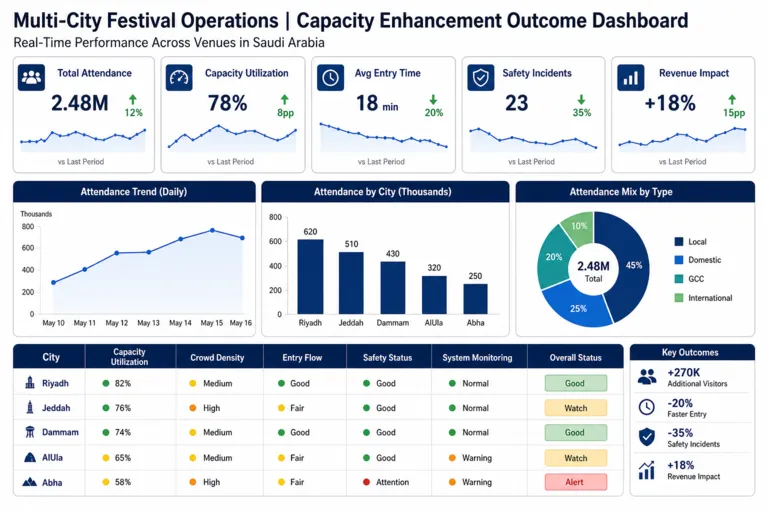
- Implement digital event dashboards that integrate ticket sales, crowd density, vendor readiness, and logistics indicators.
- Strengthen vendor quality through certification programs and performance-linked contracts.
- Enhance visitor experience by diversifying programming zones, improving signage, and adding multi-language support.
- Adopt modular event infrastructure to enable rapid scaling across different cities and venue types.
- Expand workforce development initiatives targeting part-time and seasonal event staff.
- Conduct post-event performance reviews using structured data-driven evaluation frameworks.
Engagement ROI
The engagement generated significant improvements in event execution quality and visitor satisfaction. Large-scale festivals experienced a 32% reduction in crowd congestion incidents following the implementation of optimized layouts and digital monitoring tools. Ticketing efficiency improved by 40%, reducing entry delays and enhancing first impressions. Vendor compliance levels increased by over 25%, strengthening service reliability. Visitor satisfaction scores rose by 18% due to improved navigation, reduced waiting times, and more effective programming design. Workforce training programs led to a measurable improvement in staff readiness and safety performance. Overall, the engagement provided the authority with a scalable, high-efficiency model for delivering world-class event tourism experiences.
Talk to us for your needs in:
-
Tourism Infrastructure Planning and Optimization
-
Destination Marketing and Brand Strategy
-
Tourism Workforce Development and Training
-
Sustainable Tourism Solutions
-
Visitor Experience Enhancement and Engagement
-
Tourism Project Feasibility and Strategic Planning
-
Saudi Tourism Benchmarking