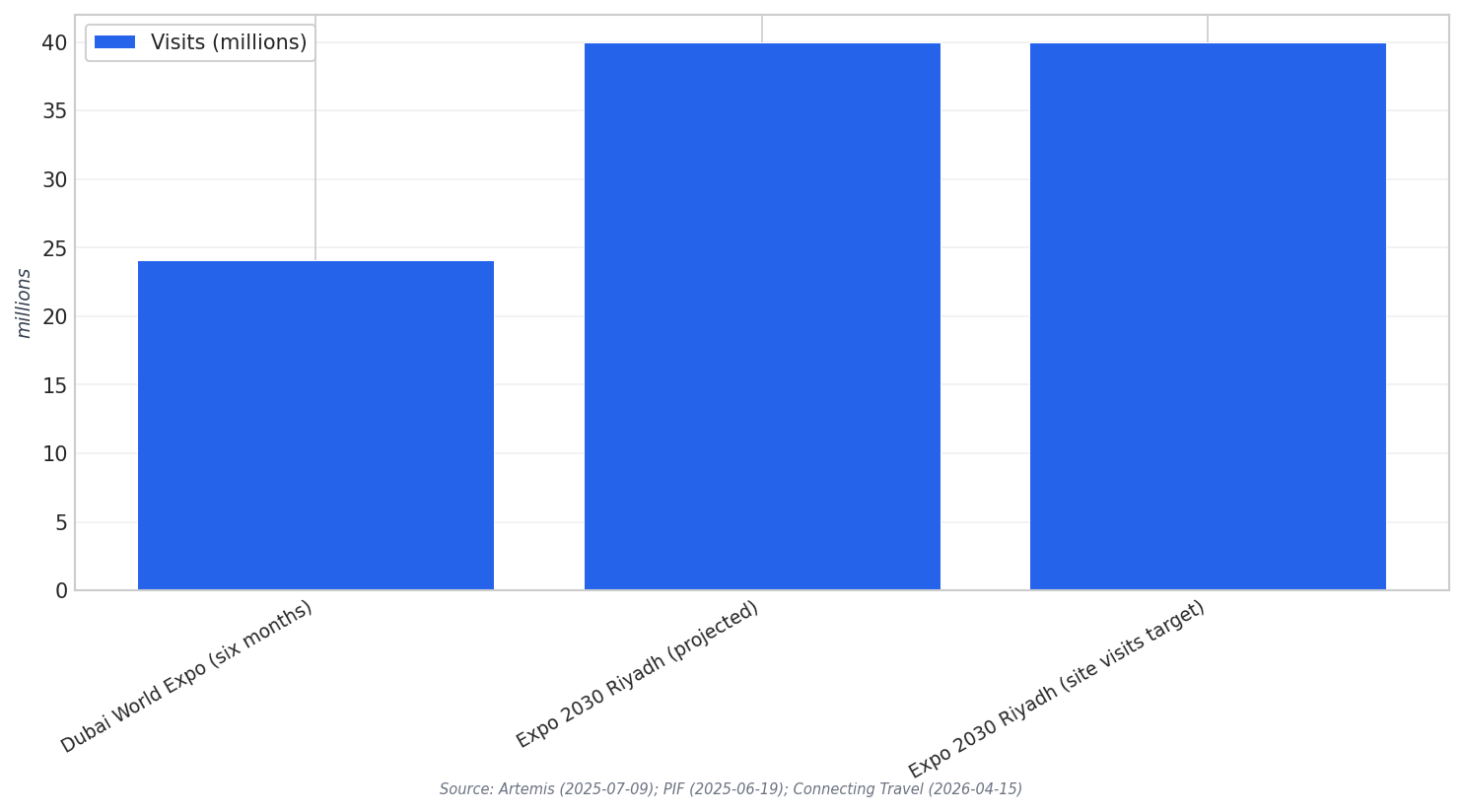
Expo 2030 Riyadh is positioned as a major tourism and event catalyst, with projections pointing to more than 40 million visits. The event will run from 1 October 2030 to 31 March 2031, for a total of 181 days. For tourism operators, that visit volume turns the supply chain into the main product: flights, arrivals, transport links, tickets, itineraries, food and beverage, and crowd-ready experiences.
Multiple sources point to the same order of magnitude for demand. Expo 2030 Riyadh is projected to attract more than 40 million visits, and one partnership announcement frames the collaboration around 40 million site visits. In the same ecosystem of readiness, Dubai’s World Expo attracted 24.1 million visits over six months, offering a reference point for how large events convert planning into throughput.
Building a Tourism Supply Chain That Can Absorb Demand
Tourism packaging is one of the clearest levers. The Saudi Tourism Authority (STA) and Expo 2030 Riyadh confirmed a partnership to integrate tourism with the event. The agreement includes travel packages combining Expo access with regional itineraries, plus coordinated marketing, data sharing, and event programming. This matters operationally because bundled offers can spread demand across time, routes, and experiences, instead of concentrating pressure on a single corridor.
Air capacity planning is another critical constraint in the chain. At King Salman International Airport (KSIA), work is under way on a third 4,200-metre runway. A new terminal with capacity for 40 million passengers annually is set to begin construction this year, supporting plans to accommodate 120 million passengers by 2030. For the Expo supply chain, these figures signal an intent to scale arrivals and departures in a way that matches peak periods.
On the ground, the Expo site itself is part of the supply chain design. Sources describe a site spanning six million square meters planned near King Salman International Airport, with more than 226 exhibition pavilions and participation described as over 195 countries in one summary. Other event overviews describe pavilions from over 180 countries and place the site in northeast Riyadh near King Khalid International Airport. Across these descriptions, the operational takeaway is the same: the visitor journey must be walkable and connected, so flows can be managed across pavilions, dining, culture, and transport.
Delivery and legacy governance also shape readiness. PIF launched a new company to deliver Expo 2030 Riyadh, and stated that after the event it plans to lead transformation of the Expo’s gated area into a global village with retail and food and beverage, surrounded by an international residential community with world-class amenities. For suppliers, that indicates procurement and capability-building are not only for a 181-day event window, but also for a long-term operating environment that keeps tourism services active after closing day.
What dates will Expo 2030 Riyadh run?
How many visits are expected for expo 2030 riyadh?
What is the STA partnership designed to deliver?
What airport expansions are mentioned for supporting demand?
What happens to the Expo area after the event?
Talk to us for your needs in:
-
Tourism Infrastructure Planning and Optimization
-
Destination Marketing and Brand Strategy
-
Tourism Workforce Development and Training
-
Sustainable Tourism Solutions
-
Visitor Experience Enhancement and Engagement
-
Tourism Project Feasibility and Strategic Planning
-
Saudi Tourism Benchmarking