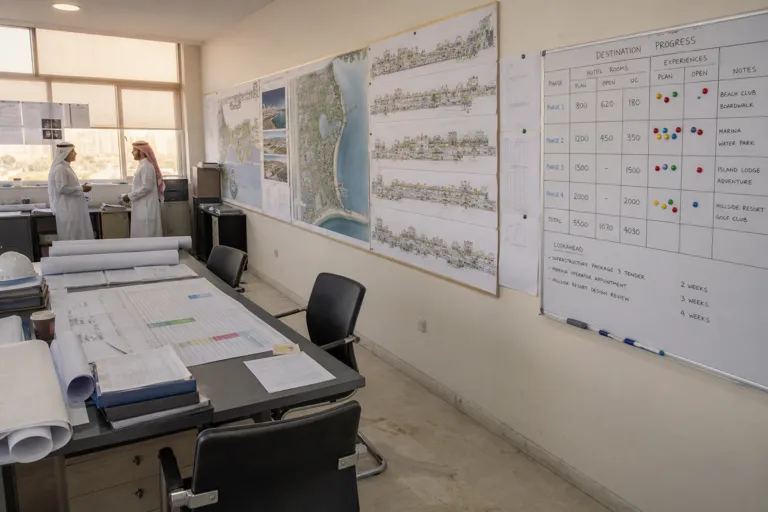
Saudi Arabia’s Public Investment Fund (PIF) has approved a 2026-2030 strategy that puts tourism, travel and entertainment at the center of its domestic “ecosystem” agenda. In a government press conference in Riyadh, PIF governor Yasir Al-Rumayyan said the strategy includes plans to develop 100,000 hotel rooms and introduce 70 tourism experiences across the Kingdom. The same strategy positions PIF as moving from rapid expansion to “sustained value creation,” with more emphasis on capital efficiency, sustainable returns and a stronger role for private sector participation.
The announced pipeline sits inside a broader investment framework that PIF has organized into three portfolios. The Vision Portfolio is tasked with building domestic economic ecosystems, including tourism and NEOM, while also aiming to unlock opportunities for private sector investors, suppliers and partners and attract global capital. The six domestic ecosystems named under the strategy include tourism, travel and entertainment; NEOM; and four others spanning urban development, manufacturing and innovation, industrials and logistics, and clean energy, water and renewables infrastructure. For operators, that structure matters because it signals a formal channel for partnerships and supply-chain participation.
What the Operator Opportunity Looks Like in Practice
Beyond targets, PIF also referenced its recent spending pace, which helps operators gauge how quickly projects can translate into contracts, inventory and demand. PIF said it invested more than US$199 billion in new Saudi projects between 2021 and 2025, and spent more than US$157 billion with the local private sector over the same period. Al-Rumayyan also said PIF accounts for SAR910 billion of non-oil GDP growth, which he described as roughly one-third of the Kingdom’s expansion in that segment. In this context, the 2026-2030 tourism pipeline is not framed as a stand-alone initiative, but as part of a wider diversification contribution.
The global experiences market provides useful context on where operators can win, especially in distribution and digitization. A report cited by Phocuswright sizes the global market at US$253 billion in 2024, with growth to US$342 billion projected by 2029. Yet only 33% of tours, activities and attractions were booked online in 2025, compared with 64% of travel bookings overall, and more than 70% of experience operators are small or micro-businesses. Arival also noted growth slowed to about 7% between 2024 and 2025, with more even growth projected through 2026 and beyond. Against that backdrop, PIF tourism experiences can create room for operators who professionalize inventory, adopt online booking, and build distribution partnerships early.
Delivery will also be shaped by where PIF is placing large, experience-led bets. Invest Riyadh reported that New Murabba Development Company scaled operations dramatically in early 2026 with the awarding of US$12 billion in construction contracts. It is building a 19-square-kilometer mixed-use development in downtown Riyadh anchored by the Mukaab, described as a 400-meter cube structure set to house immersive entertainment, hospitality and retail experiences. Whether an operator sells tours, tickets, or on-site programming, the practical opportunity is to align products with these emerging districts and with the strategy’s explicit intent to deepen private sector participation.
What did PIF announce for tourism under its 2026-2030 strategy?
How does the 2026-2030 strategy position private sector operators and partners?
What recent spending figures did PIF report that matter for operators?
What does global data suggest about selling tours and attractions online?
How should operators interpret the opportunity around PIF-led tourism experiences?
Talk to us for your needs in:
-
Tourism Infrastructure Planning and Optimization
-
Destination Marketing and Brand Strategy
-
Tourism Workforce Development and Training
-
Sustainable Tourism Solutions
-
Visitor Experience Enhancement and Engagement
-
Tourism Project Feasibility and Strategic Planning
-
Saudi Tourism Benchmarking