Interest in Makkah hotel investment starts with one defining feature: demand that is described as resilient and largely non-discretionary. Millions of pilgrims visit the Holy City each year for Hajj, Umrah, and Ramadan, creating recurring hotel demand that is not framed as dependent on leisure tourism cycles or corporate budgets. Industry benchmarks cited in market commentary suggest Umrah contributes approximately 35–50% of annual demand, while Ramadan accounts for an additional 20–30% of yearly hotel revenue. This shift matters for owners and operators. It supports a more even demand profile across the year, rather than relying on only a few peak periods.
The sizing question now is less about whether demand exists, and more about how the city absorbs new rooms. One market assessment notes more than 22,800 hotel rooms are currently under development in Makkah, spanning 35 projects, and highlights landmark projects such as Masar and King Salman Gate as part of the city’s transformational pipeline. At a national level, Knight Frank reports 105,225 hotel rooms are under construction or in advanced planning stages across Saudi Arabia, with an existing inventory of 176,260 rooms. Knight Frank adds that, once completed, the current development pipeline will increase Saudi Arabia’s inventory to more than 281,500 rooms by 2030.
How to Underwrite Supply Risk in a Pilgrimage-Led City
Oversupply concerns are real, but the same Makkah market analysis argues the answer is nuanced. Absorption depends on where hotels are built, which market segments they target, and how effectively they improve the pilgrim experience. A Vision 2030 investment guide frames religious tourism as a structural differentiator for the Saudi hotel market, stating that Hajj and Umrah pilgrims generate year-round occupancy in Makkah and Madinah, with pronounced seasonality during Hajj months and Ramadan. The same guide also states that Makkah hotels historically achieve the Kingdom’s highest revenue per available room due to compressed demand during peak periods.
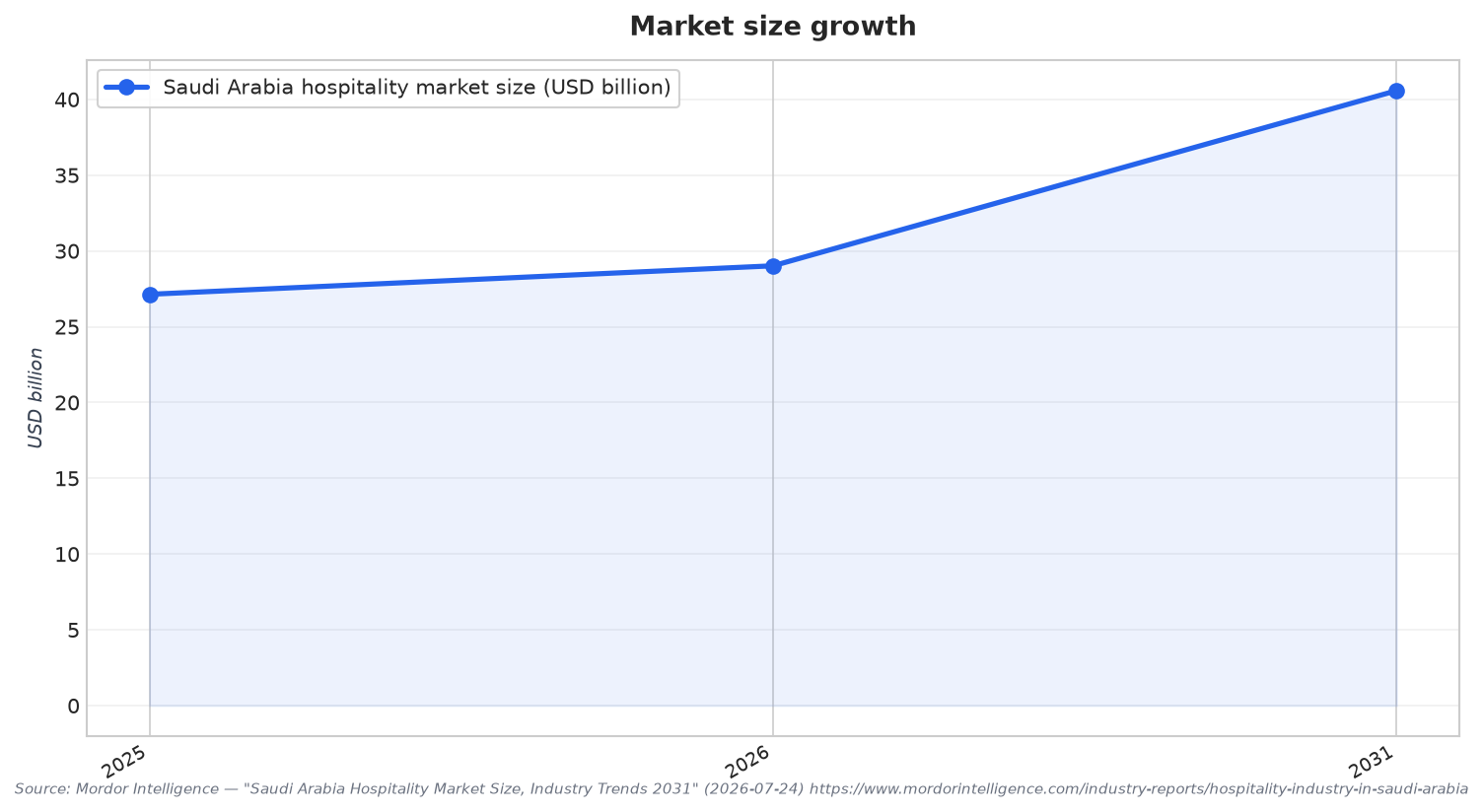
Demand indicators in the sources reinforce why investors keep focusing on the western corridor. Mordor Intelligence estimates the Saudi Arabia hospitality market at USD 29.02 billion in 2026, up from USD 27.14 billion in 2025, with projections of USD 40.58 billion by 2031 at a 6.93% CAGR over 2026–2031. By geography, Mordor Intelligence says the Makkah–Jeddah corridor held 26.62% of the Saudi Arabia hospitality market size in 2025. In religious tourism volumes, Mordor Intelligence states Hajj attendance reached approximately 2.1 million in 2025 and stood at 1.71 million in 2026, while Umrah pilgrims totalled 18 million in 2025 and are expected to exceed 20 million in 2026.
Segment strategy is a second sizing lever, especially when pipelines skew upscale. Knight Frank notes that 35% of Saudi Arabia’s existing hotel inventory is classified as luxury and upper-upscale, and adds that more than half of the future hotel pipeline is concentrated in the luxury and upper-upscale segments, creating a need to deliver more affordable options. For investors, this aligns with the Vision 2030 investment guide, which says the most immediate opportunities lie in midscale and select-service hotel development in Riyadh, Jeddah, and the Makkah–Madinah corridor. A separate industry post adds that Makkah and Madinah represent nearly 40% of the Kingdom’s total upcoming room volume, emphasizing how central religious demand is to the national room build-out.
What makes hotel demand in Makkah different from leisure destinations?
How large is Makkah’s current hotel development pipeline?
What Hajj and Umrah volumes are cited for recent years?
How should investors think about segment fit when assessing Makkah hotel investment?
How important is the Makkah–Jeddah corridor within Saudi hospitality market sizing?
Talk to us for your needs in:
-
Tourism Infrastructure Planning and Optimization
-
Destination Marketing and Brand Strategy
-
Tourism Workforce Development and Training
-
Sustainable Tourism Solutions
-
Visitor Experience Enhancement and Engagement
-
Tourism Project Feasibility and Strategic Planning
-
Saudi Tourism Benchmarking