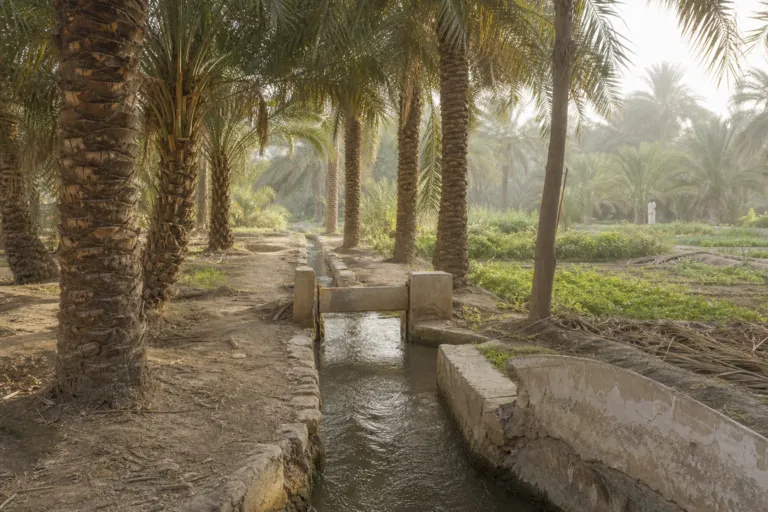
Al-Ahsa Oasis is an oasis and historical region in eastern Saudi Arabia, located about 60 km inland from the Persian Gulf coast. It includes four main cities and 22 villages, with Al-Mubarraz and Al-Hofuf listed among the country’s largest cities. The oasis spans nearly 85.4 km² and is described as the largest oasis in the world. It is a landscape where water access shaped settlement and farming in an otherwise sand-desert context, and the majority of the oasis is located in the Empty Quarter (Rub’ al Khali), with residential areas constituting 18% of the oasis.
The investment story of the oasis starts with the agricultural system that kept it productive for millennia. Al-Ahsa is fed by a huge underground aquifer and irrigated by the flow of more than 280 artesian springs, enabling year-round agriculture. The oasis contains more than 2.5 million palm trees, including date palms, making its farming scale a central visitor draw as well as an economic asset. In Saudi Arabia’s broader agricultural geography, the Eastern Province is described as supporting the most extensive plantation economy, and the major oasis centered around Al Hasa is noted for high water tables, natural springs, relatively good soils, and the ability to produce rice.
Heritage Status That Anchors Premium Destination Building
Al-Ahsa Oasis was inscribed as a UNESCO World Heritage Site in 2018 as “Al-Ahsa Oasis, an Evolving Cultural Landscape.” It is also part of the UNESCO Creative Cities Network, listed since December 2015. Saudi Arabia’s heritage tourism strategy places World Heritage Sites at the center of destination development, with Al-Ahsa included alongside other UNESCO properties. In 2025, Saudi Arabia welcomed 122 million visitors, surpassing an original Vision 2030 target of 100 million five years early, and authorities raised the 2030 ceiling to 150 million arrivals, split into 70 million international and 80 million domestic. Total tourism spending reached SAR 300 billion (USD 80 billion) in 2025, up 6% year-on-year.
In this national context, Al-Ahsa’s proposition is unusually clear for travelers and developers focused on place-based experiences. The oasis is a living agricultural landscape with archaeological remains and traditional irrigation channels, and it represents sustained human settlement in an arid environment through water management and agriculture. That combination helps explain why the conversation around Al Ahsa tourism often blends culture, farm-to-table storytelling, and outdoor oasis experiences rather than treating “heritage” and “nature” as separate products. The site’s scale and accessibility from the Gulf coast also support day-trip and longer-stay itineraries across the Eastern Province.
Agritourism adds an additional lens for investors looking at Al-Ahsa’s next chapter. Globally, the agritourism market was valued at USD 8.79 billion in 2025 and is projected to grow from USD 9.82 billion in 2026 to USD 23.8 billion by 2034, at a CAGR of 11.7% for 2026–2034. One trend cited is the emergence of luxury agritourism experiences. As an example, Hilton announced the Al-Ahsa Agritourism Resort under its LXR Hotels & Resorts brand in March 2024, described as being situated in Saudi Arabia’s Al-Ahsa region. The project is presented as connecting high-end facilities to agricultural experiences, including gardens, amphitheaters, dining, retail options, and spaces for local agricultural vendors.
Why is Al-Ahsa Oasis considered a heritage destination?
What makes the oasis suitable for year-round agriculture?
How large is Al-Ahsa Oasis and what is its settlement structure?
How does Saudi Arabia’s tourism growth support Al Ahsa tourism plans?
What is a recent example of luxury agritourism development tied to Al-Ahsa?
Talk to us for your needs in:
-
Tourism Infrastructure Planning and Optimization
-
Destination Marketing and Brand Strategy
-
Tourism Workforce Development and Training
-
Sustainable Tourism Solutions
-
Visitor Experience Enhancement and Engagement
-
Tourism Project Feasibility and Strategic Planning
-
Saudi Tourism Benchmarking