For investors watching Saudi Arabia’s destination pipeline, AlUla’s next phase is increasingly defined by execution, not slogans. The Royal Commission for AlUla has rolled out two masterplans: Journey Through Time, launched in 2021, and Path to Prosperity, unveiled in 2023. Journey Through Time covers AlUla’s core heritage assets, including Hegra, and is constructed in three phases that the developer says will create five new districts by 2035. This matters for capital because it sets a long runway for staged delivery, while also making milestone timing a core part of the investment thesis.
The clearest investable signal is accommodation supply, because it is measurable and tied to demand capture. In phase two, the stated target is 5,500 hotel rooms, with an overall goal of 8,500 by 2035. Yet by the end of 2024, an estimated 730 rooms were operational or in the pre-opening stage—AGBI notes this was far fewer than anticipated. For investors, that gap cuts both ways. It can imply under-delivery risk versus plans, but it can also underscore how much of the room pipeline is still ahead, which may shape future contracting, operations, and ancillary services as capacity ramps.
What the 2026 Expansion Window Really Signals
When people refer to the AlUla Journey Through Time masterplan 2026 outlook, the practical question is which assets are expected to turn the “next phase” into visible footfall. AGBI reports that Wadi AlFann, a cultural destination for contemporary art, was expected to begin welcoming visitors, but will now probably open in 2026. The same tracker flags shifting timelines elsewhere: Six Senses AlUla is scheduled for 2027, while the Jean Nouvel-designed Sharaan Nature Resort was pencilled to open in 2026 but is now unlikely to launch before 2030. This mix of openings and delays is important for underwriting, because it affects when demand drivers and room inventory arrive.
Investors also need to place AlUla in the wider Kingdom context, because capital rules and market access shape participation. Business Today Middle East reports foreign investment into Saudi Arabia reached SAR 3 trillion by 2025, a 16% increase. It also reports that the Qualified Foreign Investor regime was abolished in February 2026 and replaced by direct market access, removing a structural barrier that had kept many international investors at arm’s length. The same article states that the masterplan built around 12 guiding principles of sustainable, responsible development targets two million visitors annually by 2035. Together, those points frame both a demand ambition and a changing access environment.
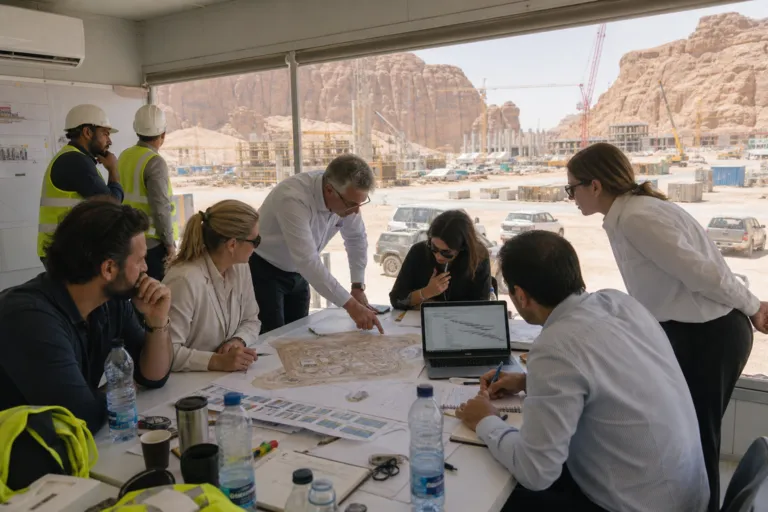
Finally, execution is being reinforced by new development activity. The Public Investment Fund says AlUla Development Company (UDC) started construction on NUMAJ, describing it as a transition “from concept to execution,” and positioning UDC as the development and investment engine driving AlUla’s masterplan into tangible assets in collaboration with the Royal Commission for AlUla. Separately, Path to Prosperity maps the urban transformation of AlUla Central and AlUla South, and RCU chief executive Abeer Al Akel told AGBI the commission is “accelerating growth across many sectors, including tourism, agriculture, film, heritage, sports, arts and culture, education and more.” For investors, the opportunity sits alongside delivery risk, so diligence should focus on phasing, timelines, and how each opening supports commercial throughput.
What is the AlUla Journey Through Time masterplan, and what changes around 2026 matter most?
How many hotel rooms are targeted in AlUla’s phase two, and what is the long-term goal?
Which AlUla openings have moved past 2026, according to the tracker?
What broader Saudi Arabia investor-access change was reported in 2026?
What does the start of NUMAJ construction indicate for the investment narrative?
Talk to us for your needs in:
-
Tourism Infrastructure Planning and Optimization
-
Destination Marketing and Brand Strategy
-
Tourism Workforce Development and Training
-
Sustainable Tourism Solutions
-
Visitor Experience Enhancement and Engagement
-
Tourism Project Feasibility and Strategic Planning
-
Saudi Tourism Benchmarking