
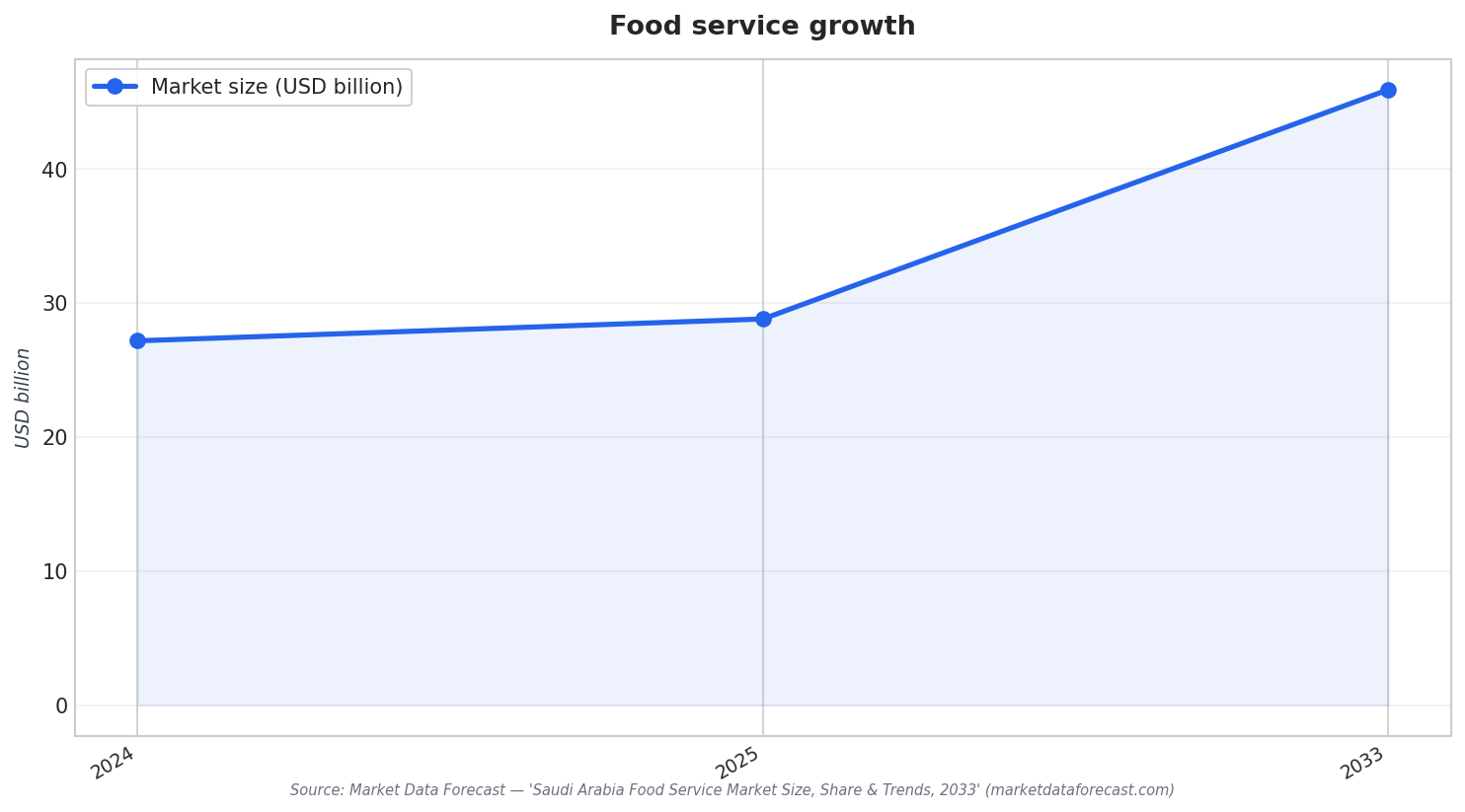
Saudi Arabia’s giga-projects are explicitly designed to host “millions of visitors annually” and include extensive food and beverage zones, with NEOM, Qiddiya, and Red Sea Global cited as examples. This is happening alongside a large domestic base, with the General Authority for Statistics cited for a population “over 36 million people.” In that backdrop, Market Data Forecast values the Saudi Arabia food service market at USD 27.18 billion in 2024, projecting USD 28.81 billion in 2025 and USD 45.92 billion by 2033 (6% CAGR for 2025-2033). For brands evaluating hospitality franchise opportunities in Saudi Arabia, the most practical starting point is to connect site strategy inside the giga-project pipeline with real-world licensing, category saturation, and how guests actually book and buy.
Capital is also being routed into the visitor economy. Market Data Forecast states that the Public Investment Fund has allocated over SAR 50 billion to entertainment and hospitality giga-projects, each designed with extensive F&B zones. In hospitality, Mordor Intelligence estimates the Saudi Arabia hospitality market at USD 29.02 billion in 2026, growing from USD 27.14 billion in 2025, with projections of USD 40.58 billion by 2031 (6.93% CAGR for 2026-2031). The same report notes PIF commitments totalling USD 500 billion to NEOM alone and describes giga-projects slated to create roughly 380,000 jobs (with some inside hotel and F&B operations). For a franchise or retail operator, this mix points to demand that is anchored in both construction-led destination buildout and an expanding chain-led accommodation base.
A Step-by-Step Market Entry Lens: Demand, Site, and Model Fit
Start with demand signals and competitive intensity in existing urban corridors, then map them onto giga-project placement. Market Data Forecast cites that over 8,000 new food service licenses were issued in 2023 alone, with a concentration in fast-casual and coffee segments. It also states that in Riyadh’s King Fahd Road corridor, one in every three retail units now hosts a café or quick-service outlet (Knight Frank). These facts imply that “easy” categories can be crowded in prime areas, so franchisors should stress-test unit economics and differentiation before copying a standard playbook. In hospitality distribution, Mordor Intelligence reports OTAs captured 41.65% of transactions in 2025, while direct digital channels are growing at a 14.78% CAGR, suggesting that both aggregator visibility and brand-owned digital conversion matter to F&B attached to hotels, resorts, and mixed-use districts.
Next, decide whether franchising truly reduces risk or only shifts it. Creation Business Consultants frames franchising as potentially faster with lower upfront capital, but with constraints such as royalties, reduced pricing agility, and limited control over operations or menu innovation. Their same source quotes that the F&B sector in Saudi Arabia is expected to see an annual growth rate of 6.8% through 2028, and claims international names such as PF Chang’s and Five Guys are synonymous with 60% of new outlets opening in Riyadh and Jeddah since 2020. Nimbus Consultancy similarly notes that many international players (including PF Chang’s and Five Guys) entered via franchise models, while niche and luxury concepts can benefit from owning and operating outlets directly. Either path still requires licensing through MISA and attention to requirements such as Saudization, along with tax-structure awareness referenced by Nimbus (Zakat versus corporate income tax).
Finally, align your offer to retail and consumer shifts that are explicitly called out in the sources. Market Research Future describes rising consumer spending driven by a growing middle class and rising disposable incomes, plus urbanization and infrastructure development that is expanding malls and retail complexes in major cities like Riyadh and Jeddah. It also flags ongoing mega-project development such as NEOM as likely to transform the retail landscape. On the product side, the same source highlights localization and a 2025 “surge in demand for organic and health-conscious products.” In parallel, WifiTalents states the Saudi Arabia food and beverage market is valued at approximately $23.5 billion in 2023, that the F&B sector contributes around 10% of non-oil GDP, and that online grocery shopping grew by 200% between 2020 and 2023. For franchise and retail entrants, the operational implication is clear: design for localization, health-forward demand, and omnichannel behavior, not just footfall.
What is the projected size of Saudi Arabia’s food service market in the coming years?
Why do Saudi giga-projects matter for F&B and retail franchises?
What do licensing and saturation signals suggest for new restaurant entrants?
How should brands think about hospitality franchise opportunities in Saudi Arabia when choosing franchising vs. owned operations?
Which booking channels matter for hospitality-linked F&B in Saudi Arabia?
Talk to us for your needs in:
-
Tourism Infrastructure Planning and Optimization
-
Destination Marketing and Brand Strategy
-
Tourism Workforce Development and Training
-
Sustainable Tourism Solutions
-
Visitor Experience Enhancement and Engagement
-
Tourism Project Feasibility and Strategic Planning
-
Saudi Tourism Benchmarking