Saudi Arabia’s hospitality expansion is creating a practical question for developers, operators, and lenders: where does the skilled workforce come from? Mordor Intelligence estimates the Saudi Arabia hospitality market at USD 29.02 billion in 2026, up from USD 27.14 billion in 2025, with a projection of USD 40.58 billion by 2031 (6.93% CAGR over 2026-2031). As supply diversifies, service consistency becomes harder to scale. Chain hotels held 57.74% share in 2025, while OTAs captured 41.65% of transactions, and direct digital channels are forecast to grow at a 14.78% CAGR. These shifts raise training demands across front desk, guest recovery, digital distribution, and loyalty operations.
Recruitment commentary also flags capability gaps that investors should treat as operational risk. RFS HR Consultancy reports that many Saudi nationals joining hospitality do not have specialized skills for high-end set-ups and highlights language requirements tied to pilgrimage tourism, including demand for Urdu, Malay, and French. The same source points to a lack of advanced training mechanisms as a significant recruitment challenge, alongside higher salary demands from candidates with specialized skills and retention pressure as talented workers switch to rivals or foreign markets. For projects that depend on premium positioning, these issues can show up in ramp-up timelines, service quality variance, and payroll inflation.
What’s Changing: New Academies, Corporate Upskilling, and AI Tools
Policy and education responses are starting to broaden the training base, including pathways relevant to hospitality. Oxford Business Group reports that in 2024 the government launched six new technical and vocational training academies, including in tourism, arts, media, and industry and technology, explicitly aimed at addressing skills gaps. In parallel, a corporate training market narrative described by IMARC (via openPR) highlights the Human Capability Development Program (HCDP) as a driver aligning education with labour market requirements and vocational skills. The same source states the government contributed SAR 1.2 billion to workforce development with the aim of increasing vocational training attendance by 30% to support Vision 2030’s non-oil growth goals.
Investors should also watch how corporate providers and employers translate these programs into job-ready hospitality capability. IMARC (via openPR) says hospitality companies have developed customer service courses linked to employment in new resorts and theme parks, targeting young Saudis amid an entertainment boom. On the technology side, the same source notes that over 60% of companies now use digital tools for efficient upskilling, and it also states that through HCDP the government allocates USD 400 million to integrate AI in workforce training, supporting skill-gap closure for 1.5 million needed workers in key sectors. For hotel and resort operators, faster onboarding and more standardized competency checks can reduce early-stage service failures.
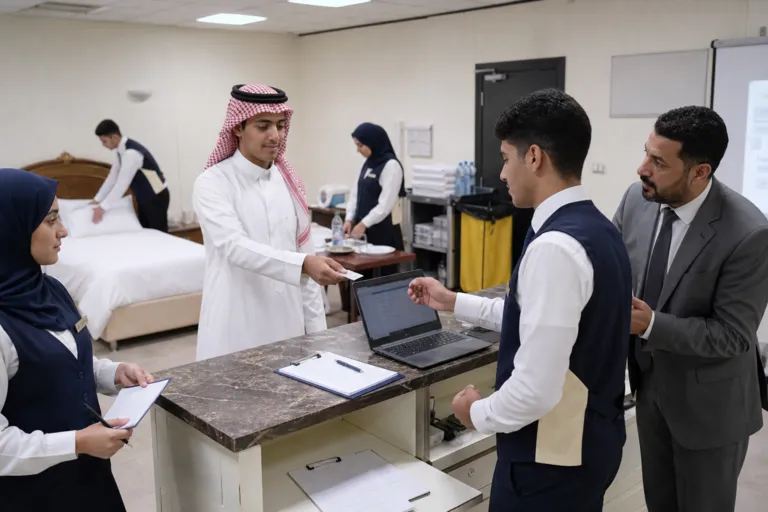
Private-sector programs are also emerging with structured, time-bound formats. Vocal.media reports that in January 2026 Dusit Thani College partnered with Alkhaleej Training for a TOP program delivering 280+ hours of practical hospitality training with internships, aimed at fast-tracking jobs in six months. The same source says the Saudi Human Resources Fund deployed AI tools that cut training time by 25% through virtual coaches and personalized analytics for skill gaps across industries. For a hospitality training academy in Saudi Arabia, these examples matter because they show a shift toward measurable hours, workplace exposure, and digitally supported assessment—signals investors can use when evaluating operator readiness and staffing plans.
Why does investor due diligence now include hospitality training capacity in Saudi Arabia?
What new government training infrastructure supports tourism and hospitality skills?
How is AI changing corporate upskilling linked to hospitality operations?
What does a hospitality training academy Saudi Arabia program look like in practice?
Which skills are highlighted as hard to hire for in Saudi hospitality recruitment?
Talk to us for your needs in:
-
Tourism Infrastructure Planning and Optimization
-
Destination Marketing and Brand Strategy
-
Tourism Workforce Development and Training
-
Sustainable Tourism Solutions
-
Visitor Experience Enhancement and Engagement
-
Tourism Project Feasibility and Strategic Planning
-
Saudi Tourism Benchmarking