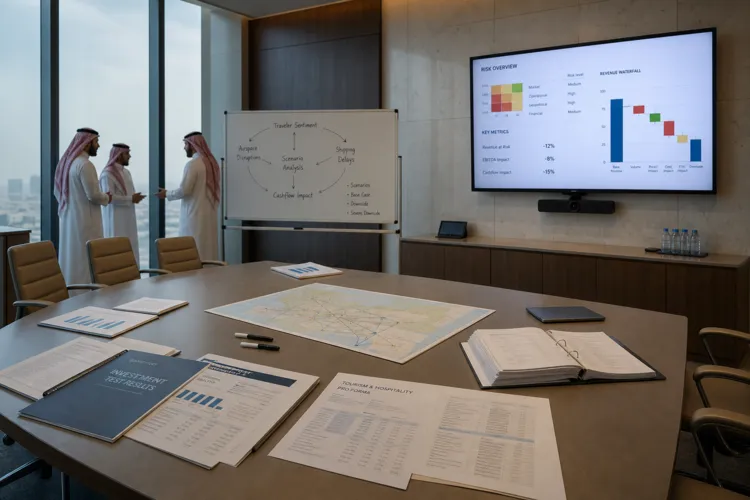

Questions about whether Saudi Arabia’s Public Investment Fund (PIF) is “ready to sell” are really questions about liquidity, timing, and the shape of future deal flow. The New York Times reported that while PIF says it holds nearly USD 1 trillion in assets, a large portion is tied up in hard-to-sell holdings with no public valuations available. The same report said PIF representatives have been telling international investors it is all but unable to allocate more money for the foreseeable future, according to six people with knowledge of those discussions. That context helps explain why private capital is watching for monetisation events in tourism-linked assets, even as PIF continues to frame its moves as restructuring and assessment rather than retreat.
At the same time, PIF is describing a more structured approach to tourism and related sectors. Nomad Lawyer states that PIF approved a 2026–2030 investment strategy that places tourism, travel, entertainment, and infrastructure at the core of diversification, and it describes a three-portfolio structure. That structure also appears in Trowers & Hamlins’ market note: a Vision Portfolio targeting domestic projects that can attract foreign investment, a Strategic Portfolio focused on core national assets, and a Financial Portfolio covering global investments. In that framing, “PIF tourism asset divestment” is not only about selling; it can also mean partial monetisation, reallocation across portfolios, and a more deliberate definition of which assets must be held versus which can be partnered or financed differently.
What Divestment Signals Could Mean in Practice for Investors
For private investors, the most actionable signal is that the rules of engagement may be changing. Trowers & Hamlins warns of reprioritisation risk as PIF sharpens its focus, noting that some projects—even those under way—may face delays, redesign, or reduced funding. The note advises market participants to revisit termination rights, variation provisions, change-in-law clauses, and force majeure protections to reflect shifting scope, sequencing, or funding. In parallel, the New York Times reported that PIF staff told asset managers that new funding would come only in exchange for help “bailing out” older investments. That combination—tighter capital plus more conditional partnerships—can create openings for investors who can underwrite complexity and structure downside protection.
The scale of PIF’s balance sheet and its evolution matters when assessing whether monetisation is plausible. Wikipedia estimates PIF assets at about USD 900 billion, while Vision2030.ai says assets under management were roughly USD 925 billion at year-end 2024 and that this was up 19% year-on-year. Nomad Lawyer similarly describes assets under management exceeding USD 900 billion and adds that between 2021 and 2025 the fund deployed more than USD 199 billion domestically, contributed USD 243 billion to non-oil GDP, and spent USD 157 billion with the local private sector. These figures suggest a system designed to build and scale domestic assets first—then, as projects mature, consider monetisation routes that recycle capital without abandoning strategic priorities.
Monetisation pathways are already being discussed explicitly in the context of tourism and real-estate style cash-generating assets. Vision2030.ai argues that if giga-projects such as NEOM, Qiddiya, and Diriyah deliver substantially against revised timelines, PIF’s domestic balance sheet could mature into cash-generating real-estate, tourism, and entertainment assets that can be partially monetised through IPOs or strategic stake sales by 2030. That is not a promise of near-term sales, but it is a framework private investors can plan around: focus on bankability, measurable performance, and defensible revenue assumptions, because tighter governance and financing discipline may reward assets that can stand up to scrutiny—and penalise those that cannot.
Is PIF actually short on cash, or just becoming more selective?
How should investors interpret tourism asset divestment signals from PIF?
What legal or commercial risks rise when PIF reprioritises projects?
What recent figures show PIF’s scale and trajectory?
Talk to us for your needs in:
-
Tourism Infrastructure Planning and Optimization
-
Destination Marketing and Brand Strategy
-
Tourism Workforce Development and Training
-
Sustainable Tourism Solutions
-
Visitor Experience Enhancement and Engagement
-
Tourism Project Feasibility and Strategic Planning
-
Saudi Tourism Benchmarking