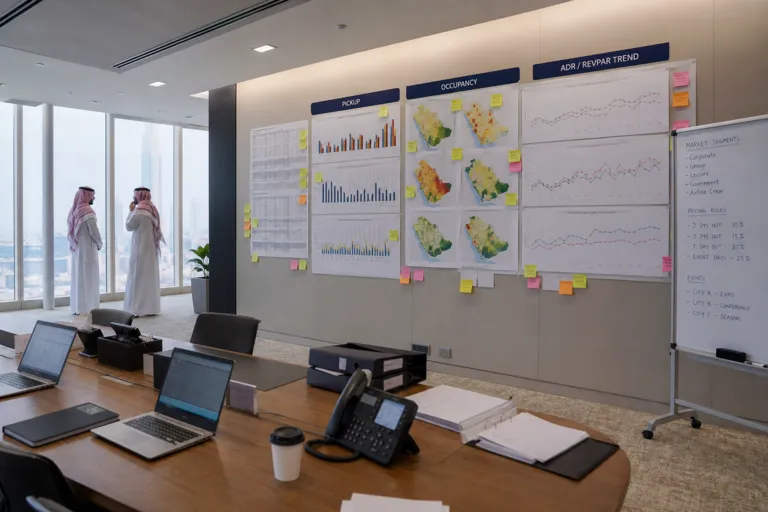
For investors, the 2026 conversation in Saudi hospitality starts with operating fundamentals. Knight Frank reports national hotel occupancy averaging 63.4% between January and April 2026, with ADR at SAR 754 and RevPAR at SAR 478. These three metrics matter together because occupancy shows demand capture, ADR reflects pricing power, and RevPAR tells you whether rate and volume are translating into room revenue efficiency. The same period also carried disruptions that weighed on parts of the sector, yet the headline national averages still point to a market that can hold rate while absorbing competition.
Zooming out, market sizing and demand drivers help frame why these numbers are investable signals rather than isolated snapshots. Mordor Intelligence estimates the Saudi Arabia hospitality market at USD 29.02 billion in 2026, up from USD 27.14 billion in 2025, with projections reaching USD 40.58 billion by 2031 at a 6.93% CAGR over 2026–2031. Within the 2025 structure, chain hotels held 57.74% share, the luxury segment led at 36.92%, and OTAs accounted for 41.65% of transactions. That mix matters in underwriting because it shapes distribution costs, brand-driven demand, and the risk of rate pressure when supply expands.
Occupancy, ADR, and RevPAR: What 2026 Divergence Means
City-level divergence is where investors can read the strongest signals behind Saudi Arabia hotel occupancy trends. Knight Frank notes that Riyadh occupancy declined by 17.9% to 49.3% during the first four months of 2026, alongside an 18.3% year-on-year RevPAR decline, as operators adjusted pricing strategies amid growing competition and weaker conditions. For added context on pre-2026 baselines, another market analysis reports that nationwide occupancy averaged 62.3% in the first half of 2025 while nationwide ADR reached SAR 822, and it describes Riyadh’s recent performance as tempering, with occupancy around ~62% and ADR around $225 (SAR ~845) and a RevPAR drop of about 5.5% year-on-year. Together, these figures suggest that underwriting in 2026 needs more neighborhood and segment precision than broad national averages imply.
Demand anchors remain central to the rate story, especially in the western corridor. Mordor Intelligence links hospitality demand in Makkah and Madinah to pilgrimage infrastructure expansion, noting Hajj attendance of approximately 2.1 million in 2025 and 1.71 million in 2026, while Umrah pilgrims totalled 18 million in 2025 and are expected to exceed 20 million in 2026, with average spending of USD 5,400 per pilgrim. It also estimates religious tourism generated about USD 30 billion in 2025 and is projected to reach about USD 34 billion in 2026. For portfolio strategy, this supports a thesis that locations tied to religious tourism may show different occupancy and ADR resilience than markets driven primarily by corporate cycles.
Finally, investors should treat hotels as competing within a broader accommodation economy, not in isolation. In Riyadh’s short-term rental market, AirDNA shows 21,812 active listings as of July 2026, with 38% average occupancy, a $91 average daily rate, and RevPAR of $33. From July 2025 to July 2026, revenue is up 54.6%, occupancy is up 24.1%, ADR is down 11.8%, and RevPAR is up 6.8%. Globally, PACE Dimensions forecasts 2026 RevPAR up 1–2% year-on-year, driven mainly by ADR increases of 1–2% rather than occupancy gains, while CoStar notes Saudi Arabia market RevPAR is expected to decline relative to 2025. Put together, 2026 investment signals in the Kingdom point toward disciplined pricing, targeted demand capture, and careful monitoring of alternative supply where occupancy gains can be hard-won.
What were the national hotel occupancy, ADR, and RevPAR levels in early 2026?
How did Riyadh’s hotel performance change in the first four months of 2026?
How should investors interpret Saudi Arabia hotel occupancy alongside ADR and RevPAR in 2026?
Which demand drivers in the sources support hotel performance in the western region?
What does Riyadh short-term rental data suggest about alternative accommodation pressure?
Talk to us for your needs in:
-
Tourism Infrastructure Planning and Optimization
-
Destination Marketing and Brand Strategy
-
Tourism Workforce Development and Training
-
Sustainable Tourism Solutions
-
Visitor Experience Enhancement and Engagement
-
Tourism Project Feasibility and Strategic Planning
-
Saudi Tourism Benchmarking