Saudi Arabia’s hotel story is often told through giga-projects and luxury headlines. But the bigger investment clue may be the missing middle. Vision 2030-linked analysis describes the Kingdom as operating about 340,000 classified hotel keys today, concentrated in Makkah, Madinah, Riyadh, and Jeddah, and suggests meeting 2030 visitor ambitions could require an estimated 500,000 to 550,000 additional keys. Another Vision 2030 tracker frames the practical execution question as whether the country can scale from roughly 122–123 million visits in 2025 toward a revised 150 million goal without bottlenecks, including hotel capacity. That combination of demand ambition and capacity math is where select-service and midscale formats become hard to ignore.
Recent performance data adds urgency. A 2025 market analysis reports national hotel occupancy hovering around 60–62% over the past 12 months, with ADR about $185–$190 (around SAR 700). It also states that in the first half of 2025, nationwide ADR reached SAR 822 (about $219), up 1.9% year-on-year, while occupancy averaged 62.3%. RevPAR is cited at roughly $115–$120, and the same source notes RevPAR growth reached almost 25% in 2023. In other words, demand recovered fast and pricing power followed. When metrics are already described as above pre-2020 levels, incremental supply choices matter more—especially for segments that can scale quickly.
Why the Pipeline Mix Creates a Midscale Opening
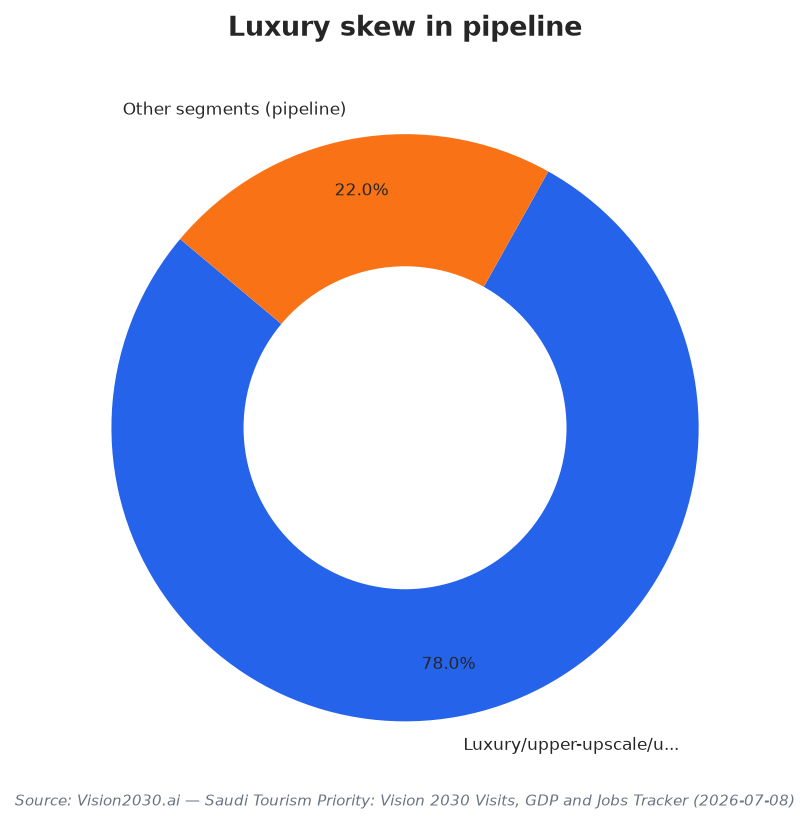
Multiple sources argue the pipeline is not balanced. The Vision 2030 tourism tracker says the structural gap is mid-scale and budget, calling the hospitality programme heavily luxury-skewed. It puts the aggregate giga-project pipeline at about 99,500 keys under construction or planning, with 78% in luxury, upper-upscale, and upscale segments, and adds that by 2030, luxury and upscale rooms are expected to represent 76% of total Saudi supply. An M&A-focused report echoes the same theme, citing that around 61% of existing inventory is concentrated in luxury and upper-upscale, while nearly 78% of new rooms through 2030 are planned at the higher end (with another viewpoint stating 75% luxury). This mix helps explain why investors are leaning toward midscale and economy exposure.
Demand drivers also support a broader price ladder than a luxury-heavy pipeline implies. Vision 2030 analysis highlights religious tourism as the largest single demand segment, with year-round occupancy in Makkah and Madinah and seasonality during Hajj months and Ramadan. It also describes leisure tourism as the fastest-growing segment, driven by purpose-built destinations such as Red Sea Global (formerly Red Sea International), AMAALA, AlUla, Diriyah, NEOM’s Sindalah, and Jeddah waterfront development, plus expanding business and MICE activity as Riyadh positions itself as a premier business destination. Ken Research adds that midscale hotels serve a growing domestic and regional middle class, while budget and economy hotels support cost-conscious travelers for intra-KSA trips. That is the customer base select-service operators are designed to capture.
Investors also have signposts on market direction. Mordor Intelligence estimates the Saudi Arabia hospitality market at USD 29.02 billion in 2026 (up from USD 27.14 billion in 2025) and projects USD 40.58 billion by 2031 at a 6.93% CAGR (2026–2031). The same source says chain hotels held 57.74% share in 2025, while OTAs accounted for 41.65% of transactions and direct digital channels are forecast to grow at a 14.78% CAGR. For midscale hotels in Saudi Arabia, this matters because select-service models can benefit from brand distribution, standardized operations, and direct-booking investment. With the pipeline skewed high and the capacity gap still large, the overlooked opportunity is building the middle tier that the visitor targets depend on.
Why are investors focusing on midscale and select-service hotels in Saudi Arabia?
How many hotel keys does Saudi Arabia operate today, and what is the estimated need by 2030?
What do sources say about the luxury-heavy pipeline mix?
What recent national hotel performance figures are reported for Saudi Arabia?
How does the Saudi eVisa policy support broader demand beyond luxury travel?
Talk to us for your needs in:
-
Tourism Infrastructure Planning and Optimization
-
Destination Marketing and Brand Strategy
-
Tourism Workforce Development and Training
-
Sustainable Tourism Solutions
-
Visitor Experience Enhancement and Engagement
-
Tourism Project Feasibility and Strategic Planning
-
Saudi Tourism Benchmarking