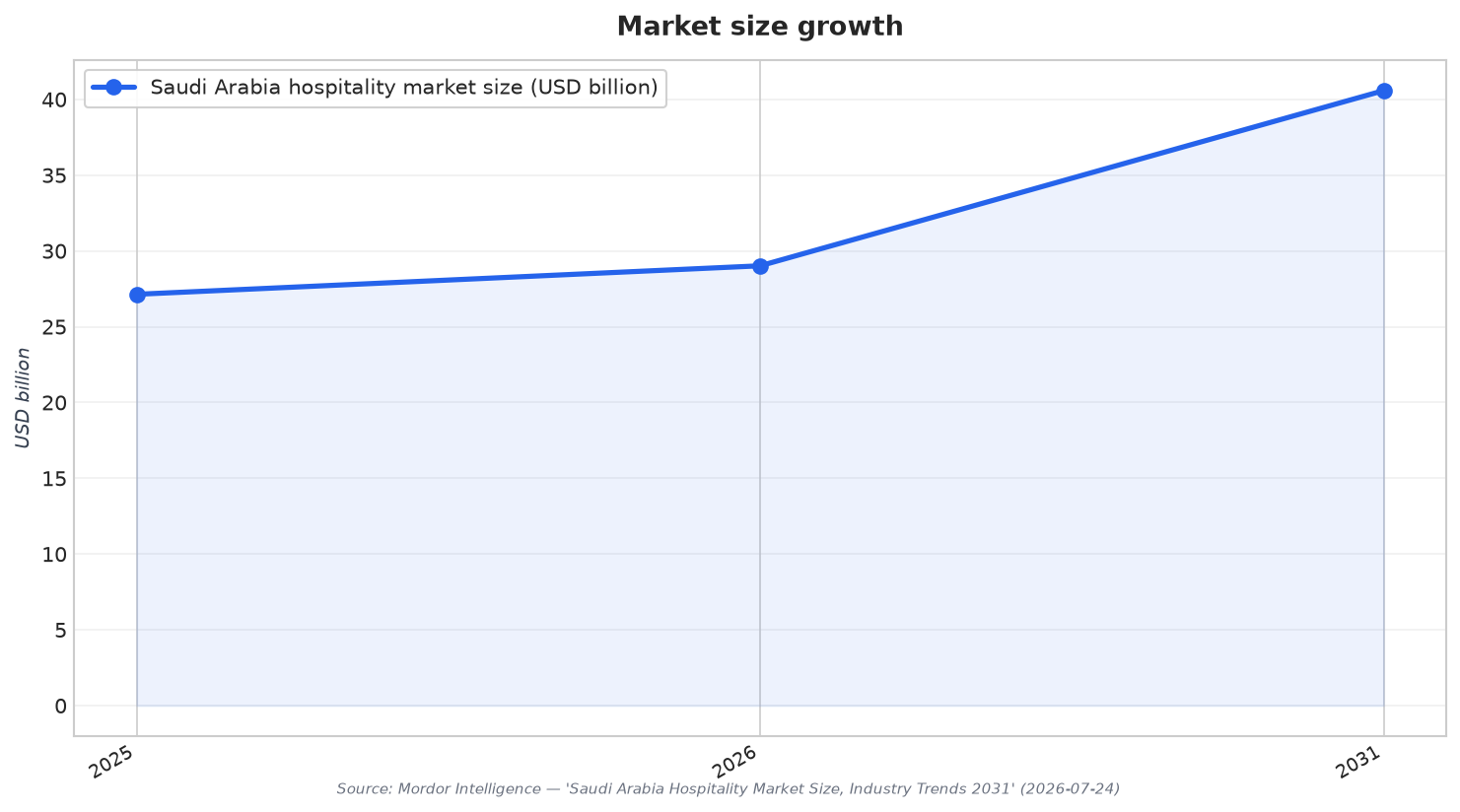
Saudi Arabia’s hospitality market is being reshaped by rapid development, expanding travel demand, and a shift toward more structured operating models. Mordor Intelligence estimates the Saudi Arabia hospitality market at USD 29.02 billion in 2026, up from USD 27.14 billion in 2025, with projections reaching USD 40.58 billion by 2031 (6.93% CAGR over 2026–2031). In this environment, the rise of homegrown Saudi hotel management companies matters because it influences how quickly projects can mobilize staff, systems, and compliance. The market is already tilted toward chains: chain hotels held 57.74% share in 2025, and independent hotels are forecast to trail as chain operators outpace them with an 11.62% CAGR through 2031.
Localisation in hotel management is also tied to a broader policy and licensing context. Vision 2030 framing points to a national tourism demand story rather than a single-city cycle, with an official target of 150 million domestic and inbound visitors by 2030 after surpassing an earlier 100 million visitor goal ahead of schedule. The Ministry of Tourism functions as the core regulator for accommodation, and the Tourism Law requires a license or permit before engaging in tourism activity. This combination of demand ambition and regulatory structure tends to reward operators that can standardize processes across regions, from Riyadh and Jeddah to AlUla and the Red Sea coast, while still handling different seasonality and access constraints.
Dur, Adeera, and Why Local Operators Matter in Execution
Within this competitive market, local operators are increasingly visible alongside global brands. A market overview describes Saudi Arabia’s hotel sector as highly competitive, naming Marriott International, Hilton Hotels, Accor, and IHG Group, alongside regional operators such as Dur Group. In investment guidance, Dur Hospitality is described as Saudi Arabia’s largest listed hospitality company, operating a portfolio of owned and managed hotels. That positioning is relevant because operating performance targets and service consistency become harder to deliver at scale without experienced management. The same guide notes that well-performing Saudi hotels typically see gross operating profit margins ranging from 30% to 45%, with occupancy rates of 65% to 80% achievable in established locations.
Religious tourism remains a defining feature of the Kingdom’s demand curve, and it is where operational localisation can be stress-tested. Mordor Intelligence notes Hajj attendance at approximately 2.1 million in 2025 and 1.71 million in 2026, with projections of around 2.3 million, and a Vision 2030 target of 30 million Hajj and Umrah pilgrims annually by 2030. Umrah pilgrims totaled 18 million in 2025 and are expected to exceed 20 million in 2026, with average spending of USD 5,400 per pilgrim; religious tourism generated about USD 30 billion in 2025 and is projected at about USD 34 billion in 2026. The Ministry of Tourism’s online portal enabled the temporary addition of 566,000 beds for Hajj 2025, underscoring how operational readiness and coordination can directly expand capacity.
Localisation is also playing out in hotel economics and product mix beyond the holy cities. The Kingdom currently operates approximately 340,000 classified hotel keys, concentrated in Makkah and Madinah and the commercial centers of Riyadh and Jeddah. Nationally, one market analysis puts occupancy over the past 12 months at around 60–62%, up from below 40% at the height of 2020, with ADR about USD 185–190 (approximately SAR 700). Meanwhile, luxury remains a fast-growing segment: one forecast values the Saudi Arabia luxury hotel market at USD 1.22 billion in 2025 and expects USD 3.07 billion by 2034 (10.76% CAGR during 2026–2034). As newer homegrown operators such as Adeera emerge alongside established names like Dur, the localisation of management is becoming part of how Saudi Arabia balances rapid supply growth with consistent guest experience and licensed operations.
Why are Saudi hotel management companies becoming more important now?
What role does Dur Hospitality play in the local operator landscape?
How does religious tourism shape hotel operations in Saudi Arabia?
What operating performance ranges are cited for well-performing hotels in Saudi Arabia?
What market indicators show hotel demand recovery in Saudi Arabia?
Talk to us for your needs in:
-
Tourism Infrastructure Planning and Optimization
-
Destination Marketing and Brand Strategy
-
Tourism Workforce Development and Training
-
Sustainable Tourism Solutions
-
Visitor Experience Enhancement and Engagement
-
Tourism Project Feasibility and Strategic Planning
-
Saudi Tourism Benchmarking