Madinah hotel investment decisions around the Prophet’s Mosque sit inside a fast-moving Saudi hospitality cycle. Nationally, occupancy over the past 12 months has been described as hovering around 60–62%, up from below 40% at the height of 2020. Average daily rate has been cited at about $185–$190 USD (approximately SAR 700), with a first-half 2025 nationwide ADR of SAR 822 (~$219) alongside 62.3% occupancy. RevPAR has been described as roughly $115–$120, about 20% higher than the 2019 pre-pandemic average, after 2023 RevPAR growth of almost 25% and a slight normalization in 2024. For Prophet’s Mosque-adjacent assets, these national signals matter because they shape financing expectations, brand appetite, and pricing power assumptions used in underwriting.
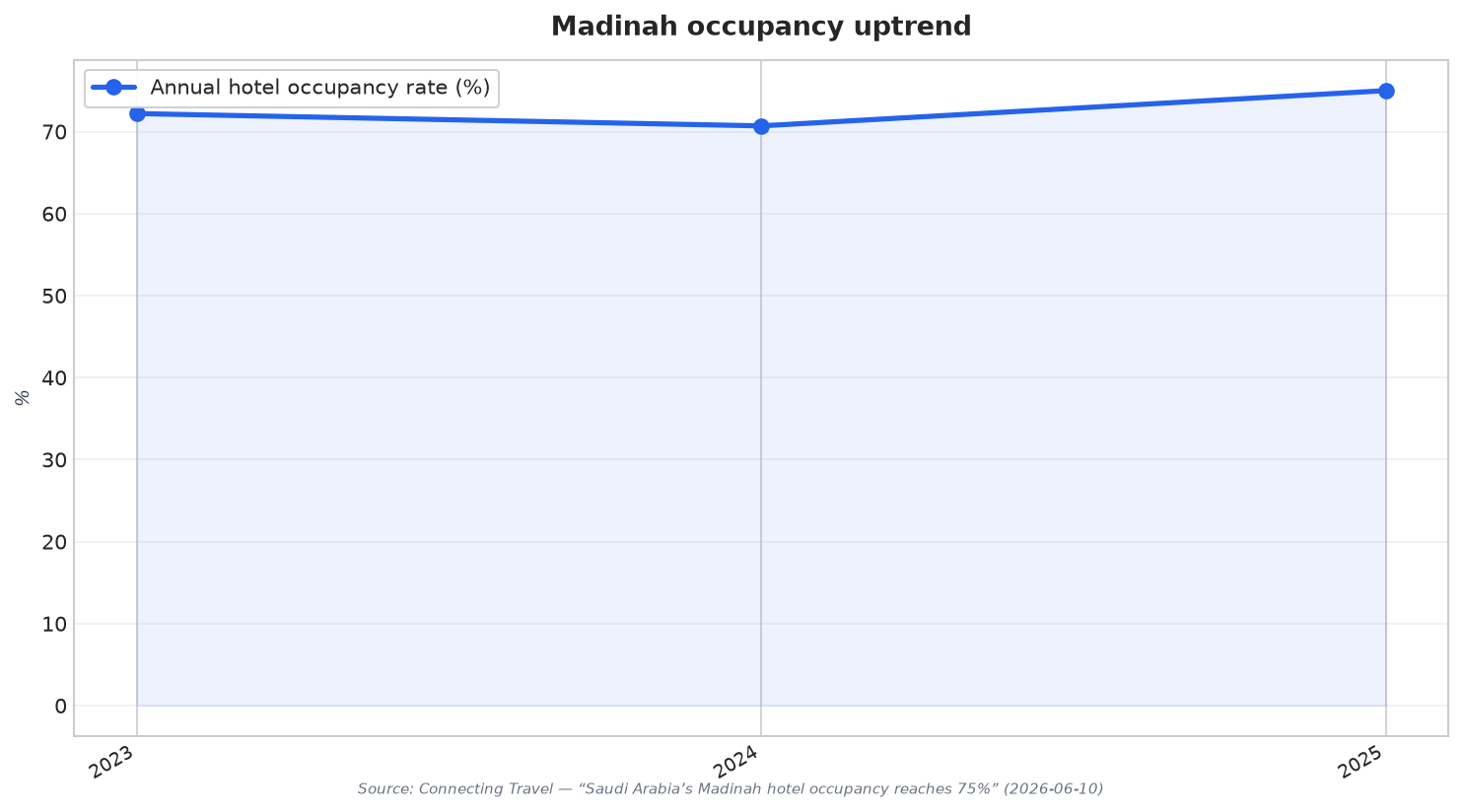
In Madinah itself, Ministry of Tourism data reported annual hotel occupancy reaching 75%, rising from 70.7% in 2024 and 72.2% in 2023. The same reporting said the city welcomed more than 21 million visitors in 2025, while spending increased 22% to SAR 52 billion (US$13.9 billion). Supply is moving with demand: licensed hospitality facilities were reported up 35% to 610, and hotel room inventory grew 24% to more than 62,000. Access is also widening, with Flyadeal launching five routes from its Madinah base, including a direct service to Istanbul Sabiha Gökçen Airport plus domestic links to Abha, Al Hofuf, Jazan, and Tabuk. For investors, these figures point to a market where both the customer base and the operating platform are deepening, not just spiking seasonally.
Room Supply Around the City Center: Pipeline and Reality Checks
The most important diligence step is reconciling different published pipeline figures and aligning them to the micro-location around the Prophet’s Mosque. One report said the Rua Al Madinah Project is expected to add more than 47,000 hotel rooms by 2030, significantly increasing accommodation capacity around the city centre. Another report described Rua Al Madinah as spanning 1.35 million square meters and featuring around 80,000 hotel rooms and nearly 500 residential units, with completion surpassing 65% according to the project CEO. These two room counts are not presented as the same statistic in the sources, so investors should treat them as separate published references and validate scope and phasing. Named additions also show brand interest near the Mosque, including a planned 383-room Crowne Plaza Madinah and a 246-room Four Seasons Hotel Madinah.
Yield thinking in Madinah is often discussed through operating performance rather than a single cap-rate number. A Saudi hospitality investment guide notes that operating margins for well-performing Saudi hotels typically range from 30% to 45% at the gross operating profit level, with occupancy rates of 65% to 80% achievable in established locations. It also emphasizes that the market is structurally distinct because Hajj and Umrah pilgrims are the largest single demand segment, generating year-round occupancy in Makkah and Madinah with pronounced seasonality during Hajj months and Ramadan. At the national level, Saudi Arabia’s hotel market has also been framed as structurally undersupplied relative to ambitions: the Kingdom currently operates approximately 340,000 classified hotel keys and is estimated to require an additional 500,000 to 550,000 hotel keys to meet 2030 visitor targets.
Entry routes around the Prophet’s Mosque usually converge on three practical paths: develop, acquire/partner, or seed into regulated vehicles tied to the area’s real estate model. The same investment guide points to midscale and select-service development opportunities, arguing the supply gap is most acute there because pipelines can be weighted toward luxury and upper-upscale. Regulatory momentum is also changing how capital participates: one report says legislative and regulatory decisions approved during 2025 and effective at the start of 2026 are reshaping investment models in Makkah and Madinah, with assets increasingly managed by investment funds and listed companies. As a concrete example of that fund pathway, Al Rajhi Capital and Thakher Development signed a memorandum of understanding to establish a real estate investment fund in Makkah with investments exceeding SAR 2 billion ($534.6 million). For Madinah, that direction of travel matters because it signals more institutional structures for partnering, operating, and eventually recycling capital.
What do the latest figures say about Madinah hotel room demand?
How fast is Madinah’s hotel supply expanding?
What operating performance ranges are cited for Saudi hotels, and how should that inform Madinah underwriting?
Which entry routes are most realistic for Madinah hotel investment near the Prophet’s Mosque?
Talk to us for your needs in:
-
Tourism Infrastructure Planning and Optimization
-
Destination Marketing and Brand Strategy
-
Tourism Workforce Development and Training
-
Sustainable Tourism Solutions
-
Visitor Experience Enhancement and Engagement
-
Tourism Project Feasibility and Strategic Planning
-
Saudi Tourism Benchmarking