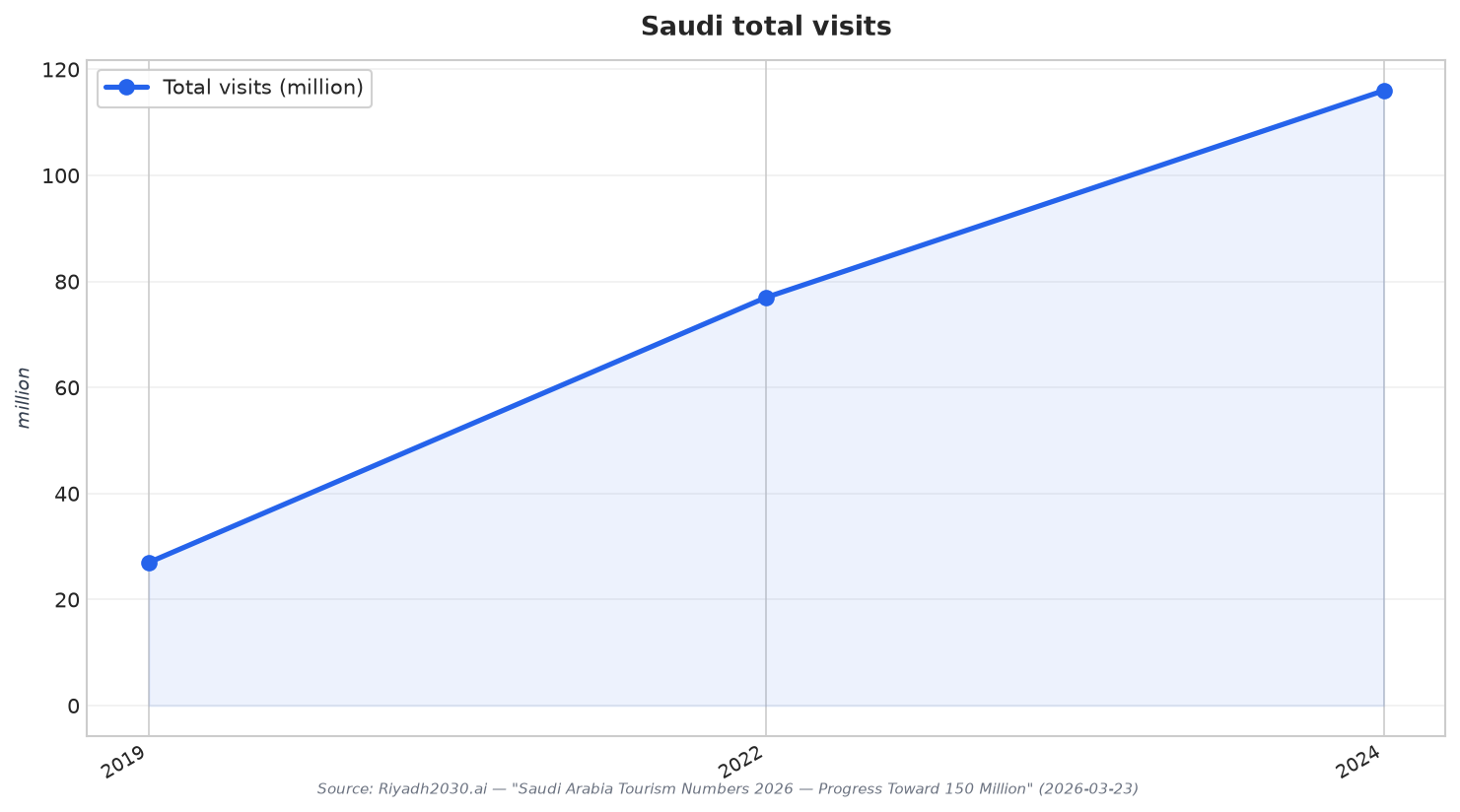
Tourism projects succeed when decision-makers can verify what they deliver. In Saudi Arabia, measurement is built into Vision 2030’s tourism scorecards, which track annual visits and the tourism share of GDP. The original Vision 2030 goal of 100 million annual visits by 2030 was met in 2023, six years early, and the target was revised upward to 150 million visits by 2030, split into 80 million domestic and 70 million international. The tourism scorecard also states a tourism GDP target of 10% of GDP by 2030, and reports the sector is roughly at that level. These clearly defined KPIs create a practical foundation for tourism economic impact assessment Saudi Arabia can apply across destinations and event calendars.
For destinations and events, assessment starts with demand and value, not just attendance headlines. Vision 2030 tourism tracking reports approximately 109 million visits in 2023, 116 million in 2024, and 122–123 million in 2025. For 2025, the tracker also pairs those visits with roughly SAR 300 billion in total tourism spending. Another Saudi tourism performance assessment adds important detail for interpretation: in 2024, total visits were approximately 116 million, including 29.7 million international visitors (an 8% year-on-year increase) and 86.2 million domestic trips (a 5% increase). It also notes that “total visits” can include multiple categories that are not equivalent to how many countries count “tourist arrivals,” so project-level evaluation should be explicit about which categories it uses.
Build the Model Around Composition, Capacity, and Constraints
Composition affects impact as much as volume. Vision 2030 tourism analysis states roughly three-quarters of visits are domestic, while religious tourism still anchors much of inbound flow. Leisure growth is described as concentrated in Riyadh Season events, AlUla winter programming, and a handful of newly operational Red Sea resorts, with the mix expected to depend on delivery timelines for AMAALA, Qiddiya, Diriyah Gate, and NEOM’s Trojena. A destination or event assessment should therefore separate domestic versus international, and distinguish religious travel from leisure programming, because each segment drives different spending patterns, seasonality, and infrastructure pressure. The same sources emphasize that scaling toward the revised 150 million goal must clear bottlenecks in hotels, aviation, labour, and destination delivery.
Supply-side indicators help quantify whether growth is feasible and what it costs to support. Mordor Intelligence estimates Saudi Arabia’s hospitality market at USD 27.14 billion in 2025 and USD 29.02 billion in 2026, with projections of USD 40.58 billion by 2031, at a 6.93% CAGR for 2026–2031. It also reports structure and concentration points that can shape local impact: chain hotels held 57.74% of market share in 2025, and the Makkah–Jeddah corridor held 26.62% of market size in 2025. For 2025 transactions, OTAs captured 41.65%. For impact assessment, these metrics support realistic assumptions about where stays occur, how bookings flow, and how operator mix can affect wages, procurement, and reinvestment at the destination level.
Religious tourism is a clear example of how event-scale demand can be evaluated with capacity, spend, and enabling actions. Mordor Intelligence reports Hajj attendance of approximately 2.1 million in 2025 and 1.71 million in 2026, and states a Vision 2030 target of 30 million Hajj and Umrah pilgrims annually by 2030. It adds that Umrah pilgrims totalled 18 million in 2025 and are expected to exceed 20 million in 2026, with average spending of USD 5,400 per pilgrim, while religious tourism generated about USD 30 billion in 2025 and is projected at about USD 34 billion in 2026. It also notes the Ministry of Tourism’s online portal enabled the temporary addition of 566,000 beds for Hajj 2025. For any Saudi destination or event, a rigorous assessment should pair outcome metrics (visits and spend) with readiness metrics (beds, airlift, and operational throughput) to show what the project truly delivers.
What should a tourism economic impact assessment in Saudi Arabia measure first?
What do the latest Vision 2030 trackers report for total visits and spending?
How should Saudi destinations handle the difference between “total visits” and “tourist arrivals”?
Which hospitality metrics can support destination and event impact evaluation?
What religious tourism figures can be used in impact assessment for major seasons?
Talk to us for your needs in:
-
Tourism Infrastructure Planning and Optimization
-
Destination Marketing and Brand Strategy
-
Tourism Workforce Development and Training
-
Sustainable Tourism Solutions
-
Visitor Experience Enhancement and Engagement
-
Tourism Project Feasibility and Strategic Planning
-
Saudi Tourism Benchmarking