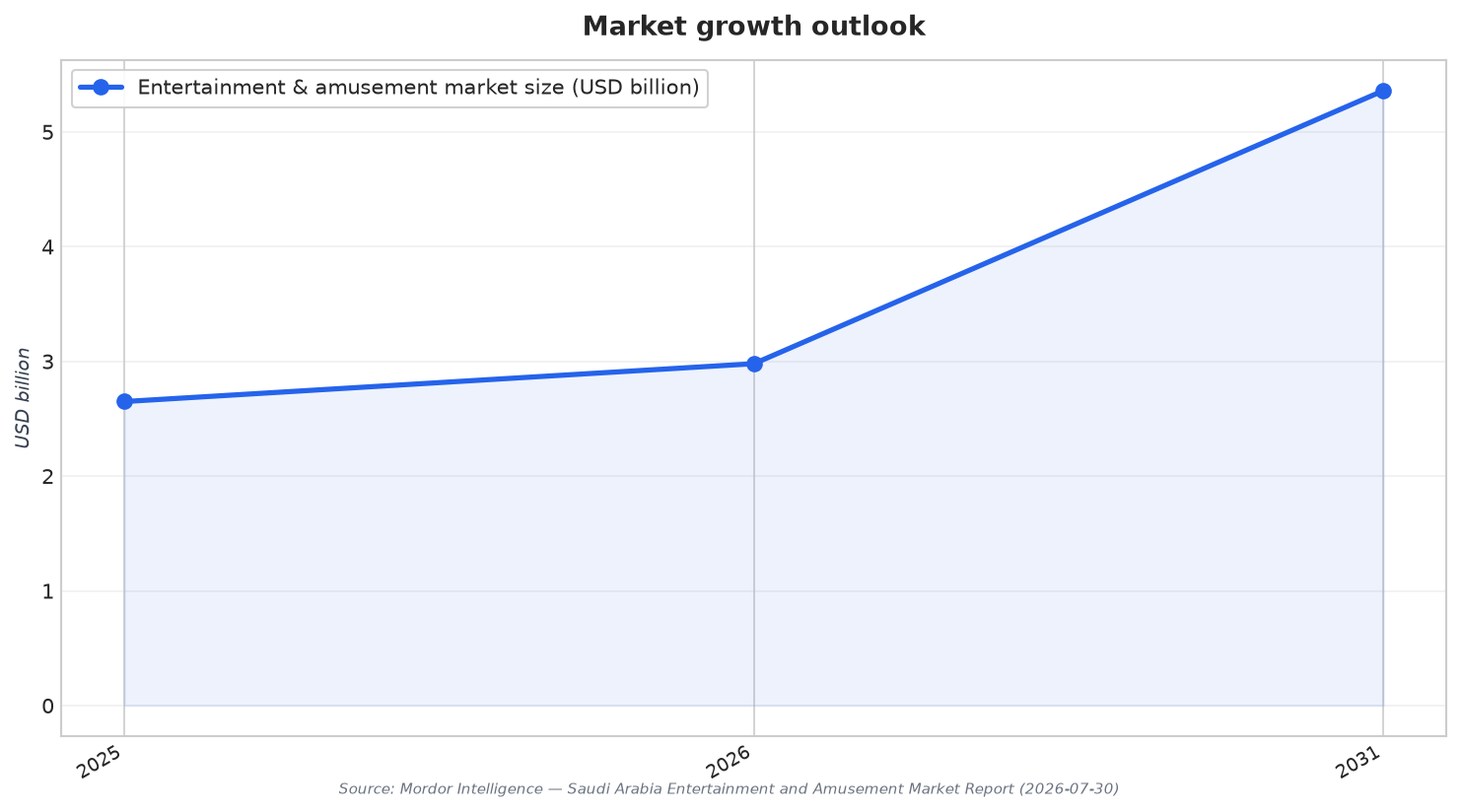
For operators evaluating a family entertainment center in Saudi Arabia, the topline market direction is supportive, but the commercial details matter. Mordor Intelligence estimates the Saudi Arabia entertainment and amusement market at USD 2.98 billion in 2026, up from USD 2.65 billion in 2025, with projections of USD 5.36 billion by 2031 at a 12.4% CAGR for 2026–2031. Within that same framing, family entertainment centers led venue share at 36.02% in 2025 (Mordor). Another market source similarly states that FECs dominated with 36.63% share in 2024, showing how consistently the format is positioned as a core venue type. Riyadh also concentrated demand, capturing 52.10% of market share in 2025 (Mordor), which influences site selection and pricing power.
Unit economics start with revenue mix. Mordor reports ticket sales at 50.10% of market revenue in 2025, while another source places ticket sales at 50.83% in 2024. That reinforces a high dependence on admissions and play cards, so throughput and repeatability drive performance. At the same time, “premium experiences” are forecast by Mordor to grow at a 20.1% CAGR through 2031, and a separate source describes premium add-ons such as VIP passes and AR-enhanced tours growing at a 20.73% CAGR. Pricing signals also appear in market commentary: ticket bundles starting at SAR 89 (USD 23.7), paired with upsold food combos, are described as a lever to lift per-visitor spending. Demographic mix supports family-heavy programming too, with families representing 46.78% of market share by visitor demographic in 2025 (Mordor).
Mall Partnerships: Why FECs Keep Becoming Anchors
Malls are a recurring distribution channel for FEC expansion, and the sources connect this to broader domestic travel and mixed-use development. One Saudi market insight notes that in 2025, intra-Kingdom leisure trips rose 17% year-on-year, and ties campaign activity to an 11% boost in mall foot traffic. Mordor also describes a pivot toward leisure components inside mixed-use real-estate projects, alongside the “rapid rollout of mall-anchored family entertainment centers.” For operators, a mall partnership can reduce demand volatility by capturing routine weekend traffic while also benefiting from tourism-linked surges. Regionally, the same Mordor dataset indicates Eastern Province is expected to grow at a 6.8% CAGR during the outlook period, suggesting that mall-based rollouts may not be limited to the capital even if Riyadh currently leads share.
Licensing and branded concepts tie into Saudi Arabia’s capital deployment and technology-heavy formats. Mordor reports that government entities channeled more than SAR 50 billion (USD 13.33 billion) into leisure infrastructure between 2024 and 2025, anchoring 21 Saudi Entertainment Ventures (SEVEN) destinations, the Qiddiya mega-theme-park cluster, and mixed-reality zones inside NEOM. Mordor also links this funding pipeline to attracting global IP partners to license ride technologies. On the format side, mixed reality and VR arcades are projected to expand at an 18.5% CAGR through 2031 (Mordor), while another source states VR and mixed-reality arcades are the fastest-growing format with a 19.27% CAGR through 2030, though still under 5% share. These growth rates matter for licensing decisions because they support the business case for differentiated content, localized experiences, and premium upsells.
Operating discipline still hinges on permitting and ecosystem readiness. One source attributes licensing streamlining to the General Entertainment Authority (GEA) and notes that global entertainment brands including AMC Theatres, VOX Cinemas, and IMAX have been attracted to the market. The same source highlights cinema as a visible reference point for how quickly supply can scale, stating that the lifting of the 35-year cinema ban in 2018 preceded the rise to 66 cinema complexes now operational, with a government target of 300 theaters and approximately 2,000 screens by 2030. For FEC operators negotiating mall leases or licensing IP, these signals point to a fast-evolving competitive set. The practical takeaway is to anchor projections in the ticket-led reality of revenue today, while building a clear path to premium experiences that the sources show are compounding faster than the base.
How large is Saudi Arabia’s entertainment and amusement market in recent estimates?
What share do family entertainment centers hold in Saudi Arabia?
In a Saudi family entertainment center, what revenue stream dominates?
Why do mall partnerships matter for FEC growth in Saudi Arabia?
What do the sources say about licensing and new formats like VR in Saudi Arabia?
Talk to us for your needs in:
-
Tourism Infrastructure Planning and Optimization
-
Destination Marketing and Brand Strategy
-
Tourism Workforce Development and Training
-
Sustainable Tourism Solutions
-
Visitor Experience Enhancement and Engagement
-
Tourism Project Feasibility and Strategic Planning
-
Saudi Tourism Benchmarking