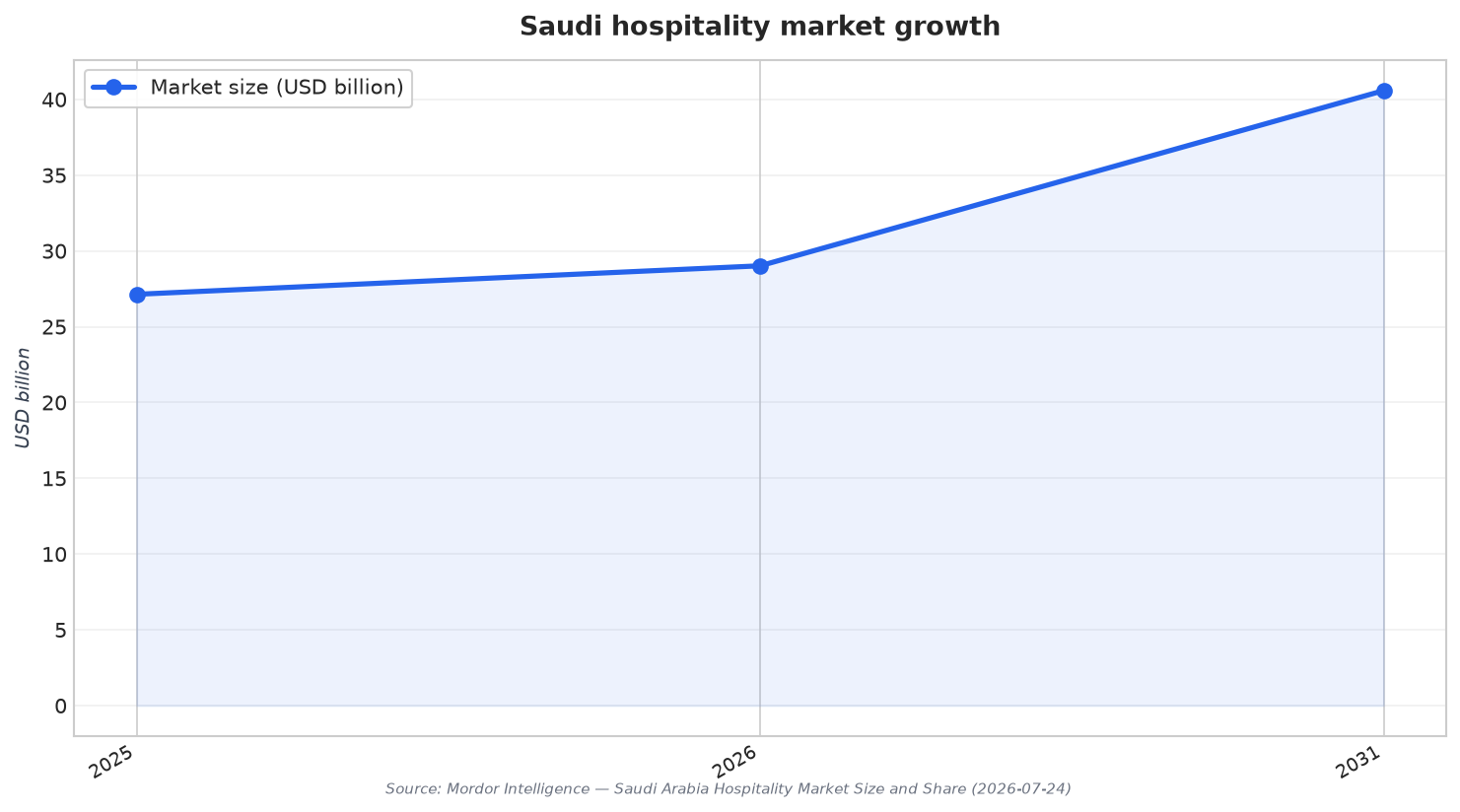
Saudi Arabia’s hospitality expansion is creating space for more local control in hotel operations. Mordor Intelligence estimates the Saudi Arabia hospitality market at USD 29.02 billion in 2026, up from USD 27.14 billion in 2025, with projections reaching USD 40.58 billion by 2031 at a 6.93% CAGR (2026–2031). In this environment, chain hotels already held 57.74% share in 2025, and online travel agencies (OTAs) captured 41.65% of transactions that year. At the same time, direct digital channels are forecast to grow at a 14.78% CAGR as hoteliers invest in their own platforms. Those shifts matter for local operators because management capability increasingly includes distribution, loyalty, and yield management, not only property operations.
Demand is no longer only about Makkah and Madinah. Vision 2030’s stated ambition is 150 million domestic and inbound visitors by 2030, after surpassing an earlier 100 million visitor goal ahead of schedule, according to Vision2030.ai. The same source links demand to multiple pools: religious travel, domestic and regional leisure in cities and destinations such as Riyadh, Jeddah, AlUla, Aseer, and the Red Sea coast, plus events-driven demand tied to conferences, Expo 2030, and the 2034 FIFA World Cup cycle. For hotel owners, the operating question becomes whether room licensing, labor, transport access, and seasonality management can scale without undermining returns.
Adeera and Dur: Localisation Meets a New Operating Reality
Against this backdrop, Saudi hotel management companies are being discussed not only as asset owners, but as long-term operators of mixed portfolios. Dur Hospitality is positioned in that conversation because Vision2030.ai’s hospitality investment guide describes Dur Hospitality as Saudi Arabia’s largest listed hospitality company, operating a portfolio of owned and managed hotels. The same guide frames the market as structurally distinct due to religious tourism: Hajj and Umrah pilgrims are described as the largest single demand segment, generating year-round occupancy in Makkah and Madinah with pronounced seasonality during Hajj months and Ramadan. It also notes that Makkah hotels historically achieve the Kingdom’s highest revenue per available room because demand compresses in peak periods.
Localisation also ties to regulation and standards. Vision2030.ai states that the Ministry of Tourism is the core regulator for tourism accommodation and that the Tourism Law requires a license or permit from the Ministry before engaging in tourism activity. As new platforms such as Adeera emerge in the local operator ecosystem, the context is a market where execution depends on repeatable operating models that can be licensed, staffed, and audited across different destinations. In established locations, Vision2030.ai’s investment guide says occupancy rates of 65% to 80% are achievable, with gross operating profit margins typically ranging from 30% to 45% for well-performing Saudi hotels, which raises the bar for operators competing on consistency.
Performance and pipeline pressures help explain why management localisation matters. A 2025 market analysis by MMCG Invest says national occupancy over the past 12 months hovered around 60%–62%, up from below 40% at the height of 2020, while average daily rate was about USD 185–190 (approximately SAR 700). Meanwhile, Vision2030.ai’s investment guide estimates the Kingdom currently operates about 340,000 classified hotel keys, concentrated in Makkah and Madinah and the commercial centers of Riyadh and Jeddah. With the Makkah–Jeddah corridor holding 26.62% of market size in 2025 (Mordor), and the Red Sea and wider western coast forecast to expand at an 18.20% CAGR to 2031, local operators face a clear mandate: build scalable systems that can handle both peak compression and off-peak volatility.
What is driving demand beyond Makkah and Madinah in Saudi Arabia’s hotel market?
How large is Saudi Arabia’s hospitality market, according to the sources?
What do the sources say about Dur Hospitality’s role as a local operator?
What do sources indicate about hotel occupancy and profitability in established Saudi locations?
How are Saudi hotel management companies affected by distribution and booking-channel trends?
Talk to us for your needs in:
-
Tourism Infrastructure Planning and Optimization
-
Destination Marketing and Brand Strategy
-
Tourism Workforce Development and Training
-
Sustainable Tourism Solutions
-
Visitor Experience Enhancement and Engagement
-
Tourism Project Feasibility and Strategic Planning
-
Saudi Tourism Benchmarking