Saudi Arabia rose to 29th in the World Economic Forum’s 2026 Travel & Tourism Development Index (TTDI), climbing three places from its 2024 ranking. The Kingdom’s rise is not a one-off: WEF reporting cited a 17-place improvement since 2019, underscoring a multi-year push to strengthen tourism as part of Vision 2030’s economic diversification strategy. For investors tracking the travel and tourism development index Saudi Arabia story, the key point is that TTDI is designed to measure the conditions and policies that enable sustainable and resilient sector growth, not to directly rank economies by visitor arrivals or tourism revenue.
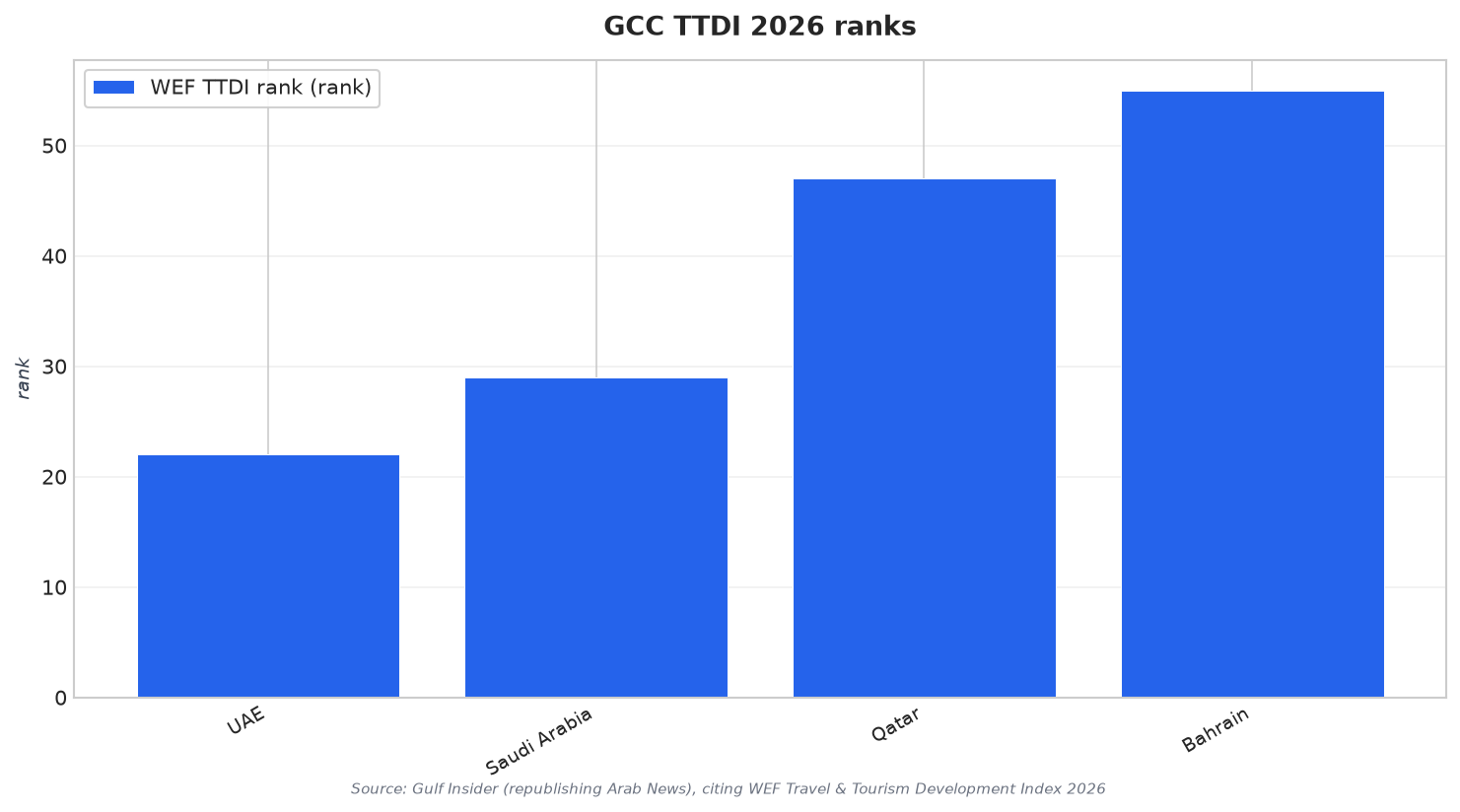
Several numbers help investors place the 2026 position in context. The 2026 TTDI covers 110 economies, while one report on the region described the UAE holding 22nd place among 119 economies in the same 2026 edition. Saudi Arabia’s score was reported as 4.45, described as up 3.4% year-on-year and up 7.8% since 2019—one of the biggest seven-year improvements. In the GCC comparison set, the UAE ranked 22nd, Qatar 47th, and Bahrain 55th, while Japan led the global index ahead of the US, Spain, and Australia.
Where the Kingdom Still Lags: Affordability, Investment, and Skills
Even with a higher rank, investors should pay attention to what WEF flags as constraints across the sector. WEF said travel and tourism-related prices have risen faster than inflation in many economies, contributing to a decline in price competitiveness in three-quarters of TTDI-ranked economies between 2024 and 2026. It also warned that, despite improvement, tourism investment has lagged behind activity since 2022. WEF added that workforce shortages and skills gaps risk constraining service quality and adaptation to digital and AI-driven change, and the report also characterized affordability as one of the biggest constraints on tourism.
Saudi Arabia’s own targets and recent volumes show why the gap between activity and investment matters to capital allocators. The Kingdom surpassed its original target of 100 million tourists and raised its ambition to 150 million visitors annually by 2030. It also recorded about 123 million domestic and inbound tourists in 2025, according to the Ministry of Tourism. For investors, that combination—high ambition plus already-large activity—can amplify pressure on areas that TTDI and WEF commentary highlight, including affordability dynamics and the capacity of the workforce to maintain service standards as new infrastructure and destinations scale.
On labor, the 2026 discussion provides both a positive signal and a reminder of execution risk. Tourism employment reached nearly 1.03 million jobs in 2025, and Saudi women accounted for about 47% of the tourism workforce, rising from 5% in 2018 through scholarship, certification, and apprenticeship programs run by the Ministry of Tourism. The WEF also highlighted Saudi Arabia as a case study for resilience building and linked the Kingdom’s progress to one of the strongest global improvements in the Human Resources and Labour Market pillar since 2019. Still, WEF’s broader caution on workforce shortages and skills gaps is relevant for investors assessing operator readiness, training costs, and the ability to adopt digital and AI-driven change.
What does the WEF Travel & Tourism Development Index measure for Saudi Arabia?
How much did Saudi Arabia improve in the 2026 TTDI rankings?
What score did Saudi Arabia receive in the 2026 index?
Where does WEF say travel and tourism still lags for investors to watch?
How has the tourism workforce changed in Saudi Arabia, according to the index coverage?
Talk to us for your needs in:
-
Tourism Infrastructure Planning and Optimization
-
Destination Marketing and Brand Strategy
-
Tourism Workforce Development and Training
-
Sustainable Tourism Solutions
-
Visitor Experience Enhancement and Engagement
-
Tourism Project Feasibility and Strategic Planning
-
Saudi Tourism Benchmarking