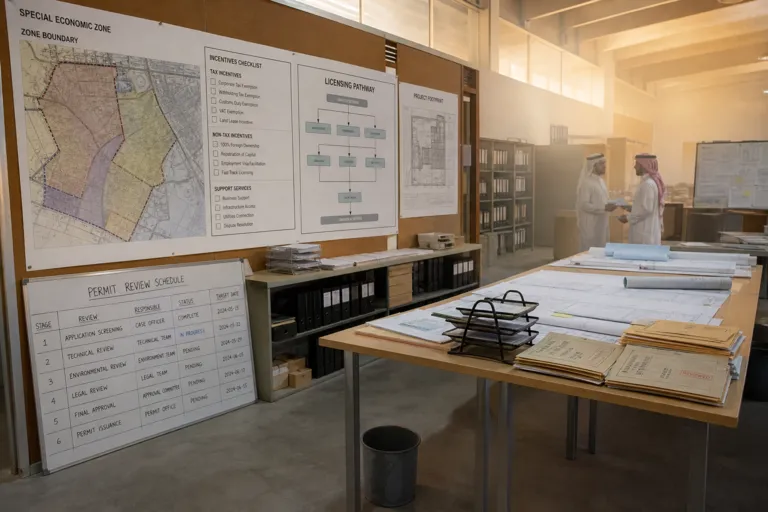
Investors tracking special economic zones Saudi Arabia tourism are often looking for one thing: clarity on what SEZ incentives actually mean for hotels, attractions, and destination operators. Saudi SEZs are geographically delimited areas with legislative frameworks that differ from the base economy while remaining within Saudi Arabia’s treaty obligations. The first wave of zones cited across sources includes King Abdullah Economic City (KAEC), Ras Al-Khair, Jazan, the Cloud Computing SEZ, and the Riyadh Integrated Special Logistics Zone. These zones are designed to enhance competitiveness, attract foreign direct investment, and accelerate economic diversification, supported by infrastructure, strategic positioning on trade routes, and a streamlined “one-stop-shop” approach to applications and licensing.
For hospitality and leisure, the incentives matter because they can improve cash flow and reduce friction in cross-border operating models. A unified set of advantages cited across SEZ discussions includes 100% foreign ownership, no restrictions on capital repatriation, and a streamlined licensing system. Economic incentives referenced in the legal analysis include 5% corporate income tax for up to twenty years, 0% customs duties deferral for goods located within an SEZ, 0% value-added tax on goods exchanged within the zone and between SEZs, and permanent 0% withholding tax on repatriation (as stated in the same incentives list). For hotel and leisure operators, these levers are most relevant when projects import fit-out equipment, run multi-entity structures, or need predictable rules for moving capital and services across borders.
Where Tourism Fits: NEOM and the Practical SEZ Logic
Tourism appears explicitly in the SEZ landscape through NEOM SEZ, which is described as targeting sectors that include tourism. A U.S. government commercial guide notes a project that is “in a special economic zone,” with its own legislative and regulatory system, strategic location, and streamlined visa requirements, and states that travelers are expected to reach one million a year by 2035 for the destination described. The same source adds that additional resorts are under development within NEOM, including on the Red Sea and at the mountain resort region Trojena, while also noting reported delays tied to late payments. For hospitality investors, the lesson is to diligence not only incentives, but also delivery timelines, counterparties, and operational dependencies that can affect openings.
Outside NEOM, tourism demand is framed as a national priority sector under Vision 2030, with the government aiming to increase domestic household spending related to entertainment and leisure and transform the country into a major global travel destination. The same commercial guide argues that tourism infrastructure remains underdeveloped, presenting opportunities for hotel operators, tour companies, and hospitality training in metros like Riyadh and Jeddah and in UNESCO-linked destinations such as Al Ula, Al Hasa, and the Aseer region. Separately, Qiddiya is described as planned to be the world’s largest entertainment city over 360 square kilometers, with over 300 leisure and entertainment facilities including a 20,000-seat clifftop stadium slated to host a portion of the 2034 World Cup. While Qiddiya is not presented in the sources as an SEZ, it provides context for the scale of hospitality and leisure buildout that SEZ-linked suppliers and service firms may seek to support.
Execution hinges on matching the project to zone scope and compliance requirements, not only the headline tax rate. Sources emphasize that eligibility depends on licensing, activity fit, and each zone’s rules, and that investor decisions should consider whether an activity qualifies, whether a physical industrial location is needed versus a virtual cloud model, and whether the business can satisfy licensing, substance, customs, tax, Saudization, and sector approvals. On timing, one source states that in January 2026 the Saudi Council of Ministers approved detailed regulatory frameworks governing KAEC, Ras Al-Khair, Jazan, and Cloud Computing, and that these frameworks entered into force on 16 April 2026, meaning investors can apply and operate under the SEZ regime today (with some sector-specific rules continuing to evolve through secondary regulations). Another source adds that the government plans to expand SEZs from four to at least eight by 2028, with potential new zones focused on tourism and entertainment, and notes that over 100 companies had signed agreements to establish operations in Saudi SEZs by the end of 2025.
How do Saudi Arabia’s SEZ incentives apply to hospitality and leisure investors?
Which Saudi SEZs are part of the official network cited in the sources?
What tourism-related evidence is linked to an SEZ setting in the sources?
When did the updated SEZ regulatory frameworks take effect?
What is the government’s stated plan for expanding SEZs that could matter for tourism and entertainment?
Talk to us for your needs in:
-
Tourism Infrastructure Planning and Optimization
-
Destination Marketing and Brand Strategy
-
Tourism Workforce Development and Training
-
Sustainable Tourism Solutions
-
Visitor Experience Enhancement and Engagement
-
Tourism Project Feasibility and Strategic Planning
-
Saudi Tourism Benchmarking