Saudi tourism investment is growing fast because the Kingdom aims to raise tourism to 10% of GDP by 2030, up from 4.45%, according to the CEO Guide to KSA. Giga projects such as the Red Sea Project, Qiddiya and AlUla create openings for hotel operators, developers and service providers, but each needs a distinct commercial model.
Eurogroup Consulting's The CEO Guide to KSA: Saudi Arabia Reimagined, Are You Ready?, published in March 2024, examines the Kingdom's tourism diversification ambitions, including the Red Sea Project, Qiddiya, and AlUla, with particular attention to AlUla's cultural tourism model and international partnerships.
How Big Is Saudi Arabia's Tourism Ambition?
The Kingdom has historically received substantial religious travel, while Vision 2030 supports the development of additional visitor segments and destinations.
The CEO Guide reports that tourism accounted for approximately 4.45% of Saudi Arabia's GDP during its research period. It also highlights the government's ambition to increase tourism's contribution to 10% of GDP by 2030. These figures describe the sector's historical position and an announced policy target, not independently verified 2026 performance.
At the time of the guide's publication, Saudi Arabia had also announced plans for more than US$800 billion in tourism-related investment over the following decade, encompassing hospitality facilities, cultural attractions, entertainment infrastructure, transport connections, and supporting services.
However, announced investment does not automatically translate into commercially viable opportunities. Hotel developments, attractions, and tourism services must ultimately match visitor demand, operating costs, destination accessibility, and competitive conditions.
Which Giga Projects Are Driving Saudi Tourism Investment?
The Red Sea Project focuses on high-end coastal tourism, while Qiddiya emphasizes entertainment, leisure, and visitor experiences. AlUla builds on cultural heritage, archaeology, and natural landscapes. Each destination requires different operating capabilities and investment approaches.
The CEO Guide describes planned investment exceeding US$10 billion for the Red Sea Project. It also identifies an anticipated US$8 billion investment for Qiddiya by 2030, alongside expectations for significant employment creation across tourism and entertainment activities. These amounts reflect the development plans described in 2024 and should not be interpreted as completed expenditure.
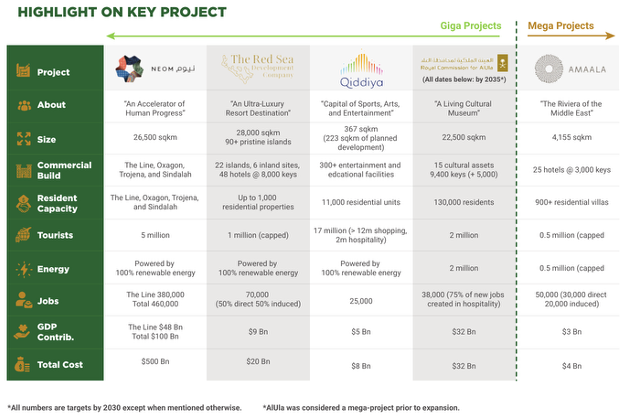
Figure 1: Highlight on Key Giga and Mega Projects (targets by 2030 unless stated otherwise). Source: The CEO Guide to KSA, Eurogroup Consulting (p. 17).
For investors, the relevant question is how each project will generate sustainable visitor activity. A luxury resort requires different distribution channels, staffing models, and service infrastructure from a large entertainment complex or heritage destination. The comparison also reinforces the importance of examining individual projects rather than treating the sector as a single investment opportunity.
What Makes AlUla Different?
Located in northwestern Saudi Arabia, AlUla covers approximately 22,561 square kilometers and contains important archaeological, historical, and natural assets. Among these is Hegra, recognized as a UNESCO World Heritage Site in 2008. The Royal Commission for AlUla (RCU) is responsible for leading the destination's development and heritage-preservation strategy.
An intergovernmental agreement signed between Saudi Arabia and France on April 10, 2018, established a framework for cooperation across cultural preservation, tourism, infrastructure, and related activities. The agreement led to collaboration involving the French Agency for the Development of AlUla (AFALULA), connecting international expertise with local development priorities.
The guide also describes a visitor composition of approximately 35% international tourists and 65% domestic and regional visitors in the research period, demonstrating the importance of developing experiences that appeal to different markets.
"We will turn AlUla into a Living Museum, creating memories that visitors will share with the world."
For investors, AlUla illustrates how tourism infrastructure can be connected with heritage management, local employment, hospitality, and specialized visitor experiences.
Hospitality Partnerships and the Challenge of Execution
International hospitality businesses can participate in Saudi tourism development through hotel management, construction, operations, and specialized services. However, projects require strong coordination between developers, operators, government institutions, and local partners.
The guide identifies Sharaan Resort in AlUla as an example of international collaboration. Designed by architect Jean Nouvel, the development involves Bouygues Construction and Saudi construction company Almabani, with a design that emphasizes integration with the surrounding landscape. This illustrates how specialist international capabilities can be combined with local delivery expertise.
Tourism infrastructure also extends beyond hotels. Museums, cultural facilities, visitor services, and destination programming influence the attractiveness and operating performance of tourism developments. Read more about this connection in Museums as Tourism Infrastructure: PPP and Operator Openings in Saudi Arabia's Cultural Build-out.
Important investment considerations include:
- Visitor demand: Evaluate target segments and realistic occupancy or attendance expectations.
- Destination positioning: Understand the experience and customer proposition of each project.
- Operating capabilities: Assess staffing, management systems, service quality, and supplier availability.
- Partnership structures: Define responsibilities between developers, owners, operators, and local stakeholders.
- Financial viability: Examine capital commitments, revenue assumptions, and implementation risks.
The CEO Guide to KSA places these considerations within Saudi Arabia's wider regulatory and investment environment. For executives, the strongest opportunities are those where destination ambitions align with a clearly defined commercial model.
For tailored support, explore our tourism consulting services or contact our team to discuss your requirements.
Frequently Asked Questions
What is Saudi Arabia's tourism target?
According to the CEO Guide to KSA, tourism accounted for about 4.45% of Saudi Arabia's GDP during the research period, and the government aims to raise this to 10% of GDP by 2030. The guide also reports plans for more than US$800 billion of tourism-related investment over the following decade, covering hospitality, attractions and infrastructure.
What is the significance of AlUla for Saudi tourism?
AlUla is a 22,561 square kilometer region in northwestern Saudi Arabia that combines archaeological heritage, natural landscapes and cultural tourism. It is home to Hegra, a UNESCO World Heritage Site since 2008, and is being developed by the Royal Commission for AlUla (RCU) as a sustainable destination that links heritage preservation with hospitality investment.
What are Saudi Arabia's major tourism giga projects?
The major tourism projects described in Eurogroup Consulting's CEO Guide are the Red Sea Project, focused on high-end coastal tourism, Qiddiya, focused on entertainment and leisure, and AlUla, focused on cultural heritage. The guide reports planned investment of more than US$10 billion for the Red Sea Project and about US$8 billion for Qiddiya by 2030.
Why is the Saudi-French partnership important for AlUla?
The intergovernmental agreement signed by Saudi Arabia and France on April 10, 2018 established cooperation on heritage conservation, tourism, culture and infrastructure in AlUla. It led to the creation of the French Agency for the Development of AlUla (AFALULA), which connects French technical and cultural expertise with the Royal Commission for AlUla's development priorities.
What opportunities exist for international hospitality companies?
Opportunities include hotel development and management, resort construction, entertainment, cultural experiences and specialized visitor services. The CEO Guide highlights Sharaan Resort in AlUla, designed by Jean Nouvel and built by Bouygues Construction with Almabani, as an example of international collaboration. Investors should assess demand, partnerships, financing and operating capabilities for each destination.
Explore Saudi Arabia's Tourism Investment Landscape
For executives assessing investment or expansion, Eurogroup Consulting's CEO Guide provides further analysis of major development initiatives, commercial conditions, and market-entry considerations.
Talk to us for your needs in:
-
Tourism Infrastructure Planning and Optimization
-
Destination Marketing and Brand Strategy
-
Tourism Workforce Development and Training
-
Sustainable Tourism Solutions
-
Visitor Experience Enhancement and Engagement
-
Tourism Project Feasibility and Strategic Planning
-
Saudi Tourism Benchmarking