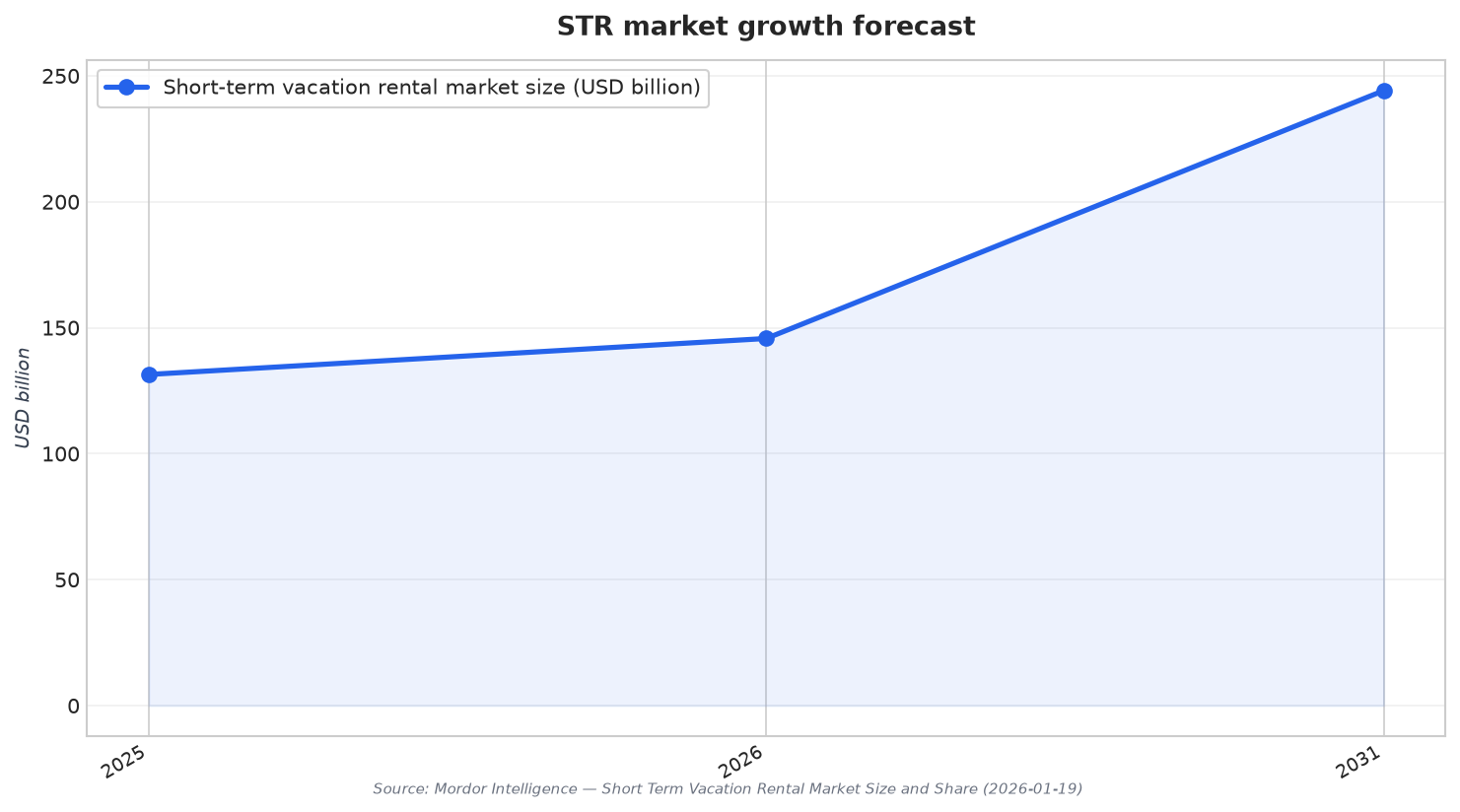
Moving from a basic permit mindset to a license-first operating model changes how investors underwrite risk and build holiday-home portfolios. That is the lens many operators apply when thinking about a private hospitality unit license in Saudi Arabia: not as a one-time formality, but as a portfolio design constraint that touches unit selection, operating processes, and platform strategy. The wider short-term vacation rental sector is expanding, which raises the stakes for doing compliance well. Mordor Intelligence expects the short-term vacation rental market to grow from USD 131.45 billion in 2025 to USD 145.73 billion in 2026, and forecasts USD 244.13 billion by 2031, at a 10.86% CAGR over 2026–2031. In that context, licensing and enforcement can become a competitive filter rather than a speed bump.
Regulation is also maturing from broad debates into operational infrastructure. SuiteOp frames 2026 as the year regulation shifted from bans to enforcement infrastructure, meaning more jurisdictions are relying on verifiable processes and platform cooperation. The same source cites examples outside Saudi Arabia that illustrate the direction of travel: the EU now requires platforms to transmit monthly per-listing data to national registries, and in the US, jurisdictions like Clark County, Nevada require platforms to verify licenses and deactivate unlicensed listings. For portfolio owners, this pushes “licenseability” to the top of acquisition and renovation checklists. It also makes documentation, repeatable check-in controls, and auditable guest verification workflows feel less optional and more like core operating capability.
Why Licensing Pressure Changes Portfolio Construction
When licensing becomes central, the best portfolio is not just the best set of addresses. It is the best set of addresses that can clear the administrative threshold with predictable time and cost. International comparisons show how high that threshold can go. In Dubai, holiday homes are regulated through a mandatory registration and permitting system overseen by the Department of Economy and Tourism (DET), and all holiday homes must be licensed and meet property standards and registration rules. One provision highlighted by HospitalityNet is especially stringent: permit approval requires the unanimous consent of all neighbors in the building, creating a high administrative threshold for legal operation. The lesson for Saudi-focused operators is structural: licensing friction can concentrate supply into assets, buildings, and operating models that are easier to keep compliant over time.
Licensing discipline also affects channel mix and the role of professional management. Mordor Intelligence reports that online travel agencies captured 64.75% of revenue in 2025 in the short-term vacation rental market, while property-manager platforms are forecast to record the highest CAGR at 14.55% through 2031. That matters because platform and manager tooling can reduce the marginal cost of staying compliant across many units. It also aligns with broader market signals of operational consolidation and scale-building: Mordor Intelligence notes Casago’s May 2025 purchase of Vacasa for USD 128.6 million, creating a 40,000-unit portfolio with unified revenue-management software and a shared housekeeping workforce. As enforcement tightens, these kinds of standardized systems can help owners treat licensing not as a unit-by-unit scramble but as a repeatable process.
Finally, licensing pressure intersects with demand patterns and product choice. Mordor Intelligence says apartments and condominiums held 47.92% of short-term vacation rental market share in 2025, while unique stays are projected to grow at 14.32% CAGR to 2031. Guest mix is also evolving: leisure travelers accounted for 44.10% of bookings in 2025, while digital nomads and remote workers expanded the fastest at 14.05% CAGR to 2031. For a holiday-home owner building around licensing realities, this supports a practical approach: choose unit types and operating setups that can meet inspection, documentation, and platform requirements, while positioning inventory for guest segments that are demonstrably expanding. In that sense, a “permit to license” shift is not only a compliance story. It is a portfolio strategy story.
What does moving from permits to licensing change for holiday-home investors in Saudi Arabia?
How fast is the short-term vacation rental market projected to grow globally?
What are examples of enforcement infrastructure that could influence licensing expectations?
What does Dubai’s holiday-home rule show about licensing thresholds?
How do distribution channels relate to a license-ready operating model?
Talk to us for your needs in:
-
Tourism Infrastructure Planning and Optimization
-
Destination Marketing and Brand Strategy
-
Tourism Workforce Development and Training
-
Sustainable Tourism Solutions
-
Visitor Experience Enhancement and Engagement
-
Tourism Project Feasibility and Strategic Planning
-
Saudi Tourism Benchmarking