Saudi travel demand is being pulled in two directions at once: expanding international connectivity and stronger, more frequent domestic flying. In 2025, Saudi airports recorded nearly 979,800 arriving and departing flights, up 8.3% versus 2024. Domestic routes accounted for 506,300 flights, while international services reached 473,500 flights, with international growth outpacing domestic expansion. Inside that environment, low-cost carriers are increasingly central to how the mid-market travels, because they make short breaks, family visits, and multi-stop itineraries easier to price and plan.
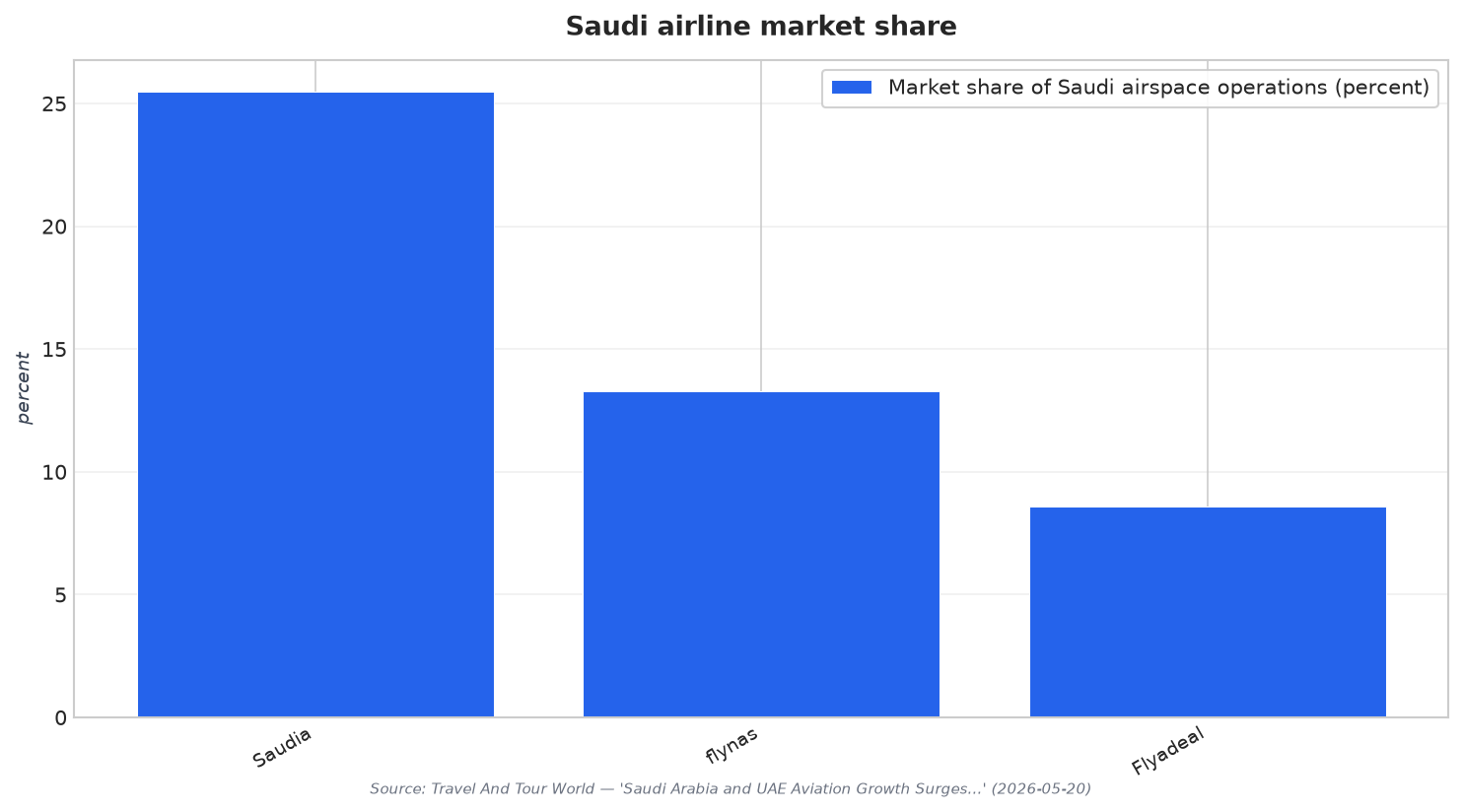
Within Saudi operations, market share figures from 2025 show how the field is splitting between full-service and low-fare options. Saudia held a 25.5% market share of Saudi airspace operations. flynas captured 13.3%, while flyadeal accounted for 8.6%. The same source links affordable ticket pricing to stimulated domestic tourism, weekend travel, religious journeys, and regional business trips. This is where the mid-market sits: travelers who are price-aware, but still need schedule choice and enough network breadth to move between major cities and secondary destinations.
flynas and flyadeal: Domestic Scale, Route Overlap, and Price Pressure
Schedule data for Summer 2026 illustrates how prominently Saudi carriers now feature in the Middle East low-cost landscape. In the region, the share of flights operated by LCCs has nearly doubled from 14% in 2016 to 27% “today,” and in 2026 the Middle East totals 403 million airline seats, split 73% mainline and 27% LCC. flynas is identified as the largest LCC with 17% of regional LCC capacity, followed by Flydubai at 16%, flyadeal at 14%, and Air Arabia at 12%. The same analysis says 79% of flyadeal’s capacity and 55% of flynas’ capacity is domestic, the two airlines compete on 53 routes, and Saudia operates on more than 37% of both their networks.
That domestic intensity matters for mid-market demand because it amplifies frequency and creates fare competition on city pairs beyond the biggest trunk routes. A separate market note describes “pricing pressure” from low-cost encroachment on secondary Saudi city pairs, where flyadeal and Air Arabia capture leisure demand with stripped-down base fares. Network growth is also visible around tourism gateways. In Madinah, flyadeal expanded from Prince Mohammad bin Abdulaziz International Airport with three new domestic routes to Jazan, Qassim, and Arar, described as strengthening regional access and supporting a tourism surge driven by religious travel and Vision 2030 reforms. The same report frames the city as shifting toward year-round demand, not only seasonal peaks.
Research on low-cost carriers and tourism dynamics reinforces why these airline changes can translate into visitor flows. A global panel study covering 2010–2022 uses international tourist arrivals (ITA) as a core demand indicator and proposes that an increase in LCC passengers is positively associated with a rise in ITA, while also influencing tourism supply such as accommodation availability. It also includes a case study on inbound tourism in Saudi Arabia. Put together with the Middle East capacity picture and Saudi market-share split, the story for low cost airlines Saudi Arabia is practical: more low-fare seats, dense domestic networks, and targeted expansions can widen the reachable tourism map and pull mid-market travelers into more frequent, multi-destination trips.
What do 2025 market shares suggest about low-cost travel in Saudi Arabia?
How domestic are flynas and flyadeal in capacity terms?
How are flyadeal’s Madinah routes linked to tourism demand?
What does research say about LCCs and international tourist arrivals?
What is the role of low-cost airlines in Saudi Arabia within the wider Middle East market?
Talk to us for your needs in:
-
Tourism Infrastructure Planning and Optimization
-
Destination Marketing and Brand Strategy
-
Tourism Workforce Development and Training
-
Sustainable Tourism Solutions
-
Visitor Experience Enhancement and Engagement
-
Tourism Project Feasibility and Strategic Planning
-
Saudi Tourism Benchmarking