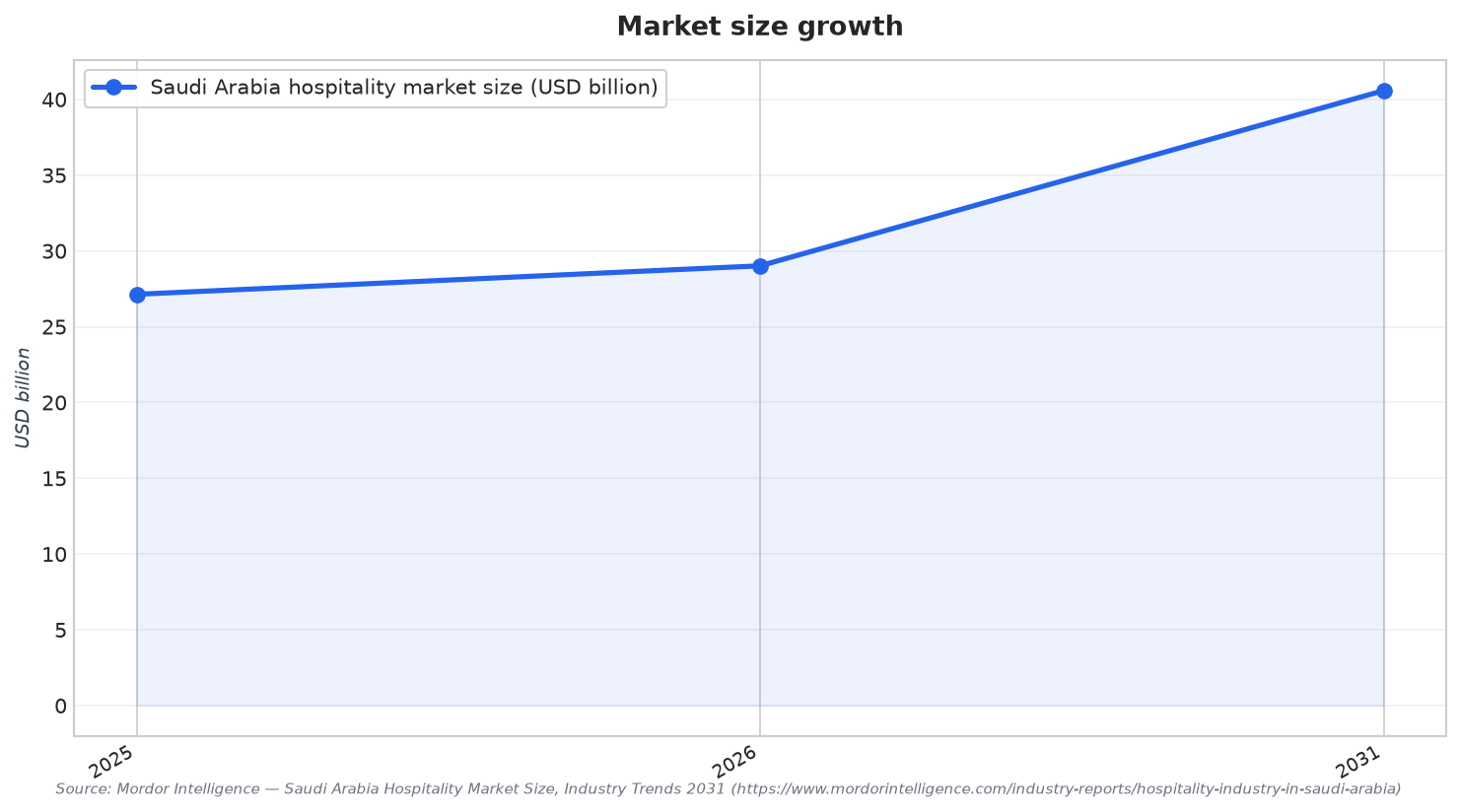
Hotel asset management in Saudi Arabia matters because performance is being pulled by multiple demand engines at once. Mordor Intelligence estimates the Saudi Arabia hospitality market at USD 29.02 billion in 2026, up from USD 27.14 billion in 2025, and projecting USD 40.58 billion by 2031 at a 6.93% CAGR (2026–2031). A practical asset-management goal is to protect pricing power while keeping the operation flexible enough for changing mix. Market structure also shapes the playbook. Chain hotels held 57.74% share in 2025, while OTAs captured 41.65% of transactions. That combination makes distribution strategy and brand standards part of the owner’s return equation, not only a marketing decision.
Start with revenue performance and demand segmentation. A 2025 market analysis reports national occupancy hovering around 60–62% over the prior 12 months, up from below 40% at the height of 2020. It also cites ADR at about USD 185–190 (approximately SAR 700). In the first half of 2025, that same source puts nationwide ADR at SAR 822 (about USD 219), up 1.9% year-on-year, with occupancy averaging 62.3%. It reports RevPAR at roughly USD 115–120, about 20% higher than the 2019 pre-pandemic average, and notes 2023 RevPAR growth “hit almost 25%.” For an owner, this data supports a disciplined rhythm: review market comp sets, then set guardrails for rate integrity, length-of-stay controls, and group displacement decisions.
Post-Opening Value Levers Owners Can Control
Distribution, product positioning, and capital planning are the levers that turn demand into owner returns. Mordor reports direct digital channels growing at a 14.78% CAGR as hoteliers invest in proprietary platforms, while OTAs still represent 41.65% of 2025 transactions. Asset managers can use that split to set measurable targets for direct mix and loyalty enrollment without ignoring OTA volume. Segment strategy also matters because growth is uneven. Luxury led with 36.92% of market size in 2025, while serviced apartments are advancing at a 12.57% CAGR through 2031. On the ground, that can translate into programming decisions, room-type strategy, and F&B concepts that match the property’s demand base rather than copying a competitor.
Geography and religious travel add another layer of operational planning. Mordor states the Makkah–Jeddah corridor held 26.62% of 2025 market size, while the Red Sea and wider western coast are set to expand at an 18.20% CAGR to 2031. It also links pilgrimage expansion to hotel demand, reporting Hajj attendance at approximately 2.1 million in 2025 and 1.71 million in 2026, with projections of about 2.3 million, and a Vision 2030 target of 30 million Hajj and Umrah pilgrims annually by 2030. Umrah pilgrims totaled 18 million in 2025 and are expected to exceed 20 million in 2026, with average spending of USD 5,400 per pilgrim. For asset managers, that means planning staffing, pricing fences, and maintenance windows around seasonality instead of reacting to it.
Finally, technology and capital markets increasingly influence post-opening performance. Grand View Research estimates the Saudi hotel and hospitality management software market at USD 96.2 million in 2025, reaching USD 231.8 million by 2033, with a 12.1% CAGR from 2026 to 2033, and says Saudi Arabia accounted for 2.3% of the global market in 2025. In parallel, the asset performance management market generated USD 544.4 million in 2025 and is expected to reach USD 1,305.8 million by 2033; Saudi Arabia accounted for 2.1% of the global market in 2025. On the investment side, one Saudi real estate M&A analysis cited in a hotel M&A report says the asset management industry reached USD 295 billion in AUM by March 2025, with real estate at 36% of allocations, and notes 24 M&A deals worth USD 689 million in Q1 2026. Together, these signals support a modern owner approach: track asset KPIs tightly, and stay ready for conversions, portfolio logic, or reinvestment that keeps the hotel competitive.
What do recent performance metrics suggest for hotel owners in Saudi Arabia after opening?
How should owners balance OTAs and direct bookings in Saudi Arabia?
Which segments are expanding that can shape a post-opening asset plan?
How does hotel asset management in Saudi Arabia account for pilgrimage demand?
What signals suggest technology is becoming more important for post-opening performance?
Talk to us for your needs in:
-
Tourism Infrastructure Planning and Optimization
-
Destination Marketing and Brand Strategy
-
Tourism Workforce Development and Training
-
Sustainable Tourism Solutions
-
Visitor Experience Enhancement and Engagement
-
Tourism Project Feasibility and Strategic Planning
-
Saudi Tourism Benchmarking