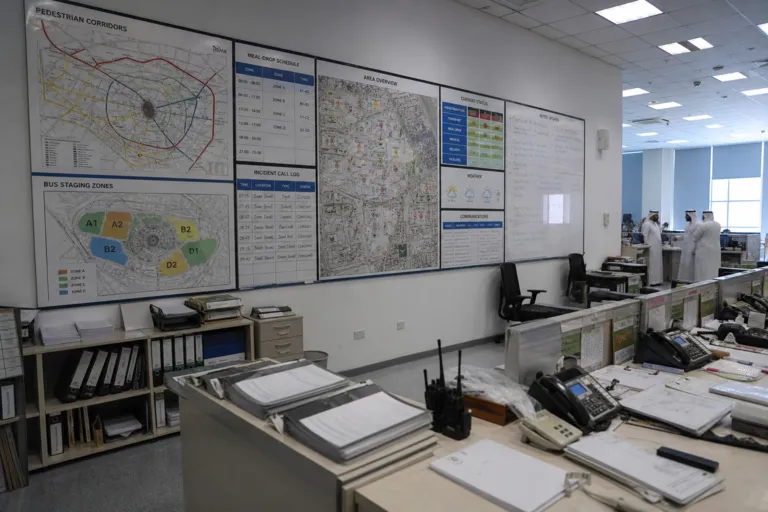
Saudi Arabia’s Hajj tourism economy is large and still expanding, and that scale makes logistics a core business. FMI projects the Saudi Arabia Hajj tourism market at USD 183.8 billion in 2025, rising to USD 368.3 billion by 2035 at a 7.2% CAGR. In that growth story, logistics is not a side function. It is the operating layer that lets accommodation, guided experiences, and welfare services work under extreme seasonal peaks. Qoyod reports that 1,707,301 pilgrims from 165 nationalities performed Hajj 1447 AH with an integrated service system that included digital visa issuance, smart crowd-flow management between holy sites, free healthcare, and a modern transport network.
Transport demand concentrates around ports of entry and the sacred sites, which creates repeatable B2B contracts for operators and suppliers. Qoyod states that 96.1% of pilgrims from abroad arrived through airports, with land and sea ports receiving the remaining guests. That pattern pushes opportunities toward airport-ground handling, dispatch, bus and fleet staging, and last-mile coordination to hotels and gathering points. Market.us adds that end-to-end pilgrimage solutions are increasingly bundled, combining flights, accommodation, and transport with digital booking and tracking tools. It also notes that tour groups dominated the “By Tourist Type” segment in 2024 with a 54.7% share, reflecting how many pilgrims prefer organized arrangements that provide safety, logistics assistance, and guided support.
Catering, Baggage Flow, and Crowd-Tech: Where Margins Can Grow
Food and catering sit inside the same peak-load reality as mobility. MarkWideResearch describes the Hajj tourism market as offering transportation, accommodation, catering, and guidance, which means catering providers can win business by integrating with schedules, movements, and package operators rather than acting as standalone vendors. NewHaj Hub highlights an operational model that separates people flow from baggage flow: on arrival in KSA, pilgrims go directly to their hotels while baggage is transported separately by specialist services, and 322,901 pilgrims used the programme in 2024. That same logic can apply to meals and supplies, too. If baggage, food, and essential items move in parallel systems, pilgrim movement becomes smoother and site congestion can be reduced.
Crowd-tech is becoming a business category, not only a public-safety tool, because it supports the service promise that packages sell. Qoyod emphasizes smart crowd-flow management and the Nusuk platform streamlining the guest journey from visa to departure. NewHaj Hub describes thermal drone networks that transmit real-time crowd density and health data to command centres, positioned as a response to the 2024 heat crisis and crowd management challenges. In parallel, Market.us points to capacity limitations and crowd management as continuing restraints, warning that logistical pressure can reduce service quality. For firms building Saudi Arabia-focused Hajj logistics services, the highest value propositions align with better movement planning, tracking, and coordination across transport, catering delivery windows, and welfare touchpoints.
Commercial upside also depends on who is traveling and how services are packaged. FMI expects international pilgrims to account for a 58.9% share of tour type demand in 2025, and projects men at 52.3% of consumer orientation demand in 2025, while NewHaj Hub notes women now represent 47.7% of Hajj pilgrims, tied to visa-rule changes in several origin markets. For operators, these shifts reinforce the need for multilingual support and service designs that work across demographics and group formats. Market.us highlights how margin expansion may depend on cross-selling value-added services such as guided experiences and premium tiers, and notes that Avis Saudi Arabia plays a niche but growing role for higher-income and corporate-sponsored pilgrims seeking flexible mobility beyond group buses.
What is driving demand for Hajj logistics services in Saudi Arabia?
Where do the biggest transport pressure points appear during Hajj seasons?
How important are organized tour groups for logistics providers?
What is the “separate baggage transport” opportunity mentioned in recent Hajj operations?
Which technologies are being used to support crowd and safety management?
Talk to us for your needs in:
-
Tourism Infrastructure Planning and Optimization
-
Destination Marketing and Brand Strategy
-
Tourism Workforce Development and Training
-
Sustainable Tourism Solutions
-
Visitor Experience Enhancement and Engagement
-
Tourism Project Feasibility and Strategic Planning
-
Saudi Tourism Benchmarking