Saudi Arabia’s room race is happening in plain sight. Mordor Intelligence tracks a pipeline of 316 hospitality projects with 83,275 rooms currently under construction, a volume that can create near-term rate-compression challenges even as demand stays active. Against that backdrop, modular hotel construction in Saudi Arabia is increasingly positioned as a practical delivery tool, not a design trend. The wider construction market context matters too: Mordor Intelligence values the Saudi Arabia construction market at USD 78.60 billion in 2025, rising to USD 82.80 billion in 2026, with a forecast to reach USD 101.83 billion by 2031. As sites fill up with parallel work packages, speed and predictability become competitive advantages.
Offsite construction is also being pulled forward by structural constraints described in the sources: traditional bottlenecks tied to cost, time, and skilled labor availability. Mordor Intelligence reports that conventional on-site work accounted for 90.92% of Saudi Arabia’s 2025 construction value, while modern construction methods are expanding at a 5.53% CAGR over 2026–2031. In housing, the same shift is visible. Annual demand is kept “around 300,000 units,” and that pressure pushes developers toward off-site construction to avoid site-capacity bottlenecks. In the residential segment, conventional on-site work retained 87.1% of 2025 share, but modern modular systems are expected to post a 6.55% CAGR over 2026–2031. Hospitality developers are reacting to the same on-the-ground realities: crowded sites, tight windows, and the need to open on time.
Why Gigaproject Schedules Make Offsite Hotels More Attractive
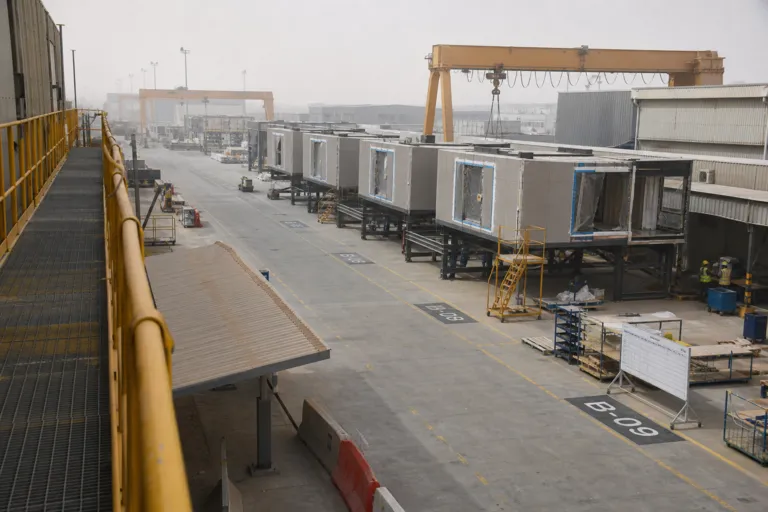
Vision 2030 giga- and mega-projects anchor multi-year pipelines, and they are already tied to modular hotel delivery in specific awards. Mordor Intelligence notes that Red Sea Global awarded USD 3.9 billion in early 2026 for 16 island resorts that use modular hotel blocks to safeguard reef ecosystems. That example frames modular as both a scheduling and site-impact strategy. More broadly, MarkWide Research describes a “modular and prefabrication convergence,” where offsite manufacturing integrated with digital twin modeling compresses project timelines for repetitive housing and hospitality typologies. In other words, hotels with repeatable room stacks and standardized back-of-house zones can align more easily with factory-style output, then move to faster assembly on constrained sites.
Demand signals around religious tourism add another layer of urgency. Mordor Intelligence’s prefabricated buildings report states that Umrah pilgrim arrivals jumped 58% year-on-year to 13.5 million in 2023, and that the government targets 36 million by 2030. The same source links this trajectory to a need for 320,000–362,000 new hotel rooms valued at USD 110 billion. For developers and operators, that scale makes schedule control a strategic issue, not just a project-management preference. In parallel, Mordor Intelligence values the Saudi Arabia hospitality market at USD 29.02 billion in 2026 and forecasts growth to USD 40.58 billion by 2031, while noting chain hotels held 57.74% share in 2025 and are projected to advance at an 11.62% CAGR through 2031. Large brands racing for flagship locations can benefit from standardized, multi-site delivery playbooks.
The modular supply base is expanding alongside this demand. Mordor Intelligence expects the Saudi Arabia prefabricated buildings market to reach USD 2.30 billion in 2025 and grow at a 9% CAGR to USD 3.5 billion by 2030. In that market, modular buildings held a 41% share in 2024 and are projected to grow at a 9.80% CAGR between 2025 and 2030. IndexBox also characterizes Saudi Arabia’s modular buildings segment as shifting from temporary facilities to mainstream methodology, spanning permanent, multi-story uses including hotels. The implication for hotel owners is clear: as offsite capacity grows and methods mature, more projects can treat modular not as an exception, but as a baseline option for cutting time, controlling interfaces, and reducing on-site labor intensity.
How big is Saudi Arabia’s current hotel development pipeline?
What evidence links modular delivery to major resort projects in Saudi Arabia?
What visitor numbers are driving urgency for new hotel rooms?
How fast is the prefabricated buildings market growing in Saudi Arabia?
Why is modular hotel construction in Saudi Arabia gaining momentum now?
Talk to us for your needs in:
-
Tourism Infrastructure Planning and Optimization
-
Destination Marketing and Brand Strategy
-
Tourism Workforce Development and Training
-
Sustainable Tourism Solutions
-
Visitor Experience Enhancement and Engagement
-
Tourism Project Feasibility and Strategic Planning
-
Saudi Tourism Benchmarking