Permits and approvals are now a core development risk for hotels in Saudi Arabia because demand is national and policy-led. Vision 2030 targets 150 million domestic and inbound visitors by 2030, after surpassing an earlier 100 million visitor goal ahead of schedule. The Saudi Tourism Authority also frames the strategy around a 10% tourism contribution to GDP and 1.6 million job opportunities by 2030. In parallel, the market already operates approximately 340,000 classified hotel keys, and meeting the same visitor target has been described as requiring an estimated 500,000 to 550,000 additional keys. That scale makes the approval pathway a practical constraint, not paperwork.
Step 1 is to anchor the project in the tourism regulator’s framework. The Ministry of Tourism is the core regulator for tourism accommodation, and the Tourism Law defines tourist accommodation facilities as places that provide accommodation for a fee on a permanent or temporary basis. It also requires a license or permit from the Ministry before engaging in tourism activity. In practice, developers should treat this requirement as the first gating item for positioning, operating model, and documentation readiness, because it determines whether the asset can legally provide paid tourist accommodation services once built and fitted out.
Step-by-step Permit Sequencing Developers Should Plan Around
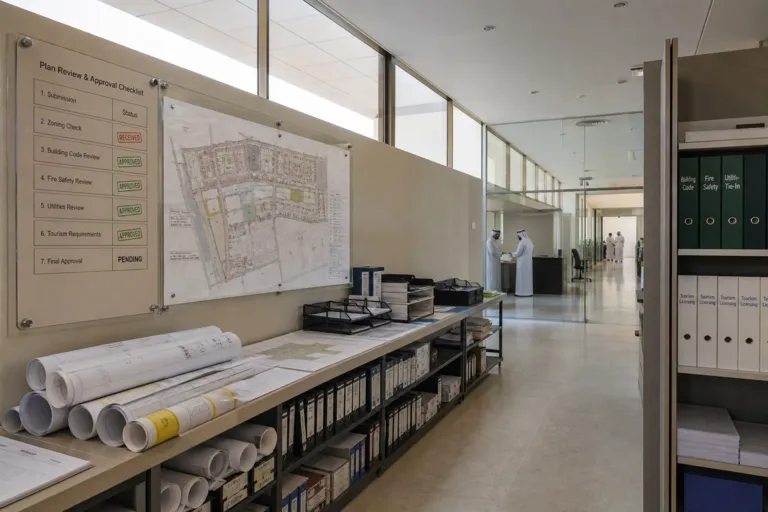
Step 2 is to build the approval plan around building-code compliance and permit conditions that shape design choices. Market guidance on construction quality points to the Saudi Building Code being enforced by the Ministry of Municipal and Rural Affairs and Housing. It also notes that Saudi Green Building Forum certification mandates are tightening thermal performance requirements for new approvals, including the need to specify low-emissivity glazing and high-efficiency district cooling interfaces to secure building permits. For a hotel building permit in Saudi Arabia, this means the permitting package is not separate from the specification set; compliance items should be locked early so the authority review does not push redesign late in the schedule.
Step 3 is to align permitting tempo with destination-specific delivery models. Some developments use mechanisms designed to accelerate approvals. For example, a December 2025 fast-track zoning pact for New Murabba is described as compressing permitting by 18 months and embedding 30% energy-reduction targets. Special-economic-zone models are also described as accelerating approvals, but the same source cautions that scale can crowd out private developers that lack similar land pipelines and utility tie-ins. The takeaway is simple: understand whether your site sits inside a fast-track framework, and if it does not, assume more conservative timelines and stronger documentation discipline.
Step 4 is to connect approvals to financing and demand realities so lenders and partners can underwrite execution. The Tourism Development Fund is described as being established with SAR 15 billion in capital to provide financing, credit enhancement, and co-investment support for hospitality development projects. Demand drivers are also visible in religious tourism capacity management: a Ministry of Tourism online portal enabled the temporary addition of 566,000 beds for Hajj 2025. At the same time, large-scale pipelines exist, including 8,000 hotel rooms across 16 resorts enabled by Red Sea Phase 1 infrastructure finished in 2024 and USD 2.1 billion in luxury-hotel contracts awarded by Diriyah in 2024. Developers who can show a clean permitting path can better translate this demand into bankable schedules.
What is the first legal step before operating a new hotel in Saudi Arabia?
Which requirements can affect a hotel building permit in Saudi Arabia at the specification level?
Are there examples of initiatives that can speed up permitting timelines?
What figures show why approvals matter for hotel delivery scale?
Talk to us for your needs in:
-
Tourism Infrastructure Planning and Optimization
-
Destination Marketing and Brand Strategy
-
Tourism Workforce Development and Training
-
Sustainable Tourism Solutions
-
Visitor Experience Enhancement and Engagement
-
Tourism Project Feasibility and Strategic Planning
-
Saudi Tourism Benchmarking