Saudi Arabia’s travel momentum is now paired with a strong technology story. WTTC data cited by Hospitality Net says Middle East travel and tourism GDP reached $385.8 billion in 2025, with Saudi Arabia leading the region at $178 billion. That scale matters because it raises the stakes for the digital layer that sits on top of travel demand. In Saudi Arabia, tourism and hospitality are tied to Vision 2030 execution, where digital transformation and AI are positioned as practical tools for competitiveness. The result is a market where booking journeys, on-property operations, and destination management are being redesigned around data, automation, and better visitor experiences.
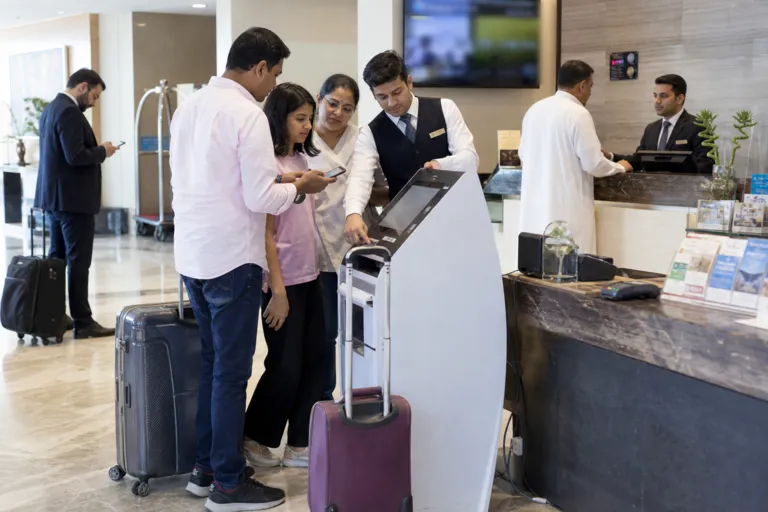
Booking is one of the clearest battlegrounds for saudi tourism technology. SiteMinder data cited by Hospitality Net shows direct bookings generate 60% higher revenue per reservation than OTAs. The same source notes BookBetterDirect found direct rates beat OTA rates in 59% of cases. These numbers explain why hotels care about owning the guest relationship, not just filling rooms. Hospitality Net also links this to the “unified PMS” idea. A fragmented stack creates fragmented data. That limits targeted retention and personalization. As agentic AI enters the booking layer, clean and unified data becomes a prerequisite for capturing more direct demand.
AI Booking Platforms and Always-On Service
On the platform side, AI is moving from experimentation to necessity, according to a PwC Middle East co-branded report covered by Hospitality Net in January 2026. In corporate and business travel, one example is Almosafer’s ChatGPT integration, described as reducing search time by 40% while delivering personalized flight, hotel, and itinerary recommendations based on traveler preferences and corporate policies. The same source describes AI chatbots providing 24/7 multilingual support in Arabic and English, reducing call center workload by 45%. It also cites machine learning that cuts expense report processing time by 60%, and predictive pricing approaches that can help corporations save 15–25% on travel costs.
AI also changes how travelers discover options. Newsweek reports that as AI becomes a starting point for travel planning, visibility inside AI-generated recommendations becomes a gatekeeper. The article argues that properties win when they make it easy for AI to match them to a traveler’s request, supported by trusted signals like strong reviews, clear policies, and consistent information across channels. This connects back to the operational reality described in Hospitality Net: if data is inconsistent across systems, AI-driven discovery and booking will be harder to win. For Saudi operators, this means distribution strategy now includes “AI legibility,” not only OTA rankings.
Investment signals are also evolving. Skift reports that Saudi Arabia is scaling back Public Investment Fund financing for large-scale tourism projects like Neom and the Red Sea Destination, while prioritizing investments in AI infrastructure and AI companies. In the same update, future tourism investment is expected to involve more private sector participation, even as the Kingdom focuses on proven demand drivers like aviation infrastructure and major events. This rebalancing sits alongside wider sector narratives. Consultancy-me reports tourism contributed 12.4% of Saudi Arabia’s GDP in 2024, while another Consultancy-me piece frames the region’s direction as building smart, connected, AI-enabled tourism ecosystems that can support a fully digital and integrated visitor experience.
What does “saudi tourism technology” mean in practice?
Why are direct bookings a focus for hotels in Saudi Arabia and the region?
What AI improvements are being reported in booking and service workflows?
How are Saudi tourism investments shifting in Vision 2030 updates?
Talk to us for your needs in:
-
Tourism Infrastructure Planning and Optimization
-
Destination Marketing and Brand Strategy
-
Tourism Workforce Development and Training
-
Sustainable Tourism Solutions
-
Visitor Experience Enhancement and Engagement
-
Tourism Project Feasibility and Strategic Planning
-
Saudi Tourism Benchmarking