Saudization in 2026 is expanding across fields in Saudi Arabia, including tourism and hospitality. Some roles are fully reserved for Saudi nationals. Other roles are covered by higher localization quotas set by the Ministry of Human Resources and Social Development (HRSD). For employers in the saudization hospitality sector, the practical task is to map jobs, plan staffing, and meet deadlines without disrupting guest operations.
Two changes matter immediately for front-of-house teams. HRSD added 69 administrative support professions that will be Saudized 100%, effective 5 April 2026, with a phased approach. In Phase 1, 19 professions became Saudi-only immediately on 5 April 2026, including “Hotel Receptionist”. In Phase 2, the remaining 50 professions have a six-month grace period, with a compliance deadline of 4 October 2026.
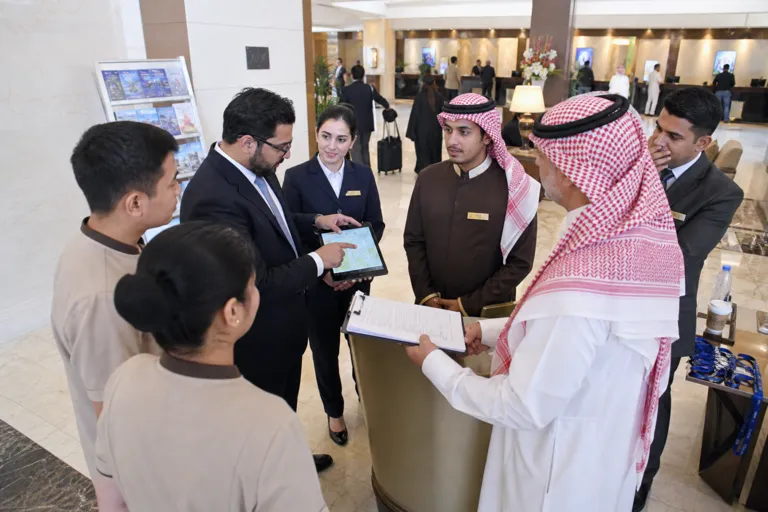
Tourism policy also tightens workplace expectations inside hospitality venues. A Ministry of Tourism policy increases the general Saudisation quota for tourism business activities using a phased approach. It also mandates that hospitality establishments have a Saudi receptionist present during working hours. The policy aims to increase direct employment of Saudi nationals in tourism establishments, while recognizing employers still need flexibility, especially in hospitality where demand fluctuates.
Support Programs and What the Numbers Say
To help employers hire and retain Saudi talent, Saudi Arabia expanded wage subsidies for tourism-related jobs. On 25 May 2025, the Human Resources Development Fund (HADAF) and the Ministry of Tourism announced an expanded initiative covering 63 eligible tourism-related occupations. The updated subsidy covers up to 50% of Saudi workers’ salaries in these roles, and it applies to full-time and part-time Saudi workers. Subsidies can run for up to 24 months, contingent on continued employment and compliance with Saudization targets.
Recent workforce data highlights why compliance planning is now operationally critical. In Q4 FY 2023-24, tourism employment reached 966,531 workers, including 242,073 Saudi nationals (25%) and 724,458 foreign workers, according to the General Authority for Statistics (GASTAT). This mix means hotels, restaurants, and tourism service providers may need structured transitions, especially in roles moving to 100% Saudization and in reception coverage requirements.
For implementation, many companies align actions to Saudization enforcement frameworks such as Nitaqat. Nitaqat links company classification to quota compliance. A practical 2026 playbook for the saudization hospitality sector is simple: confirm which job titles map to Saudi-only roles, schedule replacements before 4 October 2026 where a grace period applies, and build Saudi front-desk coverage into shift rosters. Employers can also evaluate whether eligible tourism roles qualify for HADAF wage subsidies, since the program covers up to 50% of salaries for 63 tourism-related occupations for up to 24 months.
What does “saudization hospitality sector” mean in 2026?
Which hospitality role became 100% Saudi-only in April 2026?
What is the Phase 2 Saudization deadline mentioned for administrative support roles?
Are there wage subsidies that can support Saudization in tourism jobs?
What do recent tourism workforce numbers show about reliance on foreign workers?
Talk to us for your needs in:
-
Tourism Infrastructure Planning and Optimization
-
Destination Marketing and Brand Strategy
-
Tourism Workforce Development and Training
-
Sustainable Tourism Solutions
-
Visitor Experience Enhancement and Engagement
-
Tourism Project Feasibility and Strategic Planning
-
Saudi Tourism Benchmarking