Saudi Arabia’s Ministry of Tourism is proposing mandatory minimum staffing levels for hotels and other tourist accommodation, with employee numbers tied to room count and classification. The scheme, released for public consultation as “Minimum Staffing Requirements for Tourist Hospitality Facilities,” is positioned as a way to ensure sufficient staffing, improve service quality, and boost operational efficiency as tourism expands. For operators, the immediate question is not only recruitment. It is payroll modelling: how fixed staffing floors could change cost structures, especially for properties that have relied on leaner staffing approaches.
The highest proposed threshold targets luxury five-star hotels, hotel villas, hotel apartments, and resorts, which would be required to maintain three employees per room. Other five-star establishments would need four employees for every five rooms, while four-star properties would require three employees per five rooms. The ratios step down by classification: three-star facilities would need two employees per five rooms, two-star one employee per five rooms, and one-star and unclassified facilities at least one employee for every 10 rooms. The draft also covers other accommodation types, including heritage hotels at three employees per five rooms and hostels at one employee per 10 rooms.
How to Model Payroll Under the Draft Ratios
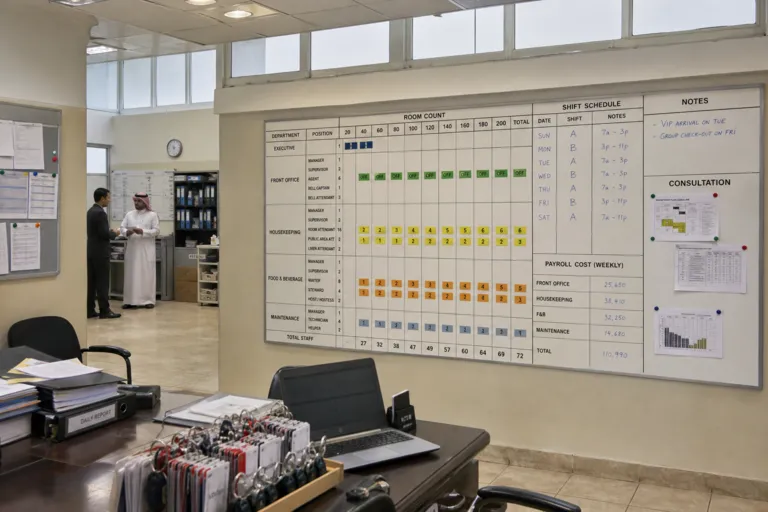
To translate the proposed hotel staffing ratio Saudi Arabia is consulting on into payroll planning, start with the property’s licensed classification and room count, then apply the minimum ratio as a headcount floor that must be maintained throughout the year. Because the framework is ratio-based, it creates a predictable staffing baseline, but it can also introduce discontinuities for properties near room-count thresholds implied by “per five rooms” rules. The draft also specifies how staffing may be counted: employees hired directly and workers employed through affiliated operating companies via the Ajeer platform can be included, and the ministry would use Ministry of Human Resources and Social Development data to verify staffing.
Compliance timing affects cash planning as much as workforce planning. Existing licensed businesses would have up to 180 days to comply after the regulations take effect, while establishments upgraded to a higher classification would have up to 90 days to meet the new threshold. Operators would also be required to update employee records within three months of workforce changes. Monitoring and penalties are scheduled to begin on January 1, 2027, with violations subject to penalties under Saudi Arabia’s Tourism Law and its executive regulations, according to the proposal.
The staffing consultation lands amid a tourism growth narrative that also informs staffing demand assumptions. One report cites the Ministry of Tourism’s latest statistical report projecting around 123 million domestic and international tourists in 2025, an increase of nearly 6% compared with the previous year, with tourism spending projected to reach SR304 billion (approximately US$81.1 billion). Another analysis notes Saudi Arabia welcomed 29.3 million inbound tourists in 2025, down 1.6% year on year, and that inbound arrivals fell 13% in the first quarter of 2026 even as domestic trips grew. Against that mixed backdrop, the draft ratios would formalize staffing expectations—and could raise operating costs for properties that are not already structured around these minimums.
What is Saudi Arabia proposing for hotel minimum staffing ratios?
Which hotel classes face the largest staffing requirement in the draft?
When would enforcement and penalties start under the proposal?
How would staffing be verified and counted for compliance?
How should operators model payroll impacts from Saudi Arabia’s hotel staffing ratio rules?
Talk to us for your needs in:
-
Tourism Infrastructure Planning and Optimization
-
Destination Marketing and Brand Strategy
-
Tourism Workforce Development and Training
-
Sustainable Tourism Solutions
-
Visitor Experience Enhancement and Engagement
-
Tourism Project Feasibility and Strategic Planning
-
Saudi Tourism Benchmarking