
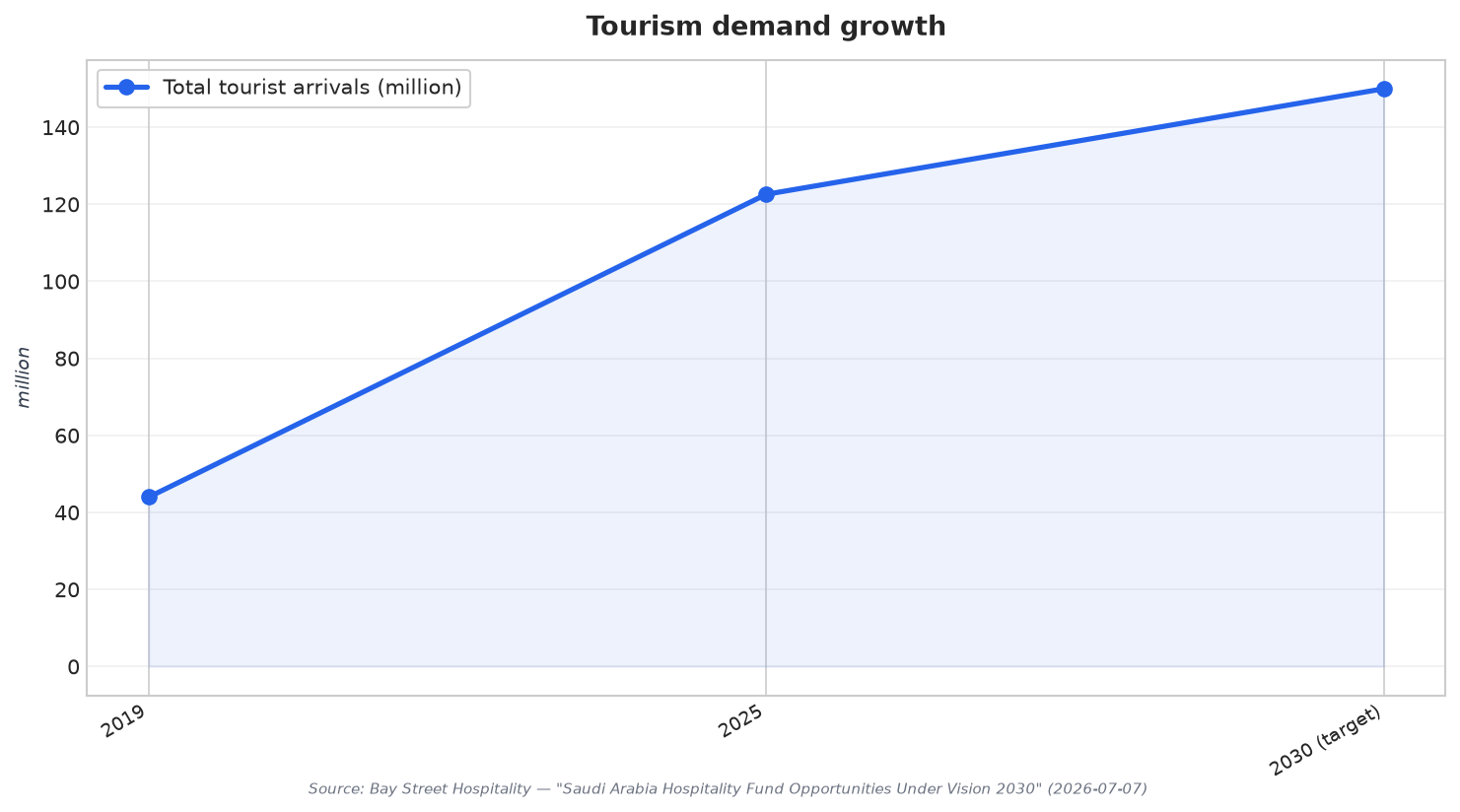
A well-structured hospitality joint venture saudi arabia strategy starts with a clear commercial rationale and a governance design that matches how projects are procured and executed in the Kingdom. Joint ventures are described as a strategically effective entry mechanism for international investors, especially where foreign technical expertise pairs with local market access and cultural fluency. MISA data cited in a Vision 2030 investment guide indicates that joint ventures represent approximately 35% to 40% of foreign investment structures in Saudi Arabia, with aggregate value exceeding SAR 400 billion across over 2,500 licensed entities. For hospitality, the demand backdrop matters, too: Saudi Arabia recorded 122.6 million total tourist arrivals in 2025, including 29.3 million international visitors generating SAR 176.6 billion in inbound spending, while total tourism spending reached SAR 304 billion in 2025 (+7% YoY).
Before documents, partners should agree what the JV is meant to deliver and what each side contributes. One legal guide describes a JV as pooling resources such as expertise, money, or skill to achieve a specific commercial objective, while each party maintains its identity. This framing is useful in hospitality where one partner may bring brand systems and technical know-how, and the Saudi partner may bring local networks and regulatory insight. Structuring choices also matter early: Legalmondo notes that JVs commonly take either an incorporated form (a separate legal entity) or a contractual form (cooperation under a contract without forming a new entity). The setup path commonly includes drafting a JV agreement, selecting a corporate form (often an LLC), obtaining an investment license from MISA, registering with the Ministry of Commerce for a Commercial Registration, and then securing any sector-specific operational licenses.
Governance and Equity: Control Without Deadlock
Governance should be written to avoid stalemate and to make accountability easy to enforce. The sources emphasize defining decision-making powers, profit distribution, and dispute resolution mechanisms in the JV agreement. For LLC governance, Legalmondo notes that at least one manager must be appointed by the partners, and the manager’s powers and term are set out in the articles of association or by separate resolution. Equity and control can be separated when needed: a case study from Ghalib Consulting proposed a 50.1% (Saudi) / 49.9% (foreign) model, balanced by a “golden share” for the foreign partner on critical IP and technology decisions, and highlights common friction points such as disagreement over 51/49 versus 50/50, governance deadlock on board composition and veto rights, and ambiguity around day-to-day management authority. In hospitality, similar mechanics can be used to protect brand standards, systems, or know-how, while still aligning with a locally led operating model.
Tax and investor economics can shift depending on whether the JV is “mixed” between foreign and Saudi/GCC partners. Legalmondo states that, in a mixed JV, foreign investors are generally subject to corporate income tax at 20% on net adjusted profits (total revenue minus allowable deductions), while Saudi and other GCC partners are subject to Zakat at 2.5% of the Zakat base, broadly defined as total sources of funding (such as equity and long-term loans) minus fixed assets. Cross-border structuring can also intersect with treaty terms in specific cases: Bay Street Hospitality notes that, for a Singapore-domiciled fund, the Singapore–Saudi Arabia DTA provides 5% withholding tax on dividends and interest. At the market level, the same source cites giga-project contract awards jumping 20% to USD 196 billion in 2025, and a PIF hotel pipeline of USD 3.6 billion across approximately 3,300 keys, which underscores why JV terms often need to handle phased capital calls, procurement timing, and project delivery risk.
Exit terms should be negotiated as seriously as entry terms, because ambiguity becomes leverage during stress. One Saudi JV setup guide explicitly calls for outlining clear withdrawal, buy-out, or termination terms, and the Ghalib case study flags missing share transfer mechanics, drag-along and tag-along rights, and unclear dispute resolution as practical failure points. On enforceability and cross-border comfort, Legalmondo notes that parties are generally free to choose a foreign governing law for the joint venture agreement and to submit disputes to international arbitration, with common seats including London, Paris, Dubai, or Singapore. In hospitality, this can be paired with defined “reserved matters,” step-in rights tied to operational underperformance, and a roadmap for how a partner can exit once the asset stabilizes or once a development phase completes.
Why use a hospitality joint venture in Saudi Arabia instead of going solo?
What steps are commonly involved in setting up a JV in Saudi Arabia?
How can partners avoid governance deadlock in a Saudi JV?
What tax differences can apply in a mixed JV with foreign and Saudi/GCC partners?
What dispute resolution approach is common for cross-border JVs with Saudi partners?
Talk to us for your needs in:
-
Tourism Infrastructure Planning and Optimization
-
Destination Marketing and Brand Strategy
-
Tourism Workforce Development and Training
-
Sustainable Tourism Solutions
-
Visitor Experience Enhancement and Engagement
-
Tourism Project Feasibility and Strategic Planning
-
Saudi Tourism Benchmarking