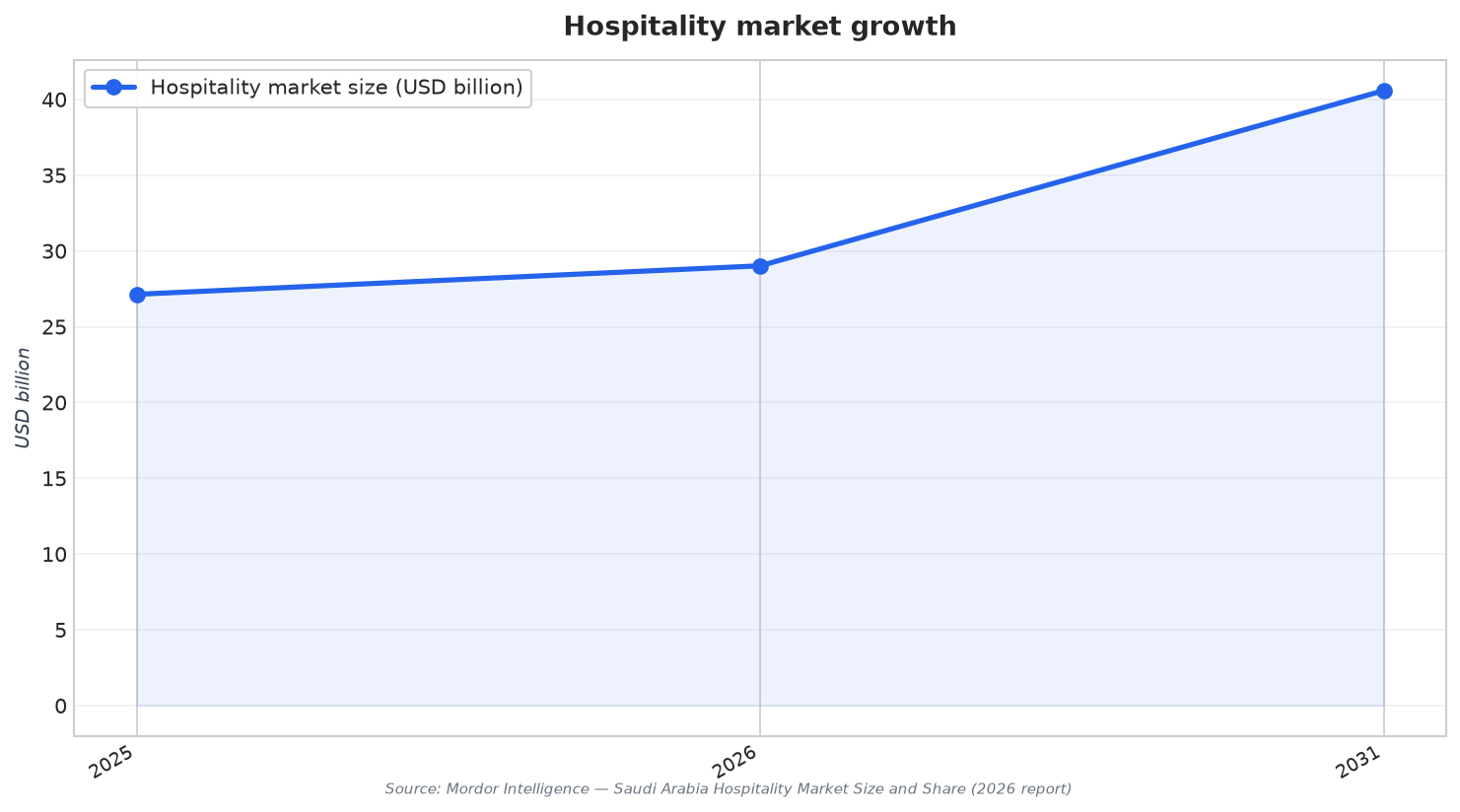
Tourism-led hotel M&A in Saudi Arabia is expanding alongside a hospitality market that Mordor Intelligence estimates at USD 29.02 billion in 2026, up from USD 27.14 billion in 2025, with a projection of USD 40.58 billion by 2031 (6.93% CAGR for 2026–2031). Tourist momentum provides context for underwriting. Total tourist trips (domestic and international) reached 115.9 million in 2024, and Saudi Arabia surpassed 122.6 million tourist arrivals in 2025, including 29.3 million international visitors. Start due diligence by mapping the asset to demand drivers. For example, the Makkah–Jeddah corridor held 26.62% of market size in 2025, while the Red Sea and wider western coast are expected to expand at an 18.20% CAGR to 2031.
Next, pressure-test supply risk and segmentation fit before you overpay. One source describes a pipeline totaling 362,000 keys by 2030 versus an existing base of approximately 167,500, with 78% of the pipeline concentrated in luxury, upper-upscale, and upscale segments. That makes class-mix diligence practical, not academic. Mordor Intelligence also reports that chain hotels commanded 57.74% of market share in 2025, and that the luxury segment led with 36.92% of market size in 2025. For distribution, OTAs captured 41.65% of transactions in 2025, while direct digital channels are growing at a 14.78% CAGR. Validate channel mix, brand terms, and whether the property can compete as supply expands.
Due Diligence Checklist: Legal, Tax, and Operating Reality Checks
For tourism investment due diligence in Saudi Arabia, legal and regulatory verification should run in parallel with commercial work. Confirm the foreign investor position and licensing route, including MISA Investment Registration License scope matching actual activities. One checklist highlights timing obligations: quarterly financial disclosures filed within 14 days, annual updates within 60 days, and capital deposit completed within 90 days of approval; it warns failures can result in license suspension. Validate Commercial Register status with the Ministry of Commerce and check sector restrictions and foreign ownership rules, including whether Screening Committee approval applies. Where the thesis relies on pilgrimage markets, flag structure constraints cited by one source: non-GCC foreign investors cannot own real estate in Makkah or Madinah without a local GCC partner or indirect structure.
Tax and financial diligence should be built around what can break a post-close model. One market-entry checklist states foreign-owned entities must comply with 20% corporate income tax or Zakat registration depending on ownership structure, plus VAT registration and ZATCA e-invoicing requirements. It also recommends confirming eligibility for double tax treaty benefits using valid tax residency certificates; separately, one source notes the Singapore–Saudi Arabia DTA provides 5% WHT on dividends, 5% on interest, and 8% on royalties for Singapore beneficial owners. On the numbers, follow a standard M&A approach: review audited financial statements, revenue trends, operating expenses, cash flow, debt obligations, working capital, and forecasts, and verify revenue sustainability rather than relying on reported profits alone.
Finally, audit operational resilience against demand spikes and seasonality, especially on pilgrimage-linked assets. Mordor Intelligence notes Hajj attendance reached approximately 2.1 million in 2025 and stood at 1.71 million in 2026, with projections of about 2.3 million, while Umrah pilgrims totalled 18 million in 2025 and are expected to exceed 20 million in 2026. It also cites average spending of USD 5,400 per pilgrim and religious tourism generating about USD 30 billion in 2025, projected to reach about USD 34 billion in 2026. On capacity readiness, the Ministry of Tourism online portal enabled the temporary addition of 566,000 beds for Hajj 2025. These figures should flow into diligence questions on staffing plans, vendor contracts, rate strategy, and peak-period controls. In the background, broader deal activity matters: Arab News (citing Ansarada) reports 24 M&A deals worth $689 million in Q1 2026, a 4% annual increase in deal volume.
How do you scope tourism investment due diligence in Saudi Arabia for a hotel acquisition?
Which demand indicators matter most for Makkah- and Madinah-linked hospitality deals?
What are the key licensing timing checks mentioned for investors entering Saudi Arabia?
What transaction channel mix should buyers validate during hotel due diligence?
Talk to us for your needs in:
-
Tourism Infrastructure Planning and Optimization
-
Destination Marketing and Brand Strategy
-
Tourism Workforce Development and Training
-
Sustainable Tourism Solutions
-
Visitor Experience Enhancement and Engagement
-
Tourism Project Feasibility and Strategic Planning
-
Saudi Tourism Benchmarking