Doing a tourism economic impact assessment in Saudi Arabia starts with a simple discipline: define what “delivered” means, then measure it consistently across years, places, and visitor types. Vision 2030 tourism tracking already gives a national scoreboard. The original target of 100 million annual visits by 2030 was met in 2023, six years early, and the goal was revised to 150 million by 2030, split into 80 million domestic and 70 million international. The same trackers report approximately 109 million visits in 2023, 116 million in 2024, and 122–123 million in 2025. For 2025, total tourism spending is cited at roughly SAR 300 billion, creating a clear anchor for national-level impact narratives.
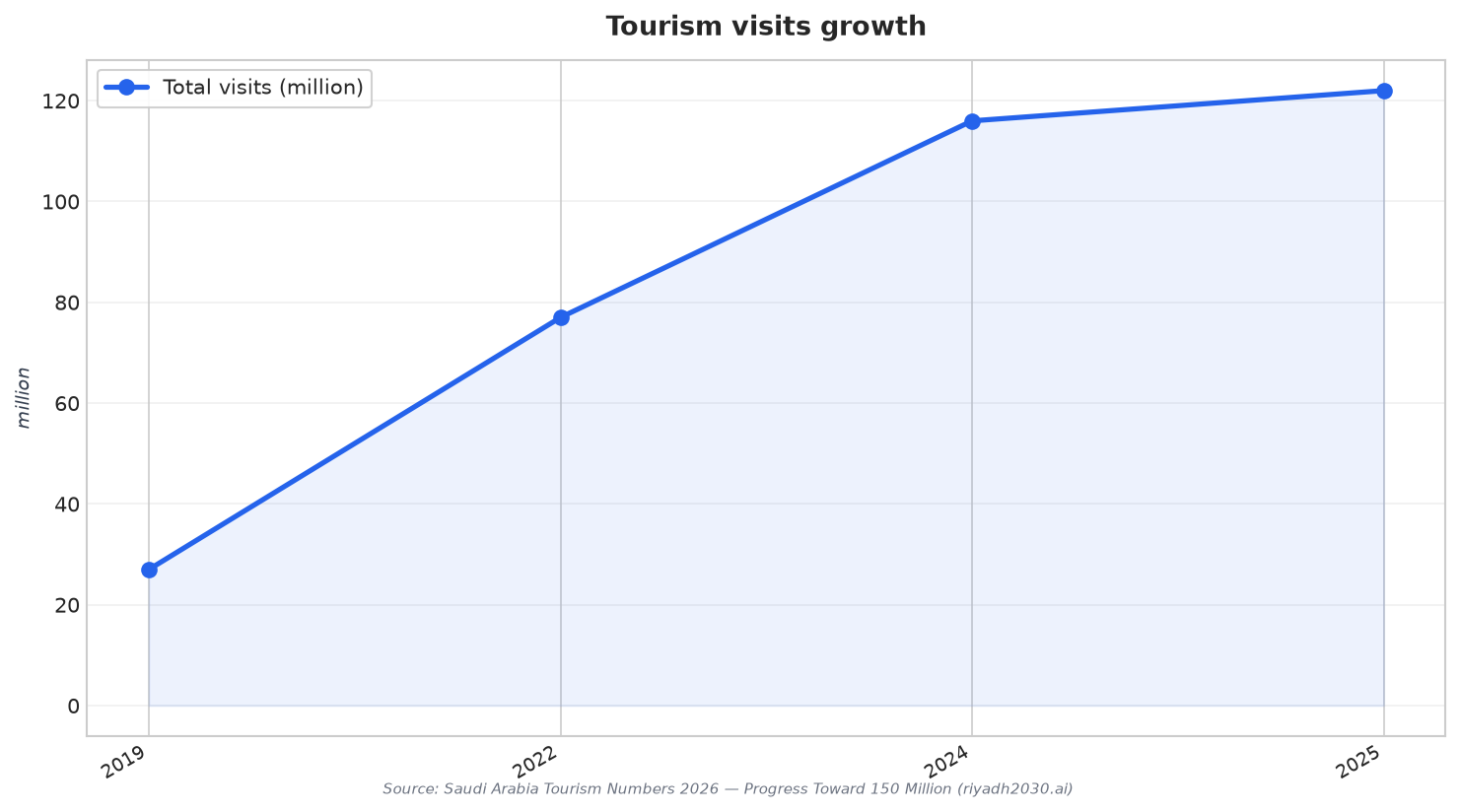
Project and event assessments must also address composition, because “total visits” can mix categories that are not comparable to standard “tourist arrivals.” Saudi analysis notes that the metric includes religious travel such as Hajj and Umrah, alongside demand linked to Riyadh Season and other programming. In 2024, reporting separates 29.7 million international visitors (an 8% year-on-year increase) from 86.2 million domestic trips (a 5% increase), while also stating a record 30 million foreign tourists. For 2025, the same intelligence summary points to Q1 international arrivals growing 15% and visitor spending surging over 20% versus Q1 2024, with European arrivals up 14% and East Asia Pacific arrivals up 15% in the first nine months. An impact study should therefore publish results by segment, not only as a blended total.
A Practical KPI Stack for Destinations and Events
For Saudi destinations and events, a useful KPI stack links demand, capacity, and delivery constraints. On demand, assess incremental visits, length of stay proxies where available, and spending, then compare to a pre-event or pre-project baseline. On capacity, connect results to the enabling system that turns marketing into arrivals. Vision 2030 tourism reporting notes the Saudi Tourism Authority operates sixteen international offices. It also cites an e-visa serving over 60 nationalities and an e-stopover visa enabling 96-hour transit visits from 18 source markets. Air connectivity is flagged as a constraint, with references to Saudia, flynas, the new Riyadh Air carrier, and direct routes from Beijing, Shanghai, Mumbai, London, and Frankfurt. In practice, an assessment should document which of these levers applied to the specific destination or event being evaluated.
Hospitality data helps convert visitation into local economic signals, while keeping the geographic scope explicit. Mordor Intelligence estimates the Saudi Arabia hospitality market at USD 27.14 billion in 2025 and USD 29.02 billion in 2026, with a projection of USD 40.58 billion by 2031 (6.93% CAGR over 2026–2031). It also reports market structure indicators for 2025: chain hotels at 57.74% share, luxury accommodation at 36.92% of market size, and OTAs at 41.65% of transactions. Regionally, the Makkah–Jeddah corridor holds 26.62% of market size in 2025, while the Red Sea and wider western coast are forecast to expand at a 18.20% CAGR to 2031. These figures can sit beside destination studies, but should not be used as proof of a single event’s impact without a defined attribution method.
Finally, Saudi assessments should treat religious tourism as both a major economic channel and a distinct measurement case. Mordor Intelligence reports Hajj attendance at approximately 2.1 million in 2025 and 1.71 million in 2026, with projections of around 2.3 million, and cites a Vision 2030 target of 30 million Hajj and Umrah pilgrims annually by 2030. It reports Umrah pilgrims totaling 18 million in 2025 and expected to exceed 20 million in 2026, with average spending of USD 5,400 per pilgrim. It also estimates religious tourism generated around USD 30 billion in 2025 and is projected to reach around USD 34 billion in 2026, and notes a Ministry of Tourism portal temporarily added 566,000 beds for Hajj 2025. For events and giga-projects, impact reporting should be equally concrete, showing what changed in visits, spending, and capacity because the project happened.
What KPIs should a tourism economic impact assessment in Saudi Arabia prioritize?
What does the revised Vision 2030 tourism target measure?
What do recent figures say about Saudi tourism growth in 2024 and 2025?
Which delivery enablers should destination and event impact reports document?
Which religious tourism metrics can be used for impact measurement?
Talk to us for your needs in:
-
Tourism Infrastructure Planning and Optimization
-
Destination Marketing and Brand Strategy
-
Tourism Workforce Development and Training
-
Sustainable Tourism Solutions
-
Visitor Experience Enhancement and Engagement
-
Tourism Project Feasibility and Strategic Planning
-
Saudi Tourism Benchmarking