Saudi Arabia’s hospitality build-out is forcing owners to think in timelines, not just concepts. Vision 2030 targets 150 million annual visitors, up from 115.9 million in 2024, after the Kingdom surpassed its original 100 million target seven years early. HVS estimates 110,000 hotel rooms are in the pipeline, while CoStar is cited at about 105,000 rooms (reported as 105,200 rooms under development). In that context, conversion and rebranding strategies are increasingly discussed as a faster route to branded room supply than waiting for every project to deliver as new-build.
This is also why the topic of hotel conversion in Saudi Arabia has become inseparable from brand strategy. Brandteliers argues that 362,000 new hotel rooms must launch with brands that justify premium positioning, secure tier-one operator partnerships, and compete globally. At the same time, its snapshot of market balance highlights that 78% of the hotel pipeline sits in the luxury, upscale, and upper-upscale segments, with 77,000 high-end rooms entering markets where occupancy runs at 61% and ADR growth is described as modest. Repositioning an existing property, rather than adding another undifferentiated launch, can help owners protect rate logic through clearer market positioning.
Why Conversions and Rebrands Fit Saudi Arabia’s Deal Logic
Saudi deal narratives are shifting from one-off trophies to platforms built for speed and execution certainty. Saudi Tourism Consulting reports the country recorded 24 M&A deals worth USD 689 million in Q1 2026, a 4% annual increase in deal volume, citing Ansarada figures reported by Arab News. Within hotels, the same report notes deal teams are screening for “asset transformation,” with conversions and adaptive reuse described as becoming central as owners apply more capital discipline. The intent is straightforward: acquire under-managed assets, rebrand them into scalable flags, and build presence faster than developing each asset individually.
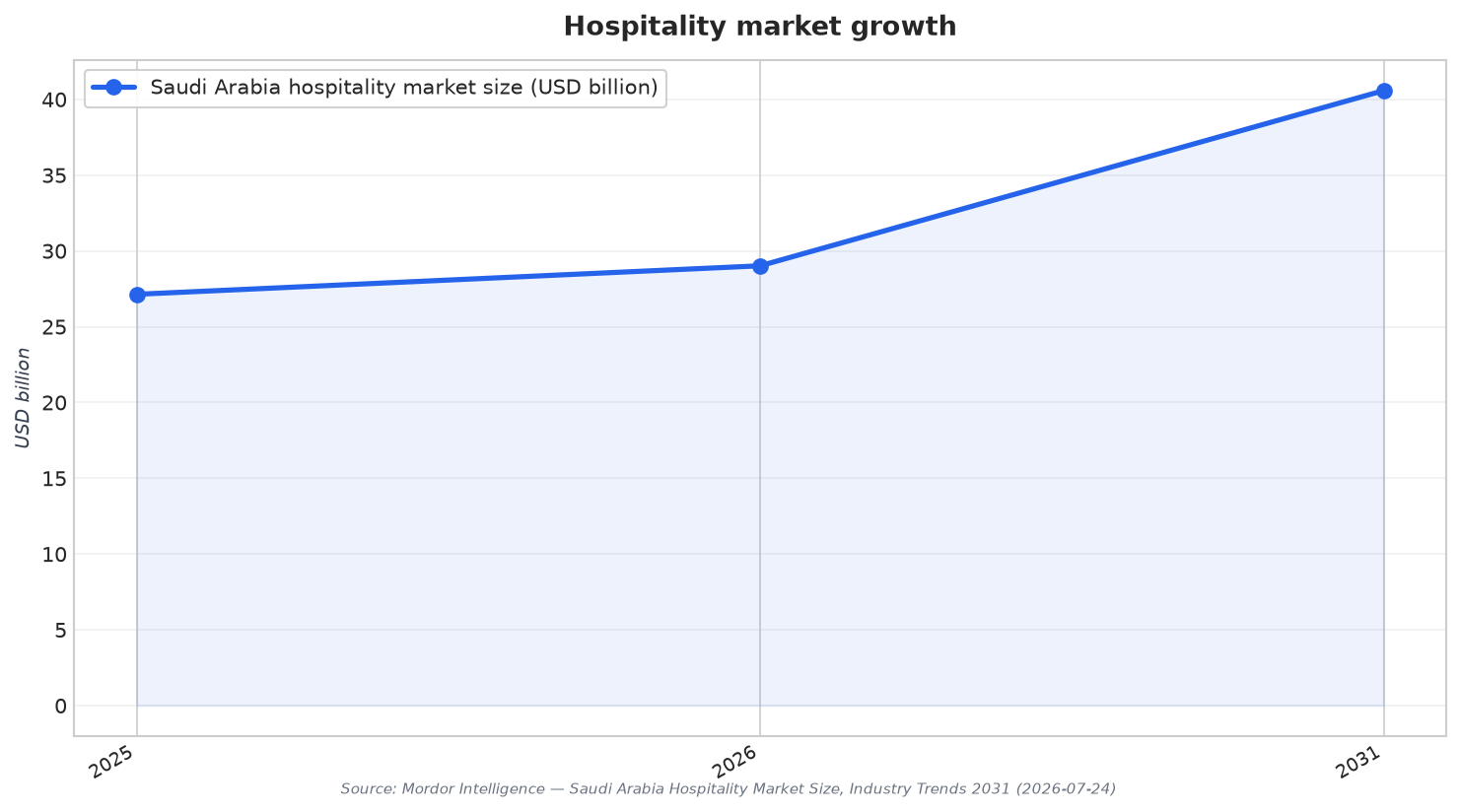
Brand rollouts and market structure reinforce the urgency. Mordor Intelligence estimates the Saudi Arabia hospitality market at USD 29.02 billion in 2026, up from USD 27.14 billion in 2025, with a projection of USD 40.58 billion by 2031 at a 6.93% CAGR (2026–2031). Chains held 57.74% market share in 2025, while independent hotels are forecast to trail as chains outpace them with an 11.62% CAGR through 2031. Hilton reported surpassing 100 hotels trading and in the pipeline in Saudi Arabia, with 21 operating and 83 in the pipeline, representing USD 8 billion of combined investment from owners and investors. For conversion candidates, these figures underline why aligning with a chain system can be a practical shortcut to distribution and brand recognition.
Location and product type help determine where conversions can move the needle fastest. Mordor notes the Makkah–Jeddah corridor held 26.62% of the Saudi hospitality market size in 2025, and it projects the Red Sea and wider western coast to expand at an 18.20% CAGR to 2031. Meanwhile, the pipeline is not just hotels: STR-tracked commentary highlights “integrated hospitality,” blending hotels with branded residences and retail, as more prevalent in Saudi pipeline than in traditional regional markets. Conversions can also be cultural projects, such as Jeddah’s Al Balad heritage district context discussed by Brandteliers, and the Boutique Group’s restoration of The Red Palace into a 70-room ultra-luxury hotel. Together, these examples show rebranding is not only about signage; it is about repositioning assets to match demand corridors and the Kingdom’s evolving hospitality formats.
Why are hotel conversions and rebranding gaining attention in Saudi Arabia?
What do the sources say about the mix of Saudi Arabia’s hotel pipeline?
How does M&A activity connect to hotel conversions in the Kingdom?
Where are the strongest geographic signals for repositioning and branded rollouts?
What should owners consider when planning a hotel conversion in Saudi Arabia?
Talk to us for your needs in:
-
Tourism Infrastructure Planning and Optimization
-
Destination Marketing and Brand Strategy
-
Tourism Workforce Development and Training
-
Sustainable Tourism Solutions
-
Visitor Experience Enhancement and Engagement
-
Tourism Project Feasibility and Strategic Planning
-
Saudi Tourism Benchmarking