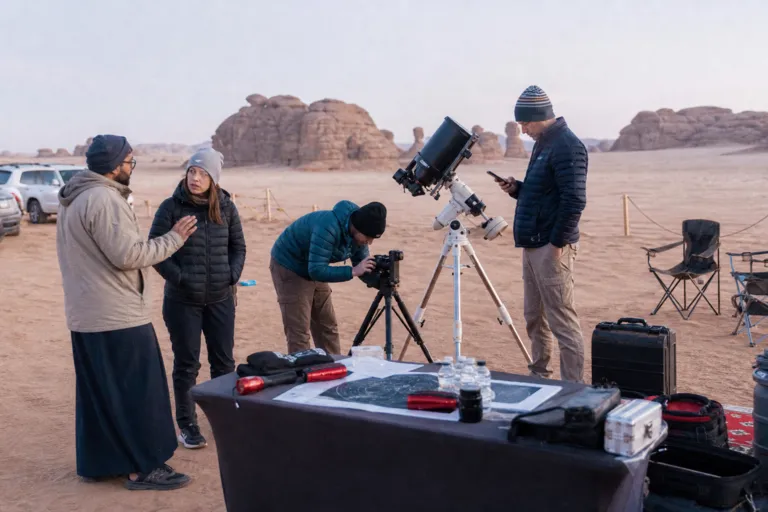
Astrotourism is travel built around the night sky. Tourism researchers in Australia define dark sky tourism as “tourism based on unpolluted night skies involving observation and appreciation of naturally occurring celestial phenomena.” In practice, that can mean simple naked-eye stargazing, astrophotography, or guided experiences that help visitors understand what they are seeing. The appeal is growing because, as one travel feature notes, light pollution is increasing by 10 percent every year. As darker skies become harder to find, destinations that protect darkness become more valuable to travelers.
In the Kingdom, astrotourism saudi arabia is emerging as a distinct niche, with AlUla gaining standout recognition. A photograph taken between Hegra—inscribed on the UNESCO World Heritage List—and Gharameel Nature Reserve was featured by NASA as an “Astronomy Picture of the Day.” NASA published it on August 25 under the title “The Meteor and the Star Cluster.” The image was described as a one-hour-long exposure that captured a green glow from a meteor crossing the Pleiades star cluster. The Saudi Gazette reported this was the first appearance of an image captured from AlUla on NASA’s platforms.
Why AlUla’s Darkness Is a Tourism Asset
AlUla’s night skies are described as exceptionally clear, placing the area among the top 5 percent of observing sites worldwide in terms of darkness and the absence of light pollution. That claim matters because the traveler experience depends on visibility after sunset, not just daytime scenery. The same report notes that Hegra and Gharameel Nature Reserve are the only two sites in the Gulf to hold the prestigious Dark Sky designation from DarkSky International. This positioning supports stargazing and astrophotography, while also creating a clear story for destination marketing built around protected darkness.
Protection and credibility are central to the niche. Dark Sky International now recognizes more than 200 dark sky places across 22 countries, certifying destinations that protect the night sky and reduce artificial light. For travelers, this type of designation works like a planning shortcut for what they can see after dark. In AlUla, the NASA feature amplified that credibility and reinforced the destination’s stargazing reputation. The Saudi Gazette also credited Manarat AlUla with supporting preservation of the region’s pristine night-sky environment and enhancing AlUla’s global position in sky exploration and astrophotography.
This niche is also landing inside a larger tourism expansion. Saudi Arabia’s tourism sector is already a bigger economic pillar, with tourism contributing 12.4% of GDP in 2024, according to Strategic Gears via Consultancy-me. That same article describes a shift toward implementation and performance measurement, focusing on ESG principles across the sector, including showcasing natural and cultural heritage sites and using more clean energy. Separately, Saudi’s broader Vision 2030 tourism strategy includes an aim to attract 150 million annual visitors by 2030. Astrotourism fits this push by linking heritage landscapes, protected environments, and high-value experiences.
Global trend signals show why the timing is favorable. A travel analysis reports dark sky tourism is projected to be worth $400 million globally by 2030, with roughly 10% annual growth. In Western Australia alone, 89% of visitors surveyed said they were interested in traveling specifically to see the stars. These figures are not Saudi-specific, but they explain why destinations with credible darkness and clear storytelling can compete internationally. With NASA attention, Dark Sky designations, and a top-tier darkness claim, AlUla gives astrotourism saudi arabia a focused flagship narrative.
What is astrotourism saudi arabia, in practical terms?
Why did NASA’s “Astronomy Picture of the Day” matter for AlUla?
Which places in AlUla have Dark Sky designation?
How dark is AlUla compared with other observing sites worldwide?
What wider trends support growth in dark-sky tourism?
Talk to us for your needs in:
-
Tourism Infrastructure Planning and Optimization
-
Destination Marketing and Brand Strategy
-
Tourism Workforce Development and Training
-
Sustainable Tourism Solutions
-
Visitor Experience Enhancement and Engagement
-
Tourism Project Feasibility and Strategic Planning
-
Saudi Tourism Benchmarking