Saudi tourism operators are building service capacity fast. That speed creates a talent gap in hotels, resorts, and luxury service operations. A core workforce strategy is now operational, not theoretical. The goal is a job-ready pipeline that protects service standards while supporting national priorities and business targets.
Planning starts with the size of the need. The Saudi Commission for Tourism and National Heritage reports the sector requires over 1.3 million new employees by 2030. Another pressure point is the pace of expansion versus the pace of traditional education cycles. Dusit Thani College highlighted that traditional pathways have struggled to keep up, which increases the need for flexible training that delivers practical skills in a shorter timeframe.
Workforce Strategy: Compliance, Retention, and Fast-Track Capability
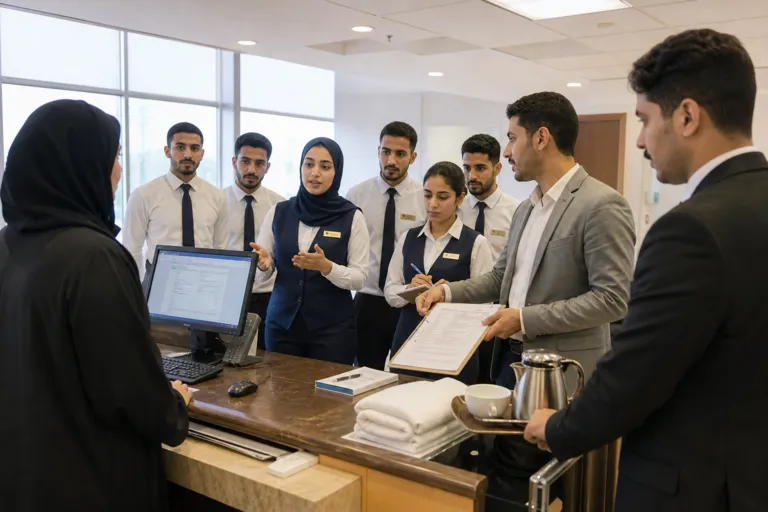
Operators must design the hospitality workforce Saudi Arabia wants and regulate. A new framework requires licensed tourism establishments to employ Saudi nationals in key operational roles, particularly customer-facing roles such as front-desk and reception duties. It also requires operators to register all employees in the Ministry of Human Resources and Social Development’s system before they commence work. This is not only governance. It is a practical backbone for workforce visibility, orderly onboarding, and consistent service execution.
Retention is the second lever because turnover is described as one of the most significant costs for hospitality operators in the region. A retention program needs both financial and non-financial components. Leading hotels have identified key elements such as competitive compensation, clear career progression pathways, a positive culture that recognizes excellence, work-life balance initiatives that accommodate cultural and religious practices, and quality accommodation and transportation for staff members. These steps help stabilize teams and protect guest experience consistency.
Training is the third lever, and the highest-impact version is the one that connects learning to operations. Dusit Thani College’s fast-track skills programme uses intensive, hands-on training combined with real-world internships, aimed at immediate workforce readiness. It also covers operational and commercial areas such as digital marketing, cost control in food and beverage operations, housekeeping supervision, online distribution performance, pricing strategies, banqueting management, and workforce development. In parallel, Adeera’s partnership with HTMi is designed to bridge the gap between classroom learning and real-world operations through theoretical education plus immersive on-the-job experiences. On the government-supported side, programs backed by the Saudi Human Resources Development Fund (HADAF) aim to provide skills and certifications that prepare more than 8,450 individuals for careers in the industry, spanning hospitality management and travel services.
To close the gap, operators can combine these moves into one playbook. Use the nationally driven framework to shape role design and onboarding, then lock in retention basics to reduce disruption, then scale fast-track training with internships and on-the-job immersion. This also supports Vision 2030’s direction on human capital development. The Vision 2030 document states the aim is to increase tourism’s contribution to GDP from 3% to 10% within the decade, which reinforces the need for continuous skills building and clear routes to advancement.
What does “hospitality workforce Saudi Arabia” mean for tourism operators?
How many new employees are needed for Saudi hospitality by 2030?
What do the new workforce policies require from licensed tourism establishments?
What retention components are highlighted for Saudi hospitality teams?
Which training models are positioned to bridge classroom learning and hotel operations?
Talk to us for your needs in:
-
Tourism Infrastructure Planning and Optimization
-
Destination Marketing and Brand Strategy
-
Tourism Workforce Development and Training
-
Sustainable Tourism Solutions
-
Visitor Experience Enhancement and Engagement
-
Tourism Project Feasibility and Strategic Planning
-
Saudi Tourism Benchmarking