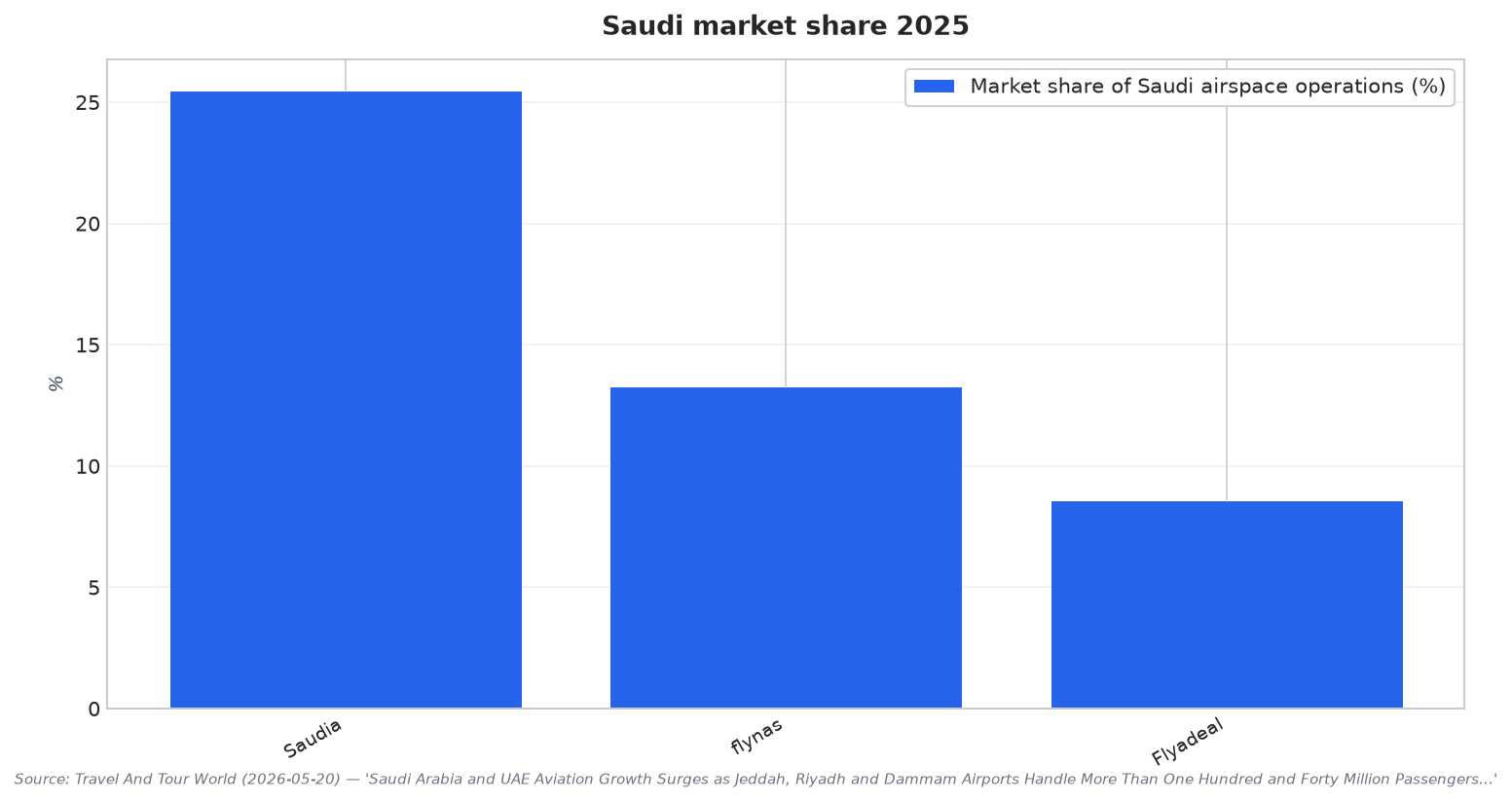
Low-cost airlines in Saudi Arabia are increasingly central to how mid-market travelers plan trips for leisure, weekends, and religious journeys. In 2025, Saudia held 25.5% of Saudi airspace operations market share, while flynas captured 13.3% and flyadeal accounted for 8.6%, highlighting rising competition across domestic carriers. In the same year, Saudi airports recorded nearly 979,800 arriving and departing flights, up 8.3% versus 2024. Domestic routes accounted for 506,300 flights and international services reached 473,500, with international growth outpacing domestic expansion as overseas demand and connectivity improved.
Regional capacity data also frames how Saudi LCCs are positioned inside a fast-changing Middle East market. Using Summer 2026 schedules, OAG reports that LCCs operate 27% of Middle East flights, up from 14% in 2016, and that the region has 403 million airline seats in 2026 with 73% mainline and 27% LCC. Within that LCC segment, flynas is cited as the largest with 17% of regional LCC capacity, followed by Flydubai at 16%, flyadeal at 14%, and Air Arabia at 12%. OAG also notes recent headwinds: total Middle East capacity is 10% below 2025 in 2026, with LCC capacity reduced by 12%.
How Domestic Networks Translate Into Mid-Market Tourism Demand
Network structure matters because mid-market demand is often time-sensitive and price-sensitive. OAG’s Summer 2026 analysis ties Saudi Arabia’s domestic focus to geography, population, and the Vision 2030 economic diversification strategy. It reports that 79% of flyadeal’s capacity is domestic and 55% of flynas’ capacity is domestic. The same source says the two airlines compete on 53 routes, and that Saudia operates on more than 37% of both their networks, creating dense overlap where fares, schedules, and frequency can shape traveler choice. Another industry view points to “pricing pressure” from low-cost encroachment on secondary Saudi city pairs, describing how flyadeal and Air Arabia capture leisure demand with stripped-down base fares.
Religious gateways show how this plays out on specific nodes and itineraries. Reporting on Madinah, Travel And Tour World describes flyadeal’s expansion from Prince Mohammad bin Abdulaziz International Airport through three new domestic routes to Jazan, Qassim, and Arar. The same coverage links year-round Umrah travel and domestic tourism campaigns with steady demand beyond peak pilgrimage months, and argues that shorter domestic sectors can enable multi-destination itineraries. In that framing, low-cost airlines attract price-sensitive travelers and hotel offerings respond with competitive positioning, supporting a mid-market travel stack that spans air seats and accommodation choices.
Research on LCCs and tourism dynamics provides a useful lens for interpreting these shifts, even when applied cautiously to local context. A ScienceDirect study of 2010–2022 uses international tourist arrivals (ITA) as a demand indicator and proposes that an increase in LCC passengers is positively associated with a rise in ITA, while also noting that LCC impacts can extend into accommodation availability and tourism employment. In the Middle East context, OAG also notes how network strategies evolve beyond the region, including Africa links where the Saudi Arabia–Egypt market is significant: for flyadeal, 96% of African capacity operates to Egypt, and for flynas, 81%. Together, these reported patterns help explain how price-led networks can shape the mid-market travel mix without relying on a single segment alone.
What do reported 2025 market shares say about low-cost airlines in Saudi Arabia?
How domestic are flynas and flyadeal networks, based on Summer 2026 schedules?
How much route overlap is there between flynas and flyadeal?
What are the key Middle East LCC capacity shares cited for flynas and flyadeal?
Which new domestic routes from Madinah are linked to flyadeal’s expansion?
Talk to us for your needs in:
-
Tourism Infrastructure Planning and Optimization
-
Destination Marketing and Brand Strategy
-
Tourism Workforce Development and Training
-
Sustainable Tourism Solutions
-
Visitor Experience Enhancement and Engagement
-
Tourism Project Feasibility and Strategic Planning
-
Saudi Tourism Benchmarking