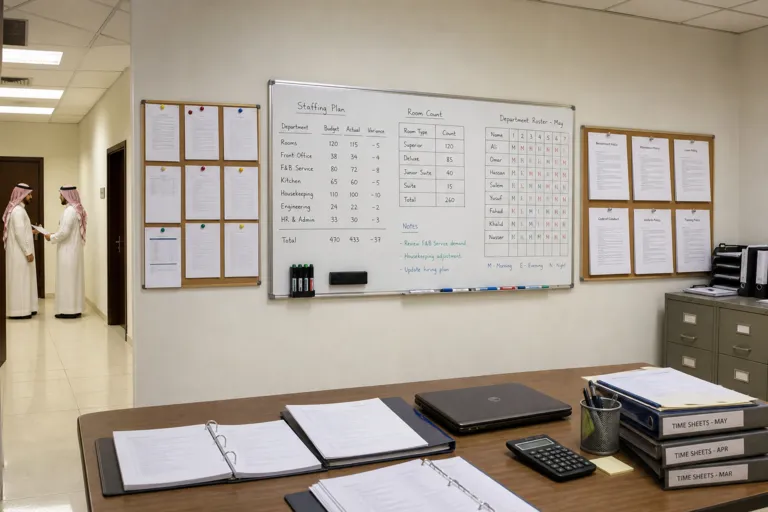
Saudi Arabia is consulting on draft “Minimum Staffing Requirements for Tourist Hospitality Facilities” that would make employee-to-room ratios a compliance issue, not only an operating choice. The Ministry of Tourism proposal links required headcount to both room count and classification, and it says establishments would have to maintain staffing levels throughout the year. The headline threshold is aimed at the top end of the market: luxury five-star hotels, hotel villas, hotel apartments, and resorts would be required to keep three employees per room. Existing licensed businesses would receive up to 180 days to comply after the regulations take effect, while establishments upgraded to a higher classification would have up to 90 days to meet the new threshold.
For operators, the payroll impact starts with translating ratios into minimum workforce floors. Beyond the luxury tier, the draft sets out a stepped structure: other five-star establishments would need four employees for every five rooms, and four-star properties three employees for every five rooms. Three-star establishments would require two employees per five rooms, and two-star properties one employee per five rooms. One-star and unclassified establishments would require at least one employee for every 10 rooms. In parallel, the same consultation also outlines rules for other accommodation types, meaning staffing and payroll assumptions would need to be modelled across mixed portfolios, not just traditional hotels.
How the Proposed Ratios Translate Into Staffing and Payroll Floors
The consultation extends beyond hotels into hostels, heritage hotels, serviced apartments, and holiday homes, each with distinct staffing ratios. Heritage hotels would require three employees per five rooms, while hostels would need one employee per 10 rooms. First-class serviced apartments would need one employee per five rooms, and economy-class serviced apartments one employee per eight rooms; holiday homes follow the same first-class and economy-class ratios. The enforcement design also matters for payroll planning. The ministry would verify staffing using Ministry of Human Resources and Social Development data, and it would count employees hired directly as well as workers engaged via affiliated operating companies through the Ajeer platform. Operators would also be required to update employee records within three months of workforce changes.
Timing is a key input in any hotel staffing ratio Saudi Arabia scenario model, because the proposal puts a date on monitoring and penalties. Multiple reports state that compliance monitoring and penalties are scheduled to begin on January 1, 2027, with violations subject to penalties under Saudi Arabia’s Tourism Law and its executive regulations. The consultation is described as a proposal, not a final rule, which means payroll forecasts should be framed as conditional until final text is issued. Still, even the draft indicates that staffing floors could become a year-round requirement, tightening flexibility for properties that currently run lean outside peak periods.
The policy discussion is happening alongside rapid tourism-sector expansion, and the same coverage provides demand-side context that affects labour planning. One analysis reports that Saudi Arabia welcomed 29.3 million inbound tourists in 2025, down 1.6% year on year, and inbound arrivals fell 13% in the first quarter of 2026 even as domestic trips grew. Separately, another report says the Kingdom expects to welcome around 123 million domestic and international tourists in 2025, nearly 6% higher than the previous year, with tourism spending projected to reach SR304 billion (approximately US$81.1 billion). For hotel owners and developers, these figures underscore why the government frames staffing rules as service protection—while operators focus on what minimum ratios mean for hiring plans, payroll baselines, and compliance risk as 2027 approaches.
What is Saudi Arabia proposing for minimum hotel staffing ratios?
When would monitoring and penalties begin under the draft rules?
How do the draft ratios differ by hotel star rating?
Do serviced apartments and holiday homes have proposed minimum staffing ratios too?
How should operators model the payroll impact of a hotel staffing ratio in Saudi Arabia?
Talk to us for your needs in:
-
Tourism Infrastructure Planning and Optimization
-
Destination Marketing and Brand Strategy
-
Tourism Workforce Development and Training
-
Sustainable Tourism Solutions
-
Visitor Experience Enhancement and Engagement
-
Tourism Project Feasibility and Strategic Planning
-
Saudi Tourism Benchmarking