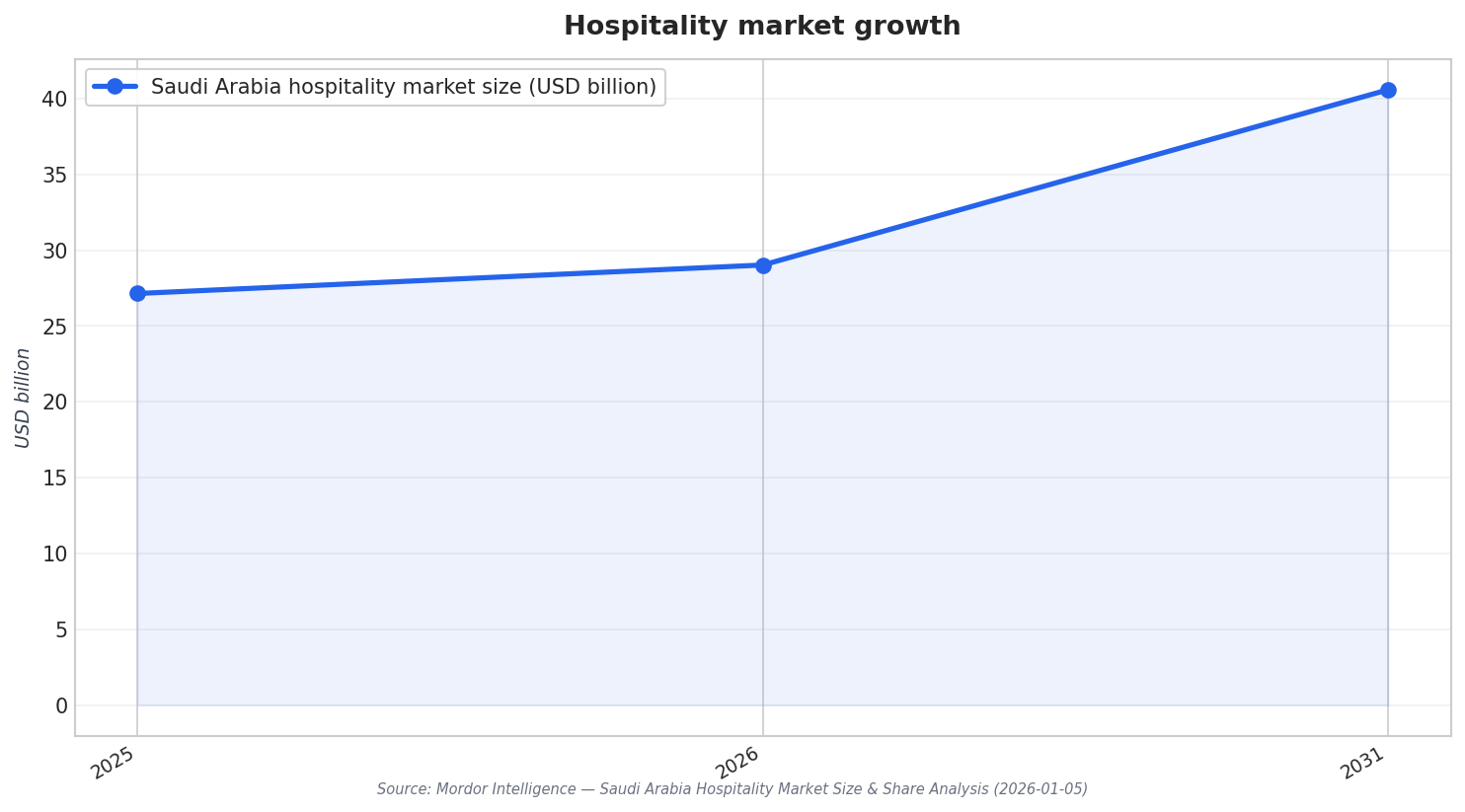
Saudi Arabia’s hospitality market is projected by Mordor Intelligence at USD 29.02 billion in 2026, up from USD 27.14 billion in 2025, with a 2031 projection of USD 40.58 billion at a 6.93% CAGR (2026-2031). That growth context matters for a heritage building conversion hotel Saudi Arabia strategy because it supports demand diversity, not only new-build supply. The same source shows chain hotels held 57.74% share in 2025, while the luxury segment led with 36.92% share in 2025. For investors, heritage conversions tend to compete on story and location rather than scale, which can help position an independent or boutique-style concept against an increasingly branded market.
Return logic starts with cost and scarcity. MMCG notes that land value and development cost inflation is a noteworthy factor, and that the cost to build new hotels in Saudi Arabia (especially luxury) is significant due to high construction costs, imported materials, and extravagant designs. In Makkah, MMCG also highlights that values per key for properties near the Grand Mosque are extremely high, often exceeding USD 1 million per key, and that operating models can differ, including annual lease agreements or condo-hotel structures. While that figure is specific to Makkah near the Grand Mosque, it frames why a well-located, properly permitted adaptive reuse project can look attractive when new-build economics become harder to pencil.
Regulatory Path: What Investors Need to Underwrite Early
Regulation shows up in timelines as much as in approvals. Mordor Intelligence flags land, permitting, and utility tie-in complexities extending timelines, especially in coastal, heritage, and environmentally sensitive zones. That means investors should underwrite schedule risk and scope clarity early for conversions in protected districts. On the standards side, Oxford Business Group reports that the National Committee for Saudi Building Code became the Saudi Building Code Centre in March 2025 as an independent government agency that develops building code regulations. For capital planning, Oxford Business Group also notes the continued 5% Real Estate Transaction Tax (RETT) regime that exempts real estate sales from the 15% VAT that previously applied, positioning this as part of reforms aimed at transparency and regulatory certainty.
Capital access and exits are also shaped by policy direction. Oxford Business Group states that the Tourism Development Fund is playing an increasingly significant role in supporting private investors in developing hotels across the Kingdom. Mordor Intelligence adds that regulatory upgrades such as expanded REIT rules and premium residency permits are narrowing the Kingdom’s risk premium relative to regional peers and opening new exit routes for global investors. Separately, Oxford Business Group notes a law that came into effect in January 2026 aligning with Vision 2030’s objective of attracting international capital and representing a significant step in opening the market to non-Saudi investors. For a conversion, these signals can support a thesis built around stabilized operations and multiple exit options rather than relying on development sales alone.
Operational performance will increasingly decide the winner. Hospitality Net argues that the market will likely become more competitive, more segmented, and more performance driven, requiring focus on feasibility, positioning, operational excellence, and long-term value creation. That aligns with Mordor Intelligence channel data: OTAs captured 41.65% of transactions in 2025, while direct digital channels are growing at a 14.78% CAGR as hoteliers invest in proprietary platforms. For heritage conversions, the product has to feel connected to its surroundings, and Hospitality Net stresses that the most successful investments will respect local identity while meeting international standards. Investors can pair that with destination dynamics highlighted by Mordor Intelligence, including the Makkah–Jeddah corridor holding 26.62% share in 2025, while the Red Sea and wider western coast are set to expand at an 18.20% CAGR to 2031.
What market growth backdrop supports converting heritage buildings into hotels in Saudi Arabia?
What are the biggest regulatory and delivery risks for a heritage hotel conversion?
How does the Saudi Building Code system show up in a conversion project’s compliance path?
How should investors think about distribution for a heritage conversion hotel in Saudi Arabia?
What locations and segments look relevant when planning a heritage building conversion hotel in Saudi Arabia?
Talk to us for your needs in:
-
Tourism Infrastructure Planning and Optimization
-
Destination Marketing and Brand Strategy
-
Tourism Workforce Development and Training
-
Sustainable Tourism Solutions
-
Visitor Experience Enhancement and Engagement
-
Tourism Project Feasibility and Strategic Planning
-
Saudi Tourism Benchmarking