Saudi Arabia’s Ministry of Tourism has approved updated rules for Hajj-season accommodation in Makkah and Madinah, covering licensing, classification standards, and violations for facilities hosting pilgrims. The stated aim is to enhance readiness, safety, and service quality during the Hajj season, which the ministry defines as running annually from the first of Dhul Qadah until mid-Muharram. The changes apply to tourist hospitality facilities in the two holy cities and form part of a tighter compliance framework that treats hosting pilgrims as a shared national responsibility, supported by inspections and oversight before licensing, before operations begin, and throughout the operational period.
Licensing and approvals sit at the center of the updated operating model. Under the new system described by travel-sector reporting, all hospitality providers must obtain official approval before operating during the Hajj season, including hotels, furnished apartments, and temporary lodging units. Only licensed properties will be permitted to accommodate pilgrims in Makkah and Madinah. Authorities also expanded inspection and monitoring across both cities, with regular checks conducted before and during the season. This approach connects the practical intent of hajj accommodation regulations in Saudi Arabia to day-to-day operations, not just a one-time paperwork step.
How Classification, Fines, and Repeat-Offense Rules Work
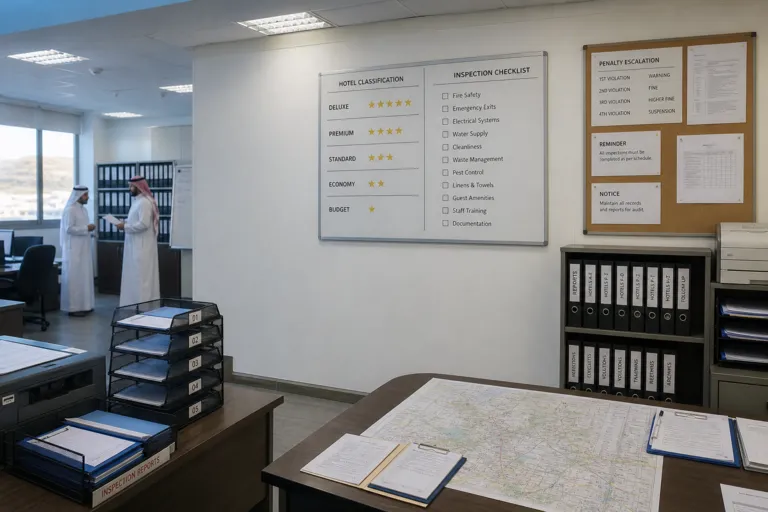
The ministry classified hospitality facilities into five categories, ranging from luxury five-star establishments to unclassified and temporary Hajj accommodations. Penalties depend on both the type of facility and the scale of the business. Fines are scaled by size at 25% for micro enterprises, 50% for small businesses, 75% for medium enterprises, and 100% for large establishments. For violations in Makkah and Madinah, financial penalties range from SR2,000 to SR14,000, alongside non-financial measures such as temporary or full closure and license cancellation for repeated offenses. For temporary Hajj accommodation facilities, fines range from SR1,000 to SR50,000, and penalties can include temporary closure until compliance is achieved or license revocation.
Repeat violations trigger escalating consequences, and the rules distinguish between timing and history of offenses. If a violation committed during the Hajj season repeats a pre-Hajj violation, the minimum fine is applied if it is higher than the previous penalty, or it is doubled if lower. If repeated within the same season, fines are doubled. The framework also covers post-season behavior: offenses committed after the season but repeated from Hajj-related violations still incur increased penalties, with fines escalating based on the number of offenses. Where repeated violations have no specified non-financial penalty, authorities may impose temporary closure or suspend licenses during Hajj, and a third offense may result in license revocation, within a gradual enforcement approach that does not exceed maximum limits.
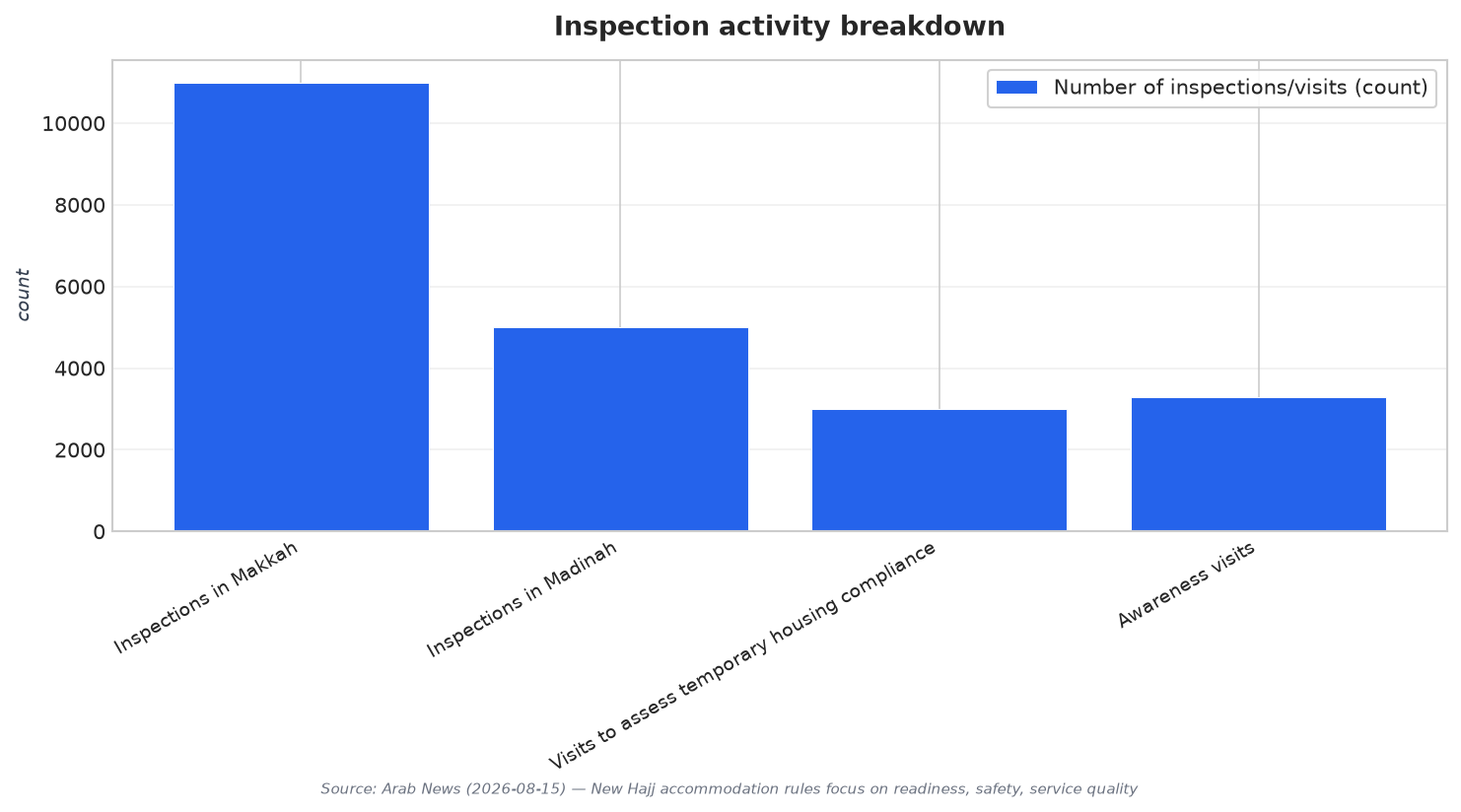
Inspection activity is a visible enforcement pillar. In April, the Ministry of Tourism reported conducting more than 19,000 inspections of hospitality facilities and temporary pilgrim accommodations in Makkah and Madinah during Hajj. That total included more than 11,000 inspections in Makkah and 5,000 in Madinah, along with about 3,000 visits to assess temporary housing compliance and service quality. Field teams also conducted more than 3,300 awareness visits to promote compliance with quality standards and licensing requirements. The ministry also urged those seeking licenses for Hajj 2027 accommodation facilities to meet requirements early, complete maintenance and preparations, and submit their applications.
When does the Ministry of Tourism define the Hajj season for these rules?
Do accommodation providers need approval before hosting pilgrims in Makkah and Madinah?
What fine ranges apply under the updated penalties framework?
How do repeat violations affect penalties during the Hajj season?
What do the Hajj accommodation regulations in Saudi Arabia mean for inspections and oversight?
Talk to us for your needs in:
-
Tourism Infrastructure Planning and Optimization
-
Destination Marketing and Brand Strategy
-
Tourism Workforce Development and Training
-
Sustainable Tourism Solutions
-
Visitor Experience Enhancement and Engagement
-
Tourism Project Feasibility and Strategic Planning
-
Saudi Tourism Benchmarking