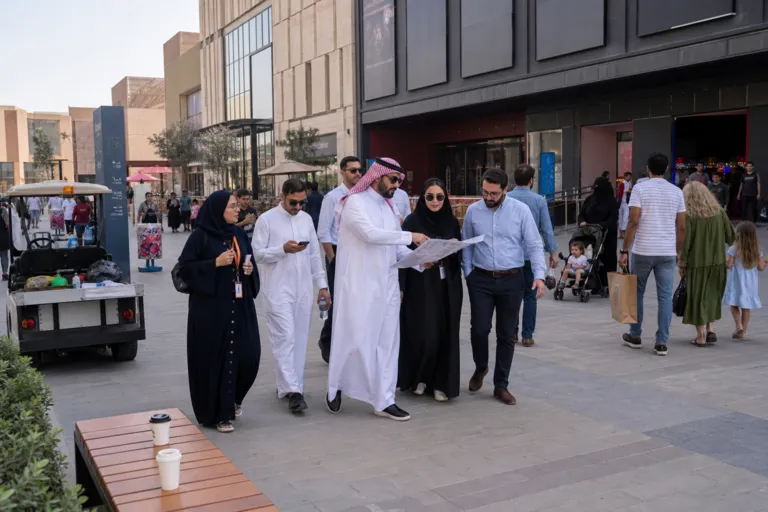
The case for a saudi entertainment district as an investable real estate theme is getting clearer in Saudi cities. Tourism scale is rising. Saudi Arabia recorded 122 million domestic and international visitors in 2025, up 5% year over year, according to Ministry of Tourism figures reported by Skift. The same report cited tourism spending that gained 6% to nearly 300 billion riyals ($81 billion). For investors, the significance is not only volume. It is how cities convert event-driven demand into repeatable, place-based demand that can support hotels, retail, and serviced living.
Entertainment districts appear in current industry framing as a way to turn “mega events into lasting economic engines” and “real estate opportunities.” Cityscape Global’s programme discussions referenced “integrated entertainment districts” alongside tailored accommodations and premium stays, positioning hospitality as part of a broader urban product rather than a standalone building. This matters for tourism real estate investors because it widens the monetization surface. In one location, hospitality, retail, and residential formats can be planned together. It also fits Saudi’s wider destination narrative, with Cityscape highlighting design-led development and sessions on branded residences and sustainable tourism, including destinations such as Diriyah and Red Sea Global.
Why Cities Are Building Integrated Districts
Demand drivers are changing. HospitalityNet’s 2026 outlook described Riyadh strengthening its position as a “business, events, and lifestyle capital,” while Jeddah continues to evolve as a “gateway city” with leisure and cultural appeal. The same source pointed to a major opportunity in domestic tourism, with Saudi citizens and residents increasingly traveling for “leisure, events, family holidays, and short breaks.” This demand mix supports district-style planning because it is repeatable and local. It also creates a rationale for a broader range of hospitality products, including lifestyle hotels, serviced residences, family resorts, wellness-led concepts, branded residences, and mid-market properties.
Supply composition is part of the investment story. HospitalityNet reported that around 61% of existing hotel inventory in Saudi Arabia is concentrated in luxury and upper-upscale segments, with nearly 78% of new rooms through 2030 planned at the higher end, even as demand rises for mid-market accommodation. Skift also flagged that nearly 80% of upcoming hotel supply is concentrated in the luxury and upscale tiers. For a saudi entertainment district, this imbalance can influence what gets built inside the district, including select-service hotels and value-led stays that match domestic and regional trip patterns described as more frequent and shorter.
Major events are being framed as anchors for year-round tourism. HospitalityNet noted that hosting major international events such as Expo 2030 and the 2034 FIFA World Cup has solidified the Kingdom’s image as a “leading year-round tourist destination.” Skift also listed mega events such as the 2027 Asian Cup, Expo 2030, and the 2034 FIFA World Cup. In parallel, religious tourism remains fundamental, particularly in Makkah and Madinah, and the Kingdom aims to host 30 million Umrah pilgrims annually by 2030, up from roughly 19 million pre-pandemic, according to Skift. For investors, districts in major cities can be designed to serve multiple demand streams rather than one season.
Institutional capital is also targeting urban, mixed-use formats that resemble the district model. The Fintech Times reported a c. $400 million (SAR 1.5 billion) fund launched for a Riyadh project on a 32,000-square-meter land plot with hospitality, office, residential, and retail, classified as a Transit-Oriented Development and located 250 meters from a metro station. This signals how urban transformation can be packaged for investors. In practice, entertainment districts can benefit from the same logic: connectivity, mixed uses, and a clear narrative around long-term value, rather than a single asset dependent on one demand spike.
What is a saudi entertainment district in real estate terms?
What demand signals support entertainment districts in Saudi cities?
How do mega events connect to district-style investment theses?
Why do investors discuss mid-market and lifestyle formats alongside districts?
What is an example of institutional capital backing a district-like urban model?
Talk to us for your needs in:
-
Tourism Infrastructure Planning and Optimization
-
Destination Marketing and Brand Strategy
-
Tourism Workforce Development and Training
-
Sustainable Tourism Solutions
-
Visitor Experience Enhancement and Engagement
-
Tourism Project Feasibility and Strategic Planning
-
Saudi Tourism Benchmarking